After more than a decade of legislation, the island’s tourism industry has a new category attached to it.
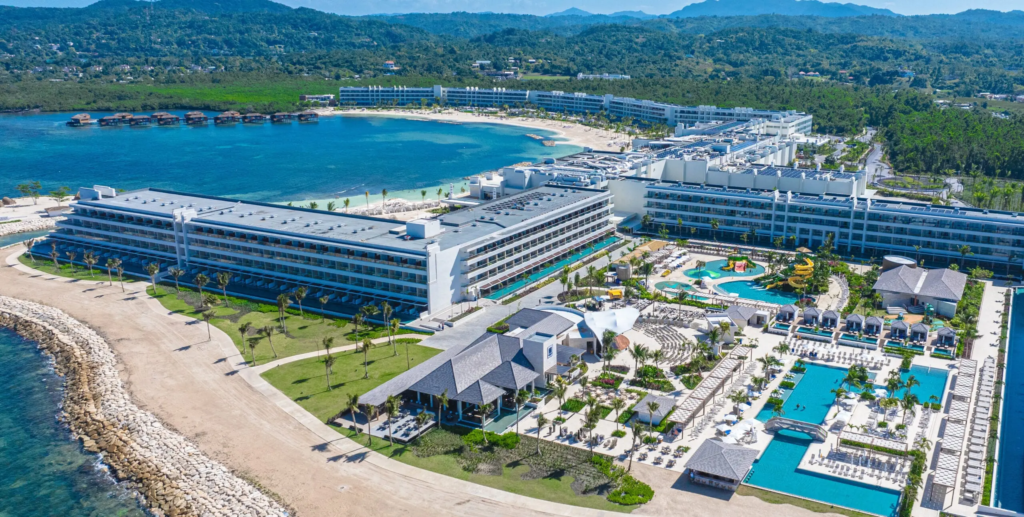
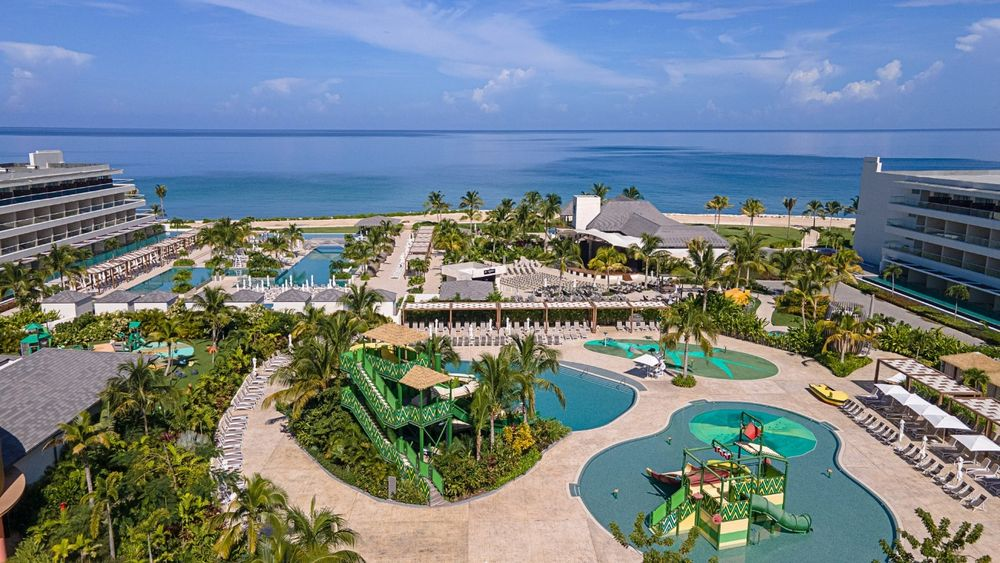
Jamaica’s Casino Gaming Commission granted the country’s first casino operator licence on July 29, ending more than a decade of legislative preparation that began with the Casino Gaming Act in 2010. The licence goes to Adamas Grand Casino Limited, which will operate inside the Princess Grand Jamaica Resort in Green Island, Hanover — a stretch of coast between Montego Bay and Negril.
What Was Actually Approved
The Casino Gaming Act doesn’t allow standalone casinos. The legislation deliberately links casino gaming to large integrated resorts rather than standalone gambling venues — hotel first, casino embedded within it, never the reverse. Tourism Minister Edmund Bartlett has said explicitly that Jamaica isn’t positioning itself as a casino destination, but as a destination where casino gaming happens to exist.
The casino itself will run under a management agreement with Grupo Orenes, a Spanish gaming and hospitality company with decades of casino operations across Spain, Mexico, and Andorra. Jamaica is a genuinely new market for the company — Adamas Grand Casino in Hanover and a second property opening in Puerto Rico’s historic district represent Orenes’ first moves into the Caribbean.
Why It Took Fifteen Years
The Casino Gaming Act became law in 2010, but the regulations needed to actually operationalise it took far longer. The Casino Gaming (General) Regulations, 2025 — which set out the Commission’s licensing rules, internal controls, and enforcement powers — cleared the House of Representatives in February 2026 and the Senate that April. Only once that framework was fully in place could the Commission begin processing a real licence application. The Princess development, already under construction and furthest along of any integrated resort proposal, became the first project able to satisfy both the commercial and regulatory requirements once the rules existed to apply.
“Jamaica isn’t positioning itself as a casino destination, but as a destination where casino gaming happens to exist.”
The Resort Around It
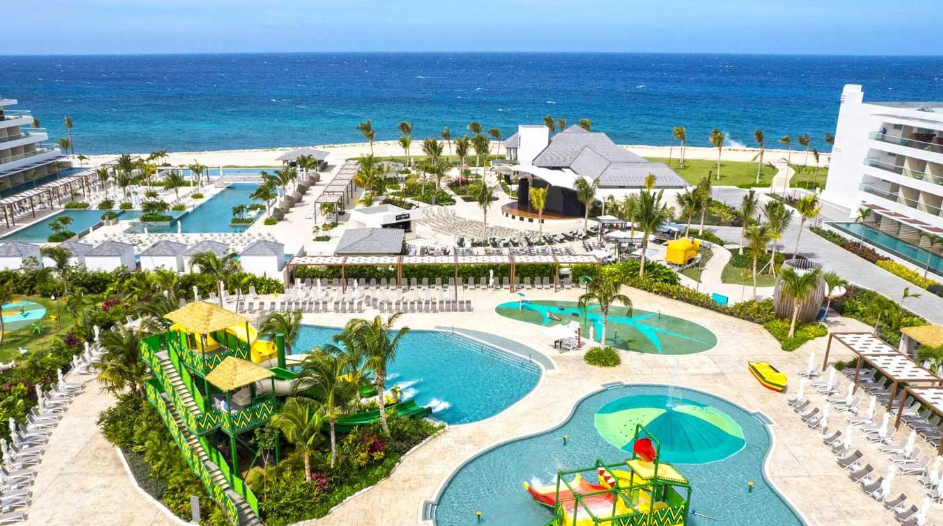
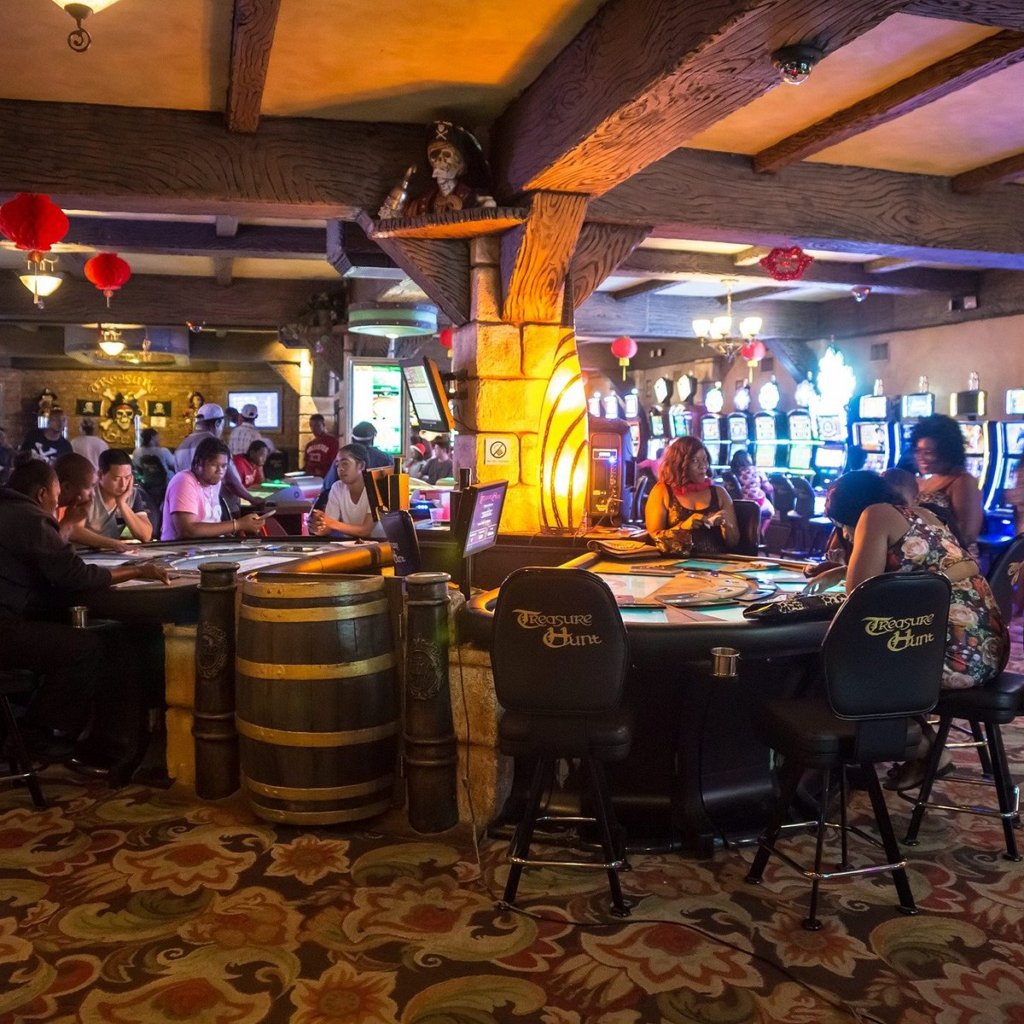
Princess Grand Jamaica and its adjacent property, Princess Senses The Mangrove, together form an approximately US$400 million integrated resort development with roughly 1,005 rooms combined, officially opened in December 2024. The casino floor itself will run over 1,000 square metres — slot machines mixing established formats with newer releases, positioned as entertainment rather than a high-stakes gaming hall.
The casino component was originally targeted for late 2025, then pushed further as the regulatory framework caught up. Bartlett now expects operations to begin during the fourth quarter of the year, timed ahead of peak winter tourist season, though no fixed date has been confirmed.
Who Can Actually Go
Jamaican law doesn’t bar Jamaicans from patronising licensed casinos — a point regulators have stated directly. But because the casino sits inside an integrated resort rather than functioning as a standalone public venue, access runs subject to the resort’s own entry policies rather than being open-door.
“The Adamas Grand licence functions less as a one-off approval than as the template the Casino Gaming Commission will now apply going forward.”
What Comes Next
Bartlett has confirmed at least three other integrated resort developments are exploring casino licences of their own, including a proposed Hard Rock property in St. James. The Adamas Grand licence functions less as a one-off approval than as the template the Casino Gaming Commission will now apply going forward — due diligence on ownership structure, financial capacity, and business competence, the same process this project went through, now with a precedent attached.
Whether this becomes a meaningful new category of Jamaican tourism or a single high-profile property comes down to how many of those other three developments clear the same bar.
Jamaica’s western edge gets the clearest descent. Elsewhere, cliffs, bays and harbour openings decide the view.
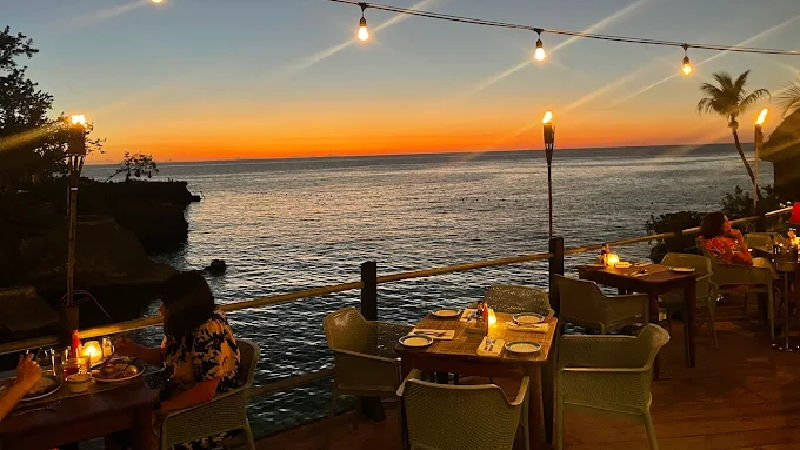
The best sunset spots in Jamaica are not distributed evenly around the island.
The western coast offers the clearest straight-on view as the sun approaches the Caribbean horizon. Along the south coast, bends in the shoreline and elevated headlands create their own versions. Even Kingston has a western view where the harbour opens around Port Royal.
The north coast can still produce a remarkable evening sky. It simply does not offer the same dependable line between shore, sun and open water.
That line is what separates these seven places.
Rick’s Cafe, Negril
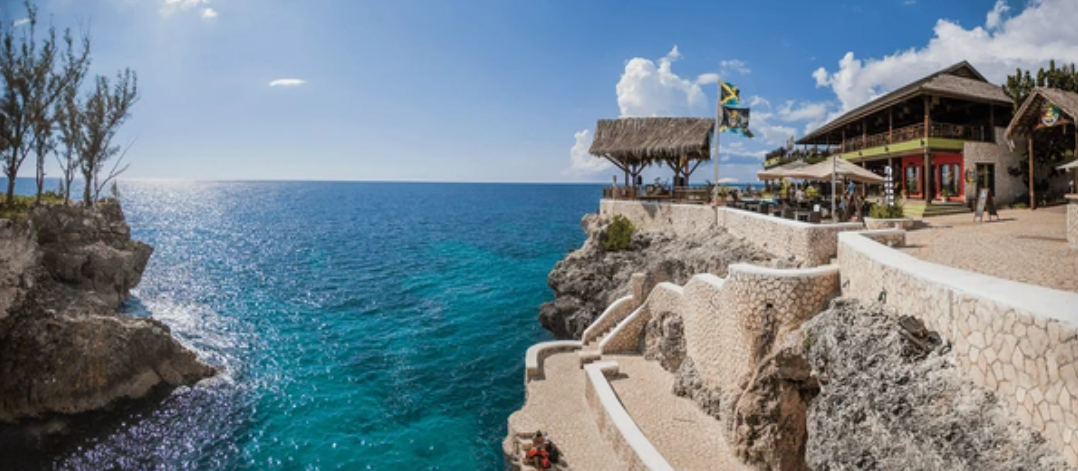
Rick’s Cafe has occupied the West End cliffs since 1974. The sunset now shares the stage with the institution built around it.
Divers climb onto platforms above the cove through the afternoon. Boats gather below. Music travels across stone terraces that fill steadily as the light begins to soften.
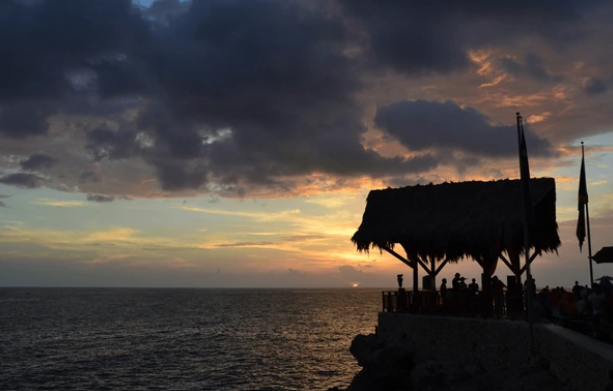
The final minutes are less orderly than photographs suggest. People shift toward the cliff edge. Phones rise. The divers time another jump against the changing sky.
Rick’s is not the place for an uninterrupted horizon or a quiet drink. The crowd is part of the scene. Arrive while there is still daylight on the limestone and enough room to see how the venue fits into the cliffs.
“The sun is the same. The pace is not.”
The West End Cliffs Beyond Rick’s
West End Road continues past smaller hotels and restaurants built along the same limestone coast.
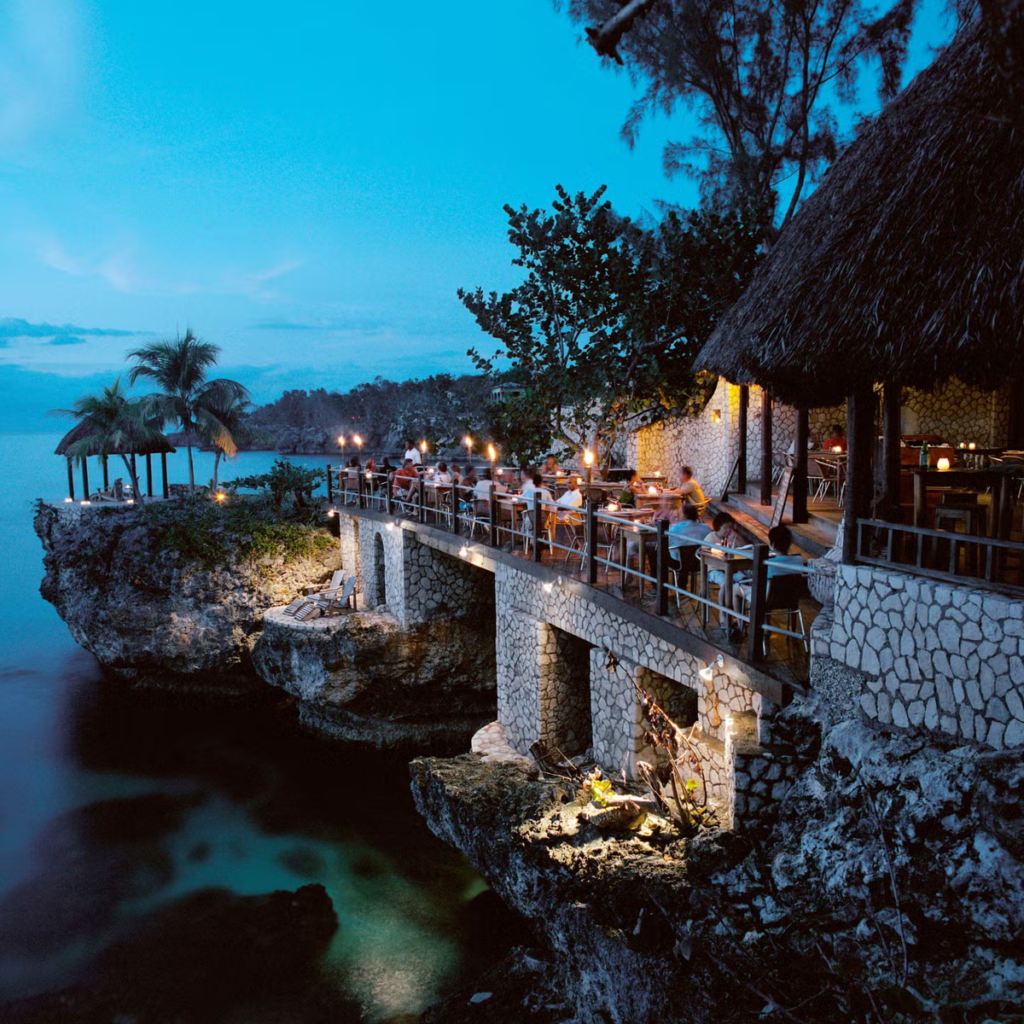
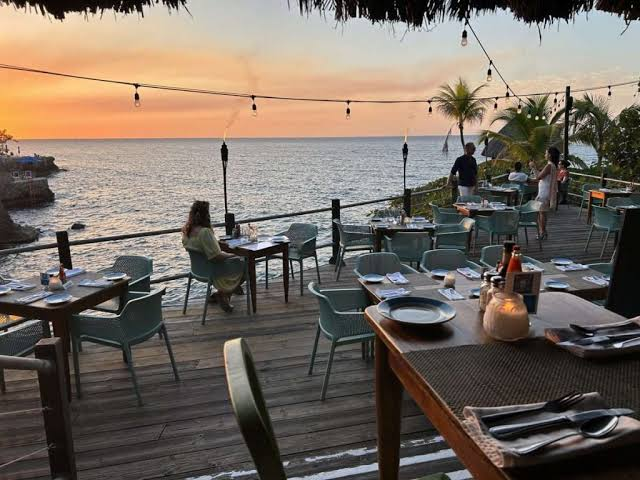
Rockhouse places its restaurant and pool bar directly above the water. Tensing Pen’s Lodge Restaurant looks outward from a quieter section of cliff. Both treat sunset as part of dinner rather than a separate performance.
Reservations are worth making. These are functioning hotels and restaurants, not public lookout platforms.
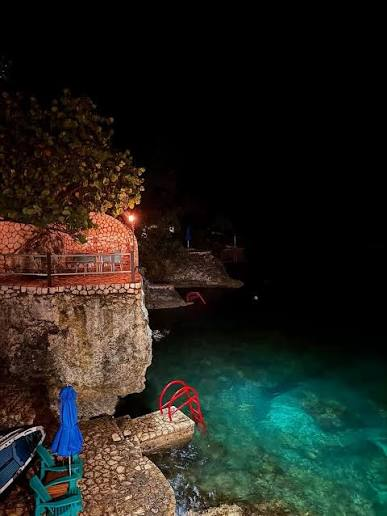
The view sits lower and closer than it does at Rick’s. Waves move through coves cut beneath the tables. Swimmers climb red ladders from the water at Rockhouse. At Tensing Pen, thatched roofs and narrow stone paths remain visible as the sky changes behind them.
The sun is the same. The pace is not.
Long Bay, Negril
Long Bay keeps the western horizon open from the sand.
The experience changes along the beach. Southern sections near central Negril carry more independent bars, vendors and music. Farther north, the gaps between properties widen and the shoreline grows quieter.
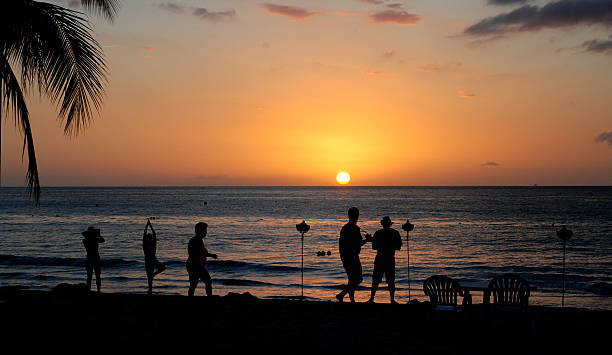
At beach level, sunset arrives gradually. The heat drops first. Boats return toward the sand. Tables begin filling behind the waterline. The surface shifts from blue to silver before taking on the colour above it.
There is no cliff edge forcing everyone toward one viewpoint. Walk until the balance of music, movement and open sand feels right, then stop.
Dead End Beach, Montego Bay
Dead End Beach sits beside the airport approach at the northern end of Montego Bay’s waterfront corridor.
The beach is public, compact and closely used. People arrive with food, music and chairs as the heat leaves the day. Aircraft descend low over the water on their way into Sangster International Airport, briefly interrupting every conversation beneath them.
The western view survives the noise.
The sun falls beyond the bay while fishing boats and airport lights begin to register in the same frame. It is not a secluded Montego Bay sunset. Its character comes from the opposite: local evening traffic, low-flying aircraft and a small piece of public shoreline holding its place beside the city.
Lovers’ Leap, St. Elizabeth
Lovers’ Leap replaces the beach with height.
The cliffs rise approximately 1,700 feet above the sea near Southfield. From the edge, the southern coastline runs across a field of view wide enough to make the ocean appear almost flat beneath it.
This is not always a direct sun-meets-water sunset. The season determines where the sun falls in relation to the land. The elevation still keeps the evening sky visible long after lower coastal viewpoints begin to lose it.
The setting carries its own history and legend, but the scale is what remains. Fields, roads and villages fall away behind the cliff. The sea takes over everything ahead.
Arrive before the light begins changing. The approach is part of the distance this view creates.
Treasure Beach, St. Elizabeth
Treasure Beach is made up of several bays and fishing communities rather than one continuous resort beach.
Billy’s Bay, Frenchman’s Bay, Calabash Bay and Great Bay each turn toward the sea at a different angle. The sunset therefore changes according to the cove. In some places the sun remains visible over water. In others, the colour moves across the sky above a headland.
Fishing boats provide the foreground. They rest on dark or coral-toned sand, pulled beyond the waterline after the day’s work. Restaurants and guesthouses sit behind them without turning the evening into a scheduled attraction.
Treasure Beach does not improve sunset by removing every person from the frame. It gives the light something real to fall across.
“Treasure Beach gives the light something real to fall across.”
Port Royal, Kingston
Port Royal watches the day close across a working harbour.
From the town’s waterfront, the view can include fishing boats, the shipping channel, the Palisadoes and Kingston rising beyond the water. Cargo movement and airport traffic remain part of the horizon.
That makes the evening different from Negril or Treasure Beach. The water is not presented as escape. It is infrastructure, livelihood and history in active use.
Port Royal once stood at the centre of British naval and commercial power in the Caribbean. Much of the seventeenth-century town was lost in the 1692 earthquake. The surviving settlement now occupies a quieter edge of Kingston, with restaurants and small waterfront spaces facing back across the harbour.
Stay after the sun disappears. The city lights take over slowly, one side of the harbour at a time.
Choosing the Evening
Jamaica does not need one definitive sunset location.
Rick’s turns the descent into a public ritual. The West End hotels place it beside dinner. Long Bay keeps it at sand level. Dead End Beach adds aircraft and city noise. Lovers’ Leap gains distance through elevation. Treasure Beach lets the light fall over working boats. Port Royal frames it through the harbour.
Two Jamaican companies sharing one name are rethinking how property is developed, owned and invested in.
A new group of companies believes there is another way.
Operating under the shared brand different, Different Properties Jamaica Limited and different Capital Limited are building a model that combines property development with investment management, using real estate not simply as something to buy and sell, but as an asset that can be owned through multiple structures.
The approach is still new. The ambition is significant.
Two Companies, One Strategy
Although they share a name, the businesses perform different roles.
Different Properties Jamaica Limited focuses on acquiring, developing and managing residential projects.
“Whether that approach becomes widely adopted will depend on execution rather than theory.”
different Capital Limited operates as a licensed real estate broker and REIT manager, creating investment structures that allow investors to participate in professionally managed property portfolios without purchasing entire properties themselves.
Together, the companies are attempting to connect property development with long-term investment rather than treating them as separate industries.
The People Behind It
The venture brings together executives with long careers in Jamaican business and finance.
Gary Matalon, Chief Executive Officer of Different Properties Jamaica Limited, also leads project management firm Neustone. Christopher Williams, Chairman and Chief Executive Officer of different Capital Limited, previously co-founded and led Proven Group, helping build one of the Caribbean’s largest diversified financial services companies before retiring from that role.
Richard Levee, also of Neustone, completes the founding shareholder group.
Collectively, the founders are applying backgrounds in finance, construction and property development to a model designed to broaden participation in Jamaican real estate.
Building for the Long Term
Different Properties was established in 2025 with a strategy that extends beyond selling completed units.
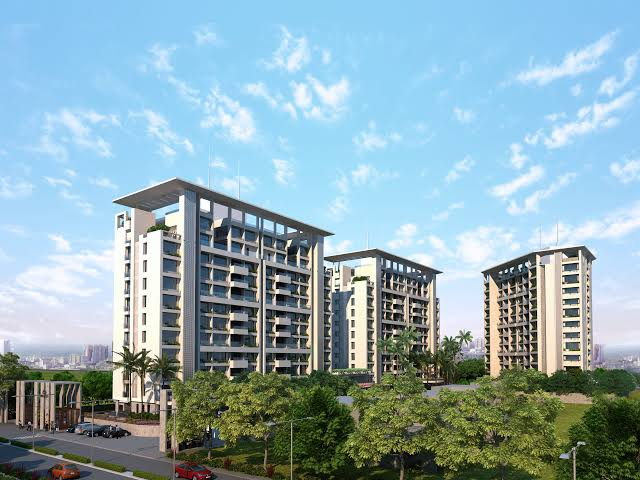
Its first major Kingston development comprises approximately 70 residential apartments with an estimated development cost of about US$12.5 million. Rather than simply completing construction and exiting the project, the company intends to retain an ongoing role through professional property management and investment structures.
The model reflects a shift from viewing developments as individual transactions toward treating them as long-term operating assets.
Expanding Access Through REITs
The second part of the strategy sits with different Capital.
Real Estate Investment Trusts, commonly known as REITs, allow investors to gain exposure to property without purchasing an entire building or taking responsibility for day-to-day management. Instead, investors own units in a professionally managed portfolio that may generate returns through rental income and long-term appreciation.
For many investors, that lowers the financial barrier to participating in commercial real estate.
The model has become well established internationally but remains relatively young in Jamaica.
Recent activity suggests different Capital intends to expand that market quickly.
“The companies are attempting to connect property development with long-term investment rather than treating them as separate industries.”
Within months of launching operations, the company reported accepted real estate transactions valued at approximately J$3.5 billion across Jamaica and the Cayman Islands.
Its most recent transaction follows the announcement that a REIT managed by different Capital will acquire land at Drax Hall, St. Ann, from Derrimon Trading Company through a private placement raising approximately J$1 billion. The site is expected to become another residential development, extending the company’s portfolio beyond Kingston.
Why It Matters
Real estate has long been viewed as one of Jamaica’s most resilient asset classes.
Historically, however, participation has required significant capital or direct ownership.
The model being developed by Different Properties and different Capital introduces another possibility: combining professional development, institutional management and collective investment within the same ecosystem.
Whether that approach becomes widely adopted will depend on execution rather than theory.
The projects now entering the market will provide the first meaningful test of whether a model built around managed ownership, rather than traditional property sales alone, can reshape how Jamaicans invest in real estate.
On Negril’s West End, five decades of careful evolution have produced one of Jamaica’s few MICHELIN Key hotels.
Rockhouse occupies a stretch of Negril’s West End where the cliffs meet the Caribbean Sea. Its setting explains part of its reputation. The rest comes from a property that has evolved steadily over five decades without losing the character that made it distinctive in the first place.
The Location
Perched on the cliffs of Pristine Cove along West End Road, Rockhouse occupies one of Jamaica’s westernmost hotel locations. The sunsets are uninterrupted. Negril’s town centre sits only a few minutes away, while Sangster International Airport is approximately an hour and a half by road. The location offers easy access to the energy of Negril without feeling defined by it.
A History That Predates the Modern Hotel
Before Rockhouse became the boutique hotel recognised today, the property formed part of Negril’s transformation from a quiet fishing village into one of the Caribbean’s most distinctive destinations.
During the 1970s, under the ownership of John Behmiller, the property became known among musicians, artists and travellers seeking a different side of Jamaica. Bob Marley, Bob Dylan and members of The Rolling Stones were among those associated with the hotel during that era.
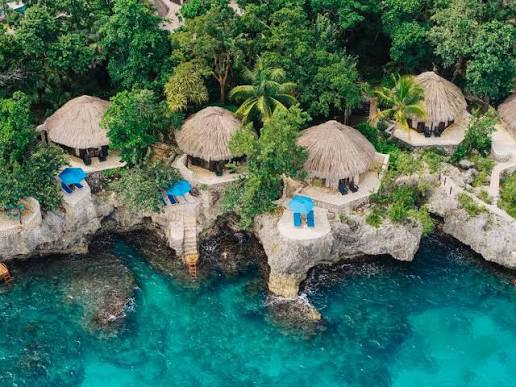
When the current owners acquired the property in 1994, they expanded thoughtfully rather than starting over. The original octagonal, thatch-roofed villas—numbers 9, 11, 12, 13, 15, 17, 19 and 20—remain standing today, restored with local timber and stone while preserving the character that first defined the property.
The Original Villas
Many hotels build new rooms designed to resemble older buildings.
Rockhouse never had to.
Its original octagonal villas are authentic structures from the property’s early years, maintained alongside newer accommodation rather than replaced. They remain one of the clearest reminders that Rockhouse evolved gradually instead of being built all at once.
“Rather than continually reinventing itself, Rockhouse has spent decades refining the qualities that made it distinctive in the first place.”
The Rockhouse Foundation
The property’s impact extends beyond its guest rooms.
Established in 2004, the Rockhouse Foundation has invested more than US$11 million in education, healthcare and community projects throughout western Jamaica. Its work has included the construction and renovation of schools, support for the Negril Community Library, and ongoing investment in the Savanna-la-Mar Inclusive Academy (Sav Inclusive) for children with special educational needs — Jamaica’s first fully inclusive public school, where children with and without disabilities learn side by side.
The Foundation is not a separate charitable initiative attached to the hotel. It has become part of the property’s identity, giving guests a direct connection to projects that continue long after checkout.
A MICHELIN Key
Rockhouse is one of a small number of Jamaican properties recognised by the MICHELIN Guide with One MICHELIN Key, awarded to hotels that deliver what the guide describes as “a very special stay.”
The recognition reflects the overall experience rather than any single feature. Architecture, service, setting and atmosphere all contribute to the distinction.
“The original octagonal villas remain standing today, restored rather than replaced.”
The Horizon Pool
The horizon pool has become one of Rockhouse’s defining images.
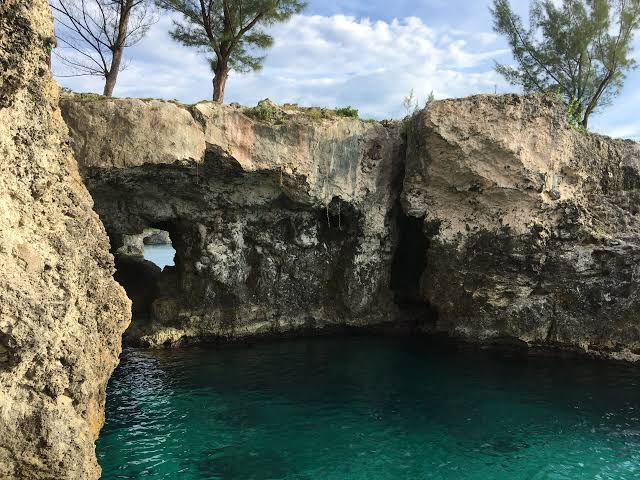
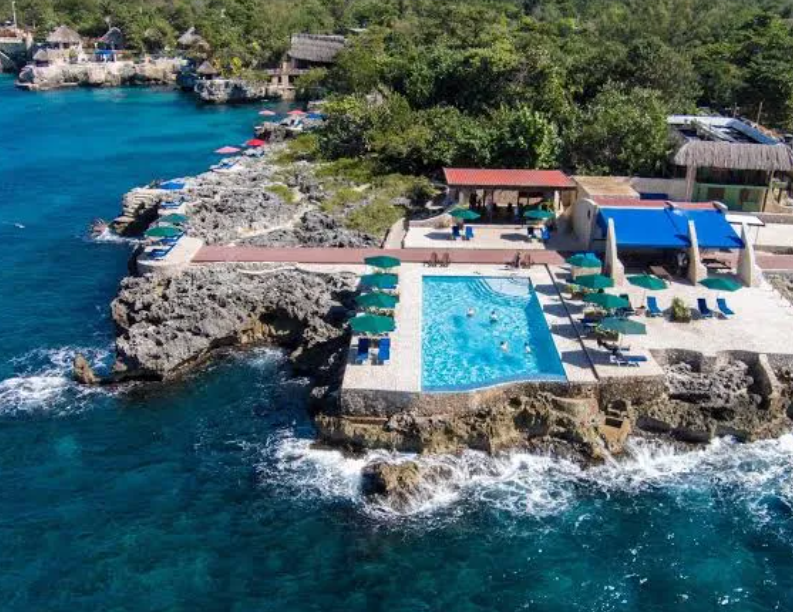
Carved directly into the limestone bluff, the sixty-foot pool appears to merge with the Caribbean beyond. The concept of an infinity pool is hardly unique, but its integration into the natural cliff face gives the space a sense of permanence rather than spectacle.
No Beach, by Design
Rockhouse does not sit on Seven Mile Beach, and that absence shapes the experience.
Guests descend ladders built into the cliffs to swim or snorkel in the clear water below, creating a more direct relationship with the sea than a traditional beachfront resort. Those looking for sand can visit the company’s sister property, Skylark Negril Beach Resort, but Rockhouse itself has always been defined by stone rather than shoreline.
A Remarkably Self-Sufficient Operation
Behind the guest experience sits an unusually hands-on operation.
Rockhouse maintains an organic farm and gardens that supply its restaurants, a woodworking shop where much of the property’s furniture is crafted, and a candle workshop producing goods used throughout the hotel.
Many of those details go unnoticed by first-time guests. They become apparent only after a few days, when the consistency of the property begins to reveal itself.
A Wedding Policy Built Around Preservation
Rockhouse hosts no more than twenty weddings each year, limiting ceremonies to the quieter months and generally to one wedding per week.
The policy says as much about the hotel’s priorities as it does about its events business. Rather than maximising bookings, the property limits them to preserve the atmosphere that draws guests there in the first place.
Close to Rick’s Cafe, Separate from It
Rick’s Cafe lies only a short drive away, making it easy to experience one of Jamaica’s most famous sunset venues before returning to a quieter setting.
The two places complement rather than compete with one another. One is built around spectacle. The other around stillness.
Dining Above the Sea
Rockhouse Restaurant extends directly over the cliffs, serving Jamaican and internationally influenced dishes with uninterrupted views across the Caribbean. Nearby, Pushcart offers a more relaxed setting inspired by traditional Jamaican roadside cooking.
The contrast reflects the wider philosophy of the property itself. Guests can dress for dinner or arrive straight from the water, and neither feels out of place.
More Than the Sum of Its Parts
No single feature explains Rockhouse’s reputation.
The villas, the Foundation, the architecture, the cliffside swimming and the restrained approach to growth all point in the same direction. Rather than continually reinventing itself, Rockhouse has spent decades refining the qualities that made it distinctive in the first place.That may be its rarest achievement.
Long Bay, Bloody Bay and the different stretches hidden inside Jamaica’s most familiar beach name.
Seven Mile Beach is less precise than the name suggests.
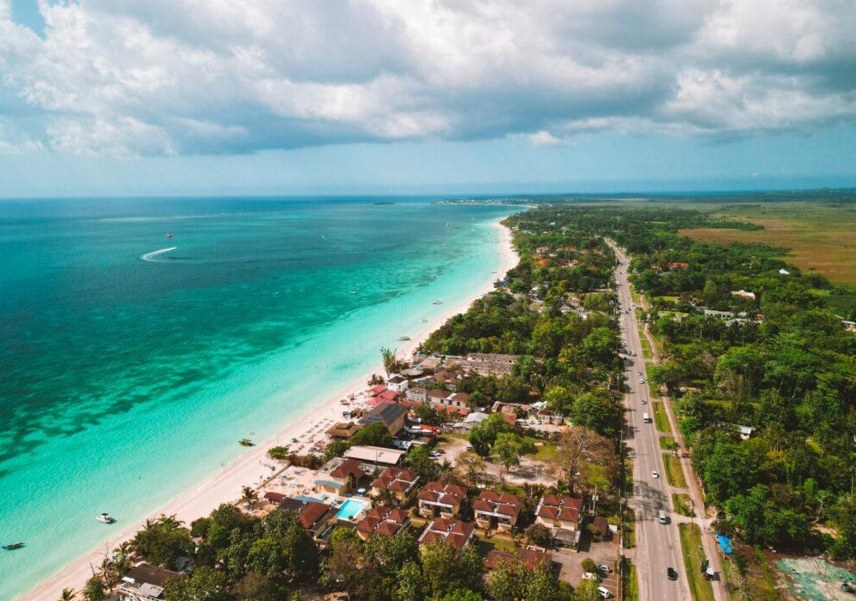
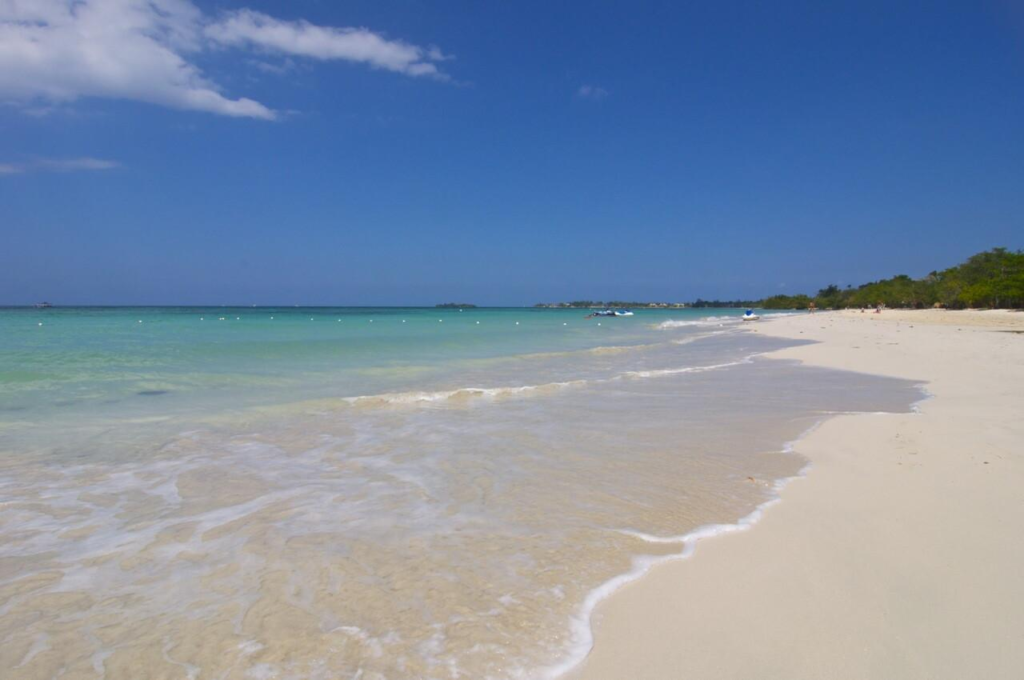
The exact distance depends on where the measurement begins and whether Bloody Bay is counted with Long Bay. The two bays are commonly marketed as one destination, although Rutland Point separates them and prevents a continuous walk along the sand from one end to the other.
That distinction matters. Long Bay carries most of the independent restaurants, bars, vendors and smaller hotels associated with Negril’s beach culture. Bloody Bay curves around a quieter northern shore where larger resorts occupy more of the frontage.
Both belong to the Seven Mile Beach story. They do not offer the same day.
Getting to Seven Mile Beach
Sangster International Airport in Montego Bay is approximately 80 kilometres from Negril. The drive usually takes between ninety minutes and two hours, depending on traffic, weather and the number of stops along the coast.
Private transfers, licensed taxis and shared transportation serve the route. Local buses cost less but generally involve more waiting and less direct travel. Anyone renting a car should expect left-side driving, narrow sections of road and frequent changes in speed through towns.
Norman Manley Boulevard runs behind Long Bay and continues north toward Bloody Bay. Almost every beach hotel, restaurant and access point uses the boulevard as its main reference.
The road is never far from the sand. Reaching the beach from it is not equally simple everywhere.
“The name turns all of these sections into one destination. The shoreline does not.”
Long Bay and Bloody Bay
Most photographs identified as Seven Mile Beach show Long Bay.
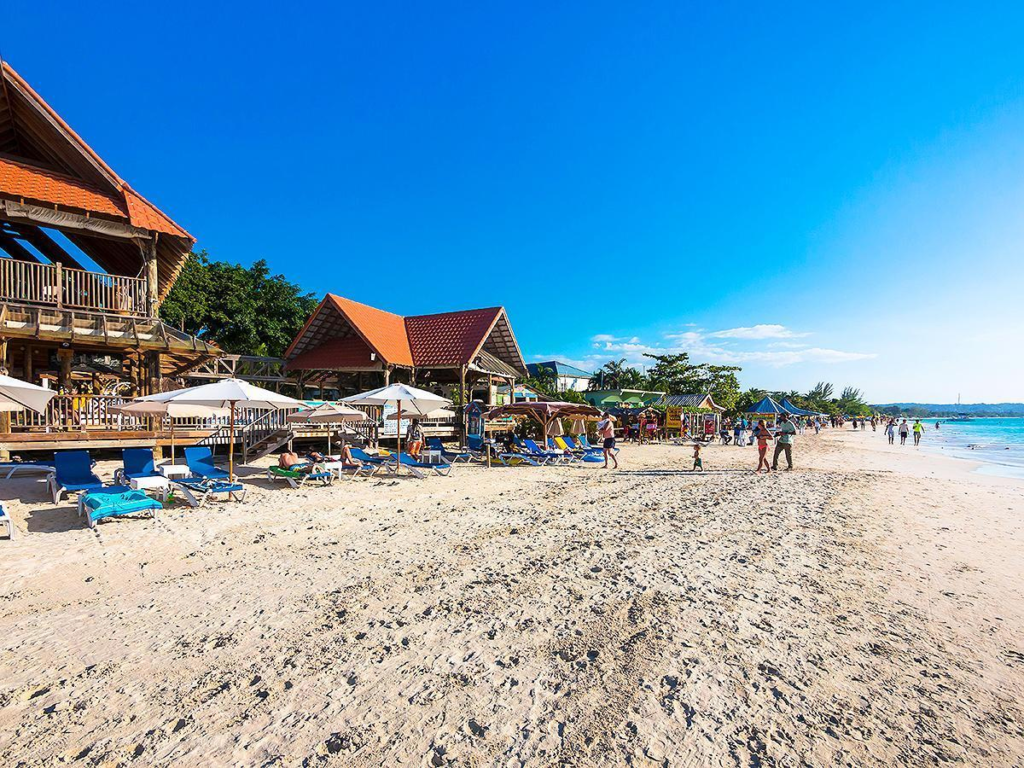
It begins near central Negril and runs north in a broad line of pale sand. The southern section carries the most movement. Small hotels, bars, restaurants, massage huts and watersports operators sit close together. Music travels between properties. Vendors walk the waterline with fruit, crafts and coolers.
Farther north, the beach opens. Buildings become less continuous and the sound from the busier section falls away. This middle portion is where the length of Long Bay becomes most apparent. The road remains nearby, but the beach no longer feels attached to downtown.
The northern end becomes more resort-heavy as it approaches Rutland Point. Landscaped properties and controlled entrances replace much of the informal street-to-sand movement found farther south.
Bloody Bay lies beyond the point. It cannot be reached by simply continuing the full walk along the water.
The bay curves inward, giving it a more enclosed shape and often calmer water. Vendors are fewer. Large resorts dominate much of the shoreline. Its name is generally traced to nineteenth-century whalers who brought their catch into the bay for processing, a history that bears no resemblance to the beach now.
Visitors choosing accommodation should therefore pay attention to the bay, not merely the phrase “Seven Mile Beach.” A room on southern Long Bay places restaurants and independent beach bars within easier reach. Bloody Bay offers a more contained resort environment.
Where the Public Can Enter
The relationship between public shoreline and public access in Jamaica is not simple.
Walking along the waterline is generally possible on much of Long Bay. Reaching it from Norman Manley Boulevard is another matter. Hotels and private properties occupy long sections of the frontage, and an open beach does not mean every property provides a public route through its grounds.
Long Bay Beach Park offers one of the clearest public entry points, with direct access from the road. Other lanes and entrances exist between properties, particularly toward the southern end, but they are not always clearly marked.
The practical approach is to choose an established beach park, independent restaurant or beach club that openly receives day visitors. Ask about chair use, minimum spending or access charges before settling in. Arrangements vary.
Resort frontage should not be treated as an invitation to enter through hotel grounds. The sand and the route used to reach it are separate questions.
The Water
Long Bay’s reputation rests partly on how little effort the water demands.
The shore slopes gradually along much of the beach. On calm mornings, the sandy bottom remains visible well beyond the first few strokes. Waves are usually modest, although weather and boat traffic can change conditions quickly.
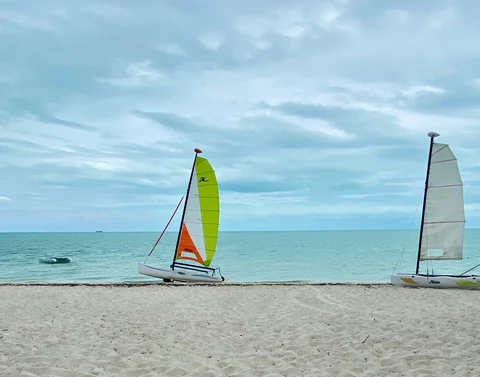
The southern and central sections support the most visible watersports trade. Kayaks and paddleboards sit near the sand. Catamarans anchor offshore before afternoon or sunset cruises. Glass-bottom boats leave for reef trips and short excursions.
Jet skis and motorised boats also operate along parts of the coast. Swimmers should remain aware of marked activity areas rather than assuming the entire bay functions as one quiet swimming zone.
Snorkelling directly from the sand is possible, but the open sandy bottom does not provide the reef life found on guided trips farther offshore. A boat excursion makes more sense for anyone interested in coral, fish or a longer session in the water.
What the Different Times Feel Like
Seven Mile Beach changes more over the course of a day than most photographs suggest.
Before breakfast, the sand belongs largely to walkers, hotel staff preparing chairs and the first fishing or excursion boats. The water is often at its clearest before wind and marine traffic increase.
By late morning, vendors and watersports operators are working the shoreline. The southern section becomes noticeably busier. Music begins carrying from bars and hotel properties.
Midday offers the strongest sun and the least natural shade. The beach’s calm water can obscure how exposed the sand is. An umbrella, covered restaurant or planned break away from the shore matters during the hottest hours.
Late afternoon brings people back toward the water. Boats return. Bars fill. The western view gives the entire beach a direct line toward sunset, although the experience changes according to location. Southern Long Bay feels social. The quieter stretches leave more distance between groups.
“Both belong to the Seven Mile Beach story. They do not offer the same day.”
Vendors on the Beach
Vendors are part of Long Bay rather than an interruption to it.
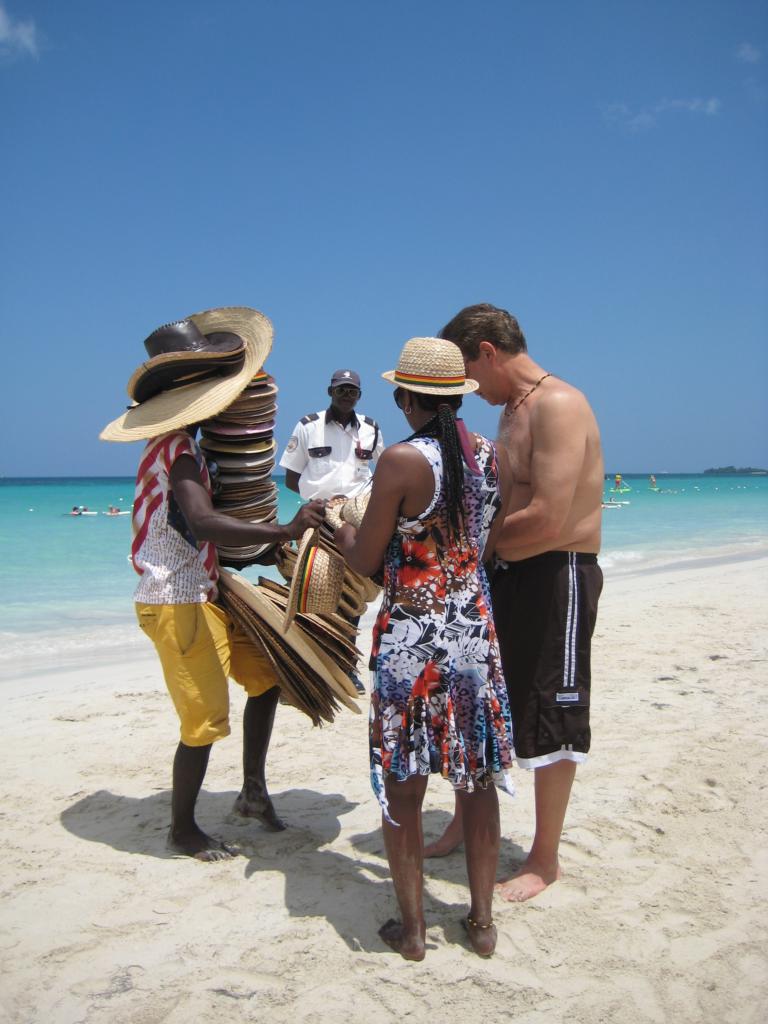
They sell fruit, coconuts, crafts, clothing, services and occasional seafood. The number of approaches is highest near the busiest hotels and independent beach bars. Bloody Bay and the quieter northern sections generally see less activity.
A clear “no, thank you” is usually sufficient. Repeated engagement can be interpreted as interest, so a polite answer delivered once works better than a long explanation.
Buying directly from a vendor keeps more of the transaction within the local beach economy. That does not create an obligation to purchase. It simply makes the difference between buying on the sand and buying through a resort worth understanding.
Eating Along Long Bay
The food changes with the beach.
Large resorts keep most of their dining behind controlled entrances and package arrangements. Independent sections of Long Bay are more porous. Restaurants open directly onto the sand. Diners arrive barefoot from the water or from Norman Manley Boulevard a few steps behind them.
Menus lean toward grilled fish, lobster when in season, jerk, Jamaican breakfasts and uncomplicated bar food. Fireman’s Lobster Pit at Boardwalk Village is one recognisable seafood stop, but the better approach is not to build the day around a single name. Walk until the grill, tables and view suit the hour.
Southern Long Bay provides the greatest concentration of independent choices. Bloody Bay offers fewer spontaneous stops because more of its dining sits inside resorts.
That difference becomes important for anyone staying in one bay and expecting the atmosphere of the other.
The Beach Before the Large Resorts
Negril did not begin as a purpose-built resort town.
Before the expansion of large hotels, visitors stayed in modest guesthouses, family homes and simple properties along the beach and cliffs. Improved road access from Montego Bay in the early 1970s made the area easier to reach and accelerated its international reputation.
The informal scale of that earlier period has not disappeared entirely.
It survives most clearly along southern Long Bay, where small hotels, independent restaurants and businesses still open directly onto the sand. The large resorts farther north represent another chapter rather than the entire story.
The two versions of Negril now sit along the same coast.
When to Visit
December through April brings drier weather and the highest visitor numbers. Restaurants, tours and beach businesses operate at full pace, while accommodation rates rise with demand.
Summer is warmer and less crowded. Afternoon showers become more likely, though they may pass quickly. The Atlantic hurricane season runs from June through November, making flexible plans and suitable travel coverage sensible during those months.
Weekdays are generally calmer than weekends, particularly near public access points and popular bars. Early morning remains the quietest time in every season.
Choosing the Right Stretch
Seven Mile Beach is too varied for “somewhere on the beach” to be a useful plan.
Choose southern Long Bay for movement, independent restaurants and easy transitions between sand and town. Move north for more space. Choose Bloody Bay for a quieter curve shaped largely by resort stays.
The name turns all of these sections into one destination. The shoreline does not.
Jimmy Cliff Boulevard holds some of Montego Bay’s longest-running dining rooms. Several more sit just beyond the walk.
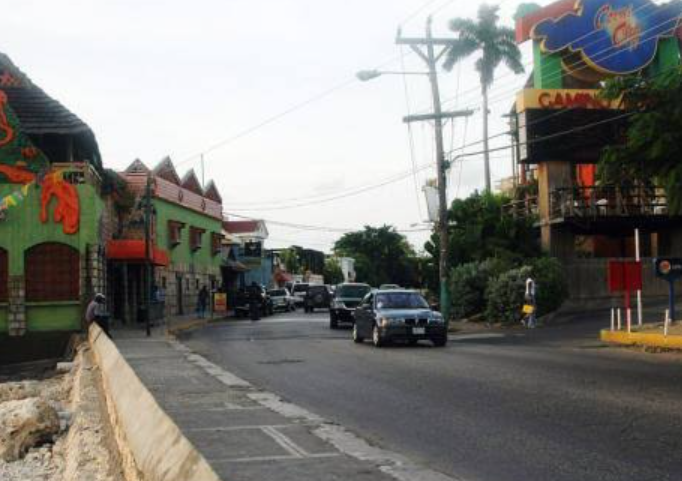
Ask for Gloucester Avenue and any taxi driver will know the road. Ask for the Hip Strip and the answer is quicker still. The stretch running past Doctor’s Cave Beach was officially renamed for Jimmy Cliff in 2019, but decades of habit remain attached to the pavement.
The exact boundaries depend on whom one asks. The central section is compact enough to explore on foot, with the sea appearing between restaurants, hotels and shopfronts. Not every restaurant associated with the Hip Strip sits directly on it. Some are above the boulevard. Others require a short drive east or south.
The distinction matters. So does knowing when to leave the strip.
On Jimmy Cliff Boulevard
Margaritaville
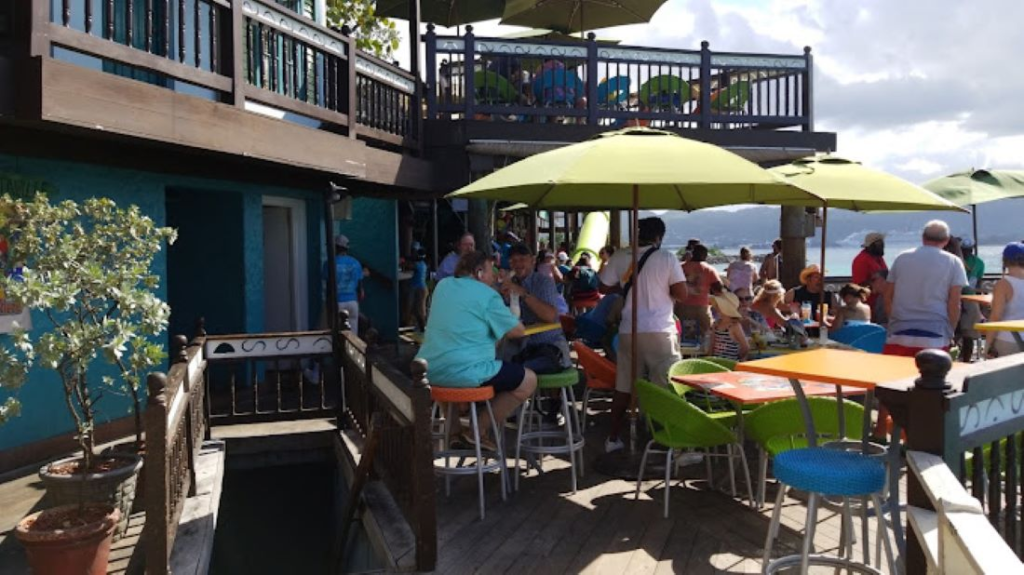
Margaritaville is difficult to mistake for anything else. Brian Jardim and Ian Dear began transforming an old waterfront restaurant here in 1995. What followed became a Caribbean chain, but Montego Bay was the starting point.
The building still operates at full volume. A waterslide curls from the upper deck into the sea. Music carries across the road. Boats move through the water below the dining terraces. The menu moves between American bar food and familiar Jamaican plates without asking diners to choose one mood for the afternoon.
Margaritaville works best when spectacle is part of the plan. Families arrive during the day for the water. The room changes after sunset, when the decks, bar and entertainment programme take over. It is the loudest address on the boulevard. It has never pretended otherwise.
Marguerites
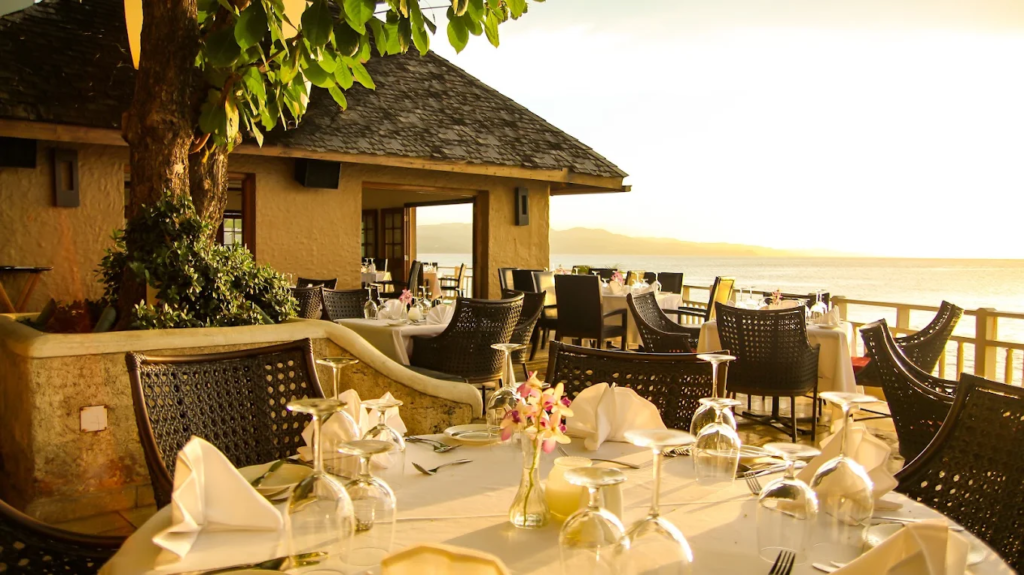
Marguerites sits beside Margaritaville and shares almost none of its character. Tables face the water. White cloth replaces bright branding. The dining room has held both Wine Spectator recognition and a Tripadvisor Traveller’s Choice award, with a seafood-led menu and a wine list built for a longer evening.
The difference becomes clearest after dark. Margaritaville announces itself from the road. Marguerites keeps the lighting low and lets the water carry the view. This is not the place for a quick plate before walking elsewhere. Dinner here is usually the evening.
Blue Beat Ultra Lounge
Blue Beat occupies the same waterfront cluster but turns the volume down another step. Jazz, blues and cocktails have defined the room since it opened. Tables sit outside beneath the night sky, with the sea close enough to register between songs. The food leans toward small plates rather than a full formal dinner.
The venue works in the space between restaurant and nightclub. Arrive early and it feels like an open-air lounge. Stay later and the music becomes the reason for being there. Its authority comes from restraint.
“The sea keeps appearing in the gaps.”
The Pork Pit
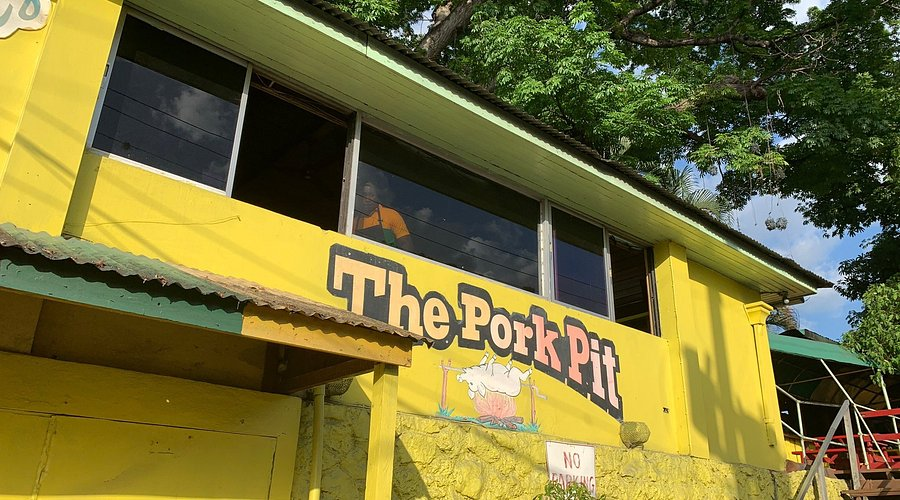
Smoke reaches the road before the sign does. The Pork Pit is open-air and direct. Chicken, pork, ribs and sausage cook over wood, then arrive with festival, rice and peas, roasted yam or plantain. There is little ceremony between the grill and the table.
This is one of the strip’s most useful stops because it does not require an occasion. Diners come in from the beach. Drivers pull over for lunch. Plates move quickly even when the tables are full. Lunch smells like lunch before anyone sits down.
The Pelican Grill
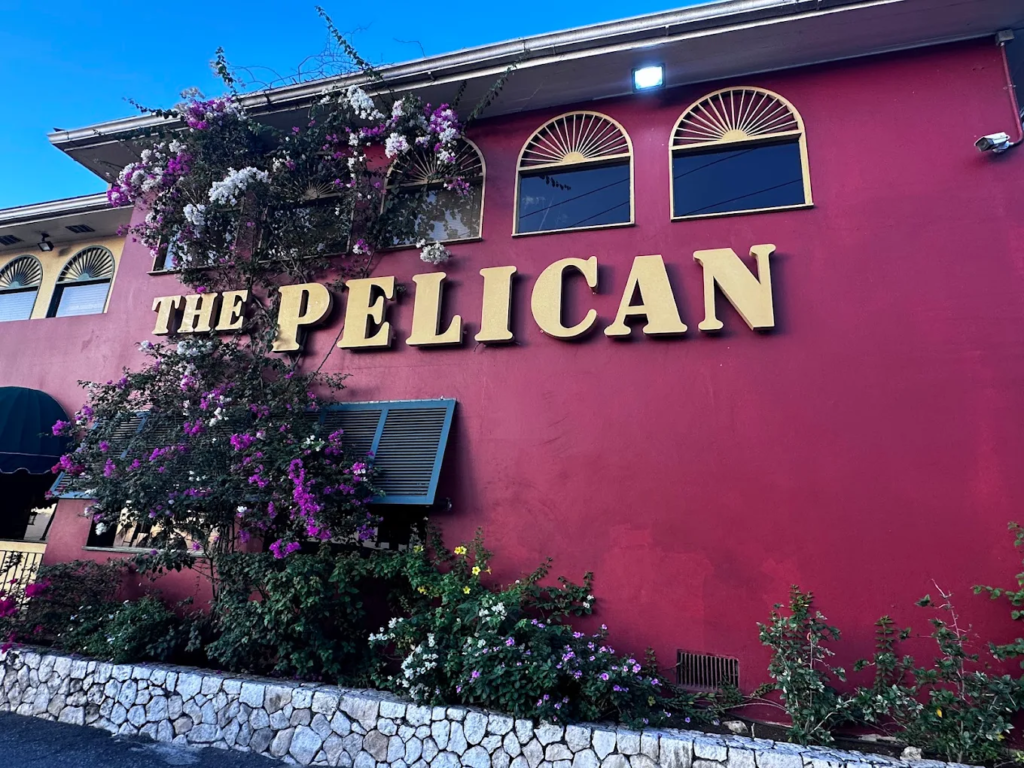
The Pelican Grill belongs to an older Montego Bay. The dining room has served Jamaican breakfasts, seafood and traditional cooked meals on the boulevard through several versions of the city’s tourism industry. That continuity is the point.
Breakfast brings ackee and saltfish, callaloo and familiar Jamaican staples. Later menus move through fish, chicken, curry and grilled dishes. The Pelican is useful when the strip’s louder rooms begin to feel interchangeable.
The Brewery
The Brewery has changed with the street around it. Earlier descriptions focused on its improbable combination of British-pub references, Jamaican food and medieval decoration. Those details remain part of the venue’s identity, but its current role leans more heavily toward nightlife, parties and ticketed events.
The space is large enough to absorb a crowd. This is the entry to check before arriving — the experience depends less on the regular menu than on what is scheduled for the night.
Just Beyond the Walk
Peppa’s Cool Spot
Peppa’s sits above the Hip Strip at Ramparts Close. The distance is short by car but significant on foot, particularly in Montego Bay heat. Leaving the boulevard is rewarded with a restaurant that feels less arranged around passing visitor traffic.
Steamed fish is one of the dishes most closely associated with the kitchen, often served with vegetables, breadfruit or plantain. Locals and visitors share the room without either group becoming its theme.
Worth the Drive
Scotchies
Scotchies is not on the Hip Strip. It sits east of central Montego Bay on Falmouth Road. The drive matters because Scotchies is often folded casually into guides to Gloucester Avenue, leaving first-time visitors expecting to find it within walking distance.
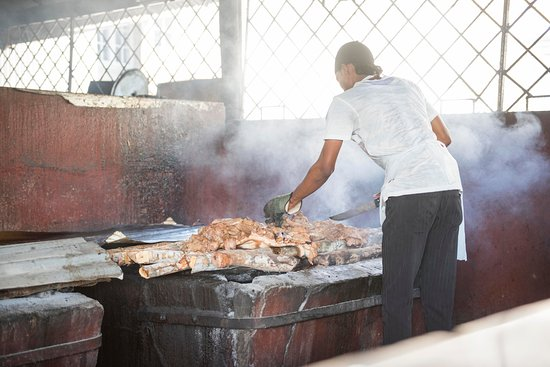
What waits there is a broad, open-air jerk centre built around the cooking itself. Meat rests over pimento wood. Smoke collects beneath the roof. Orders arrive in foil with festival, bammy, roasted breadfruit or sweet potato. Scotchies is not a detour made for polished dining. It is a detour made because the method can be seen, smelled and tasted in the same place.
Pier 1 on the Waterfront
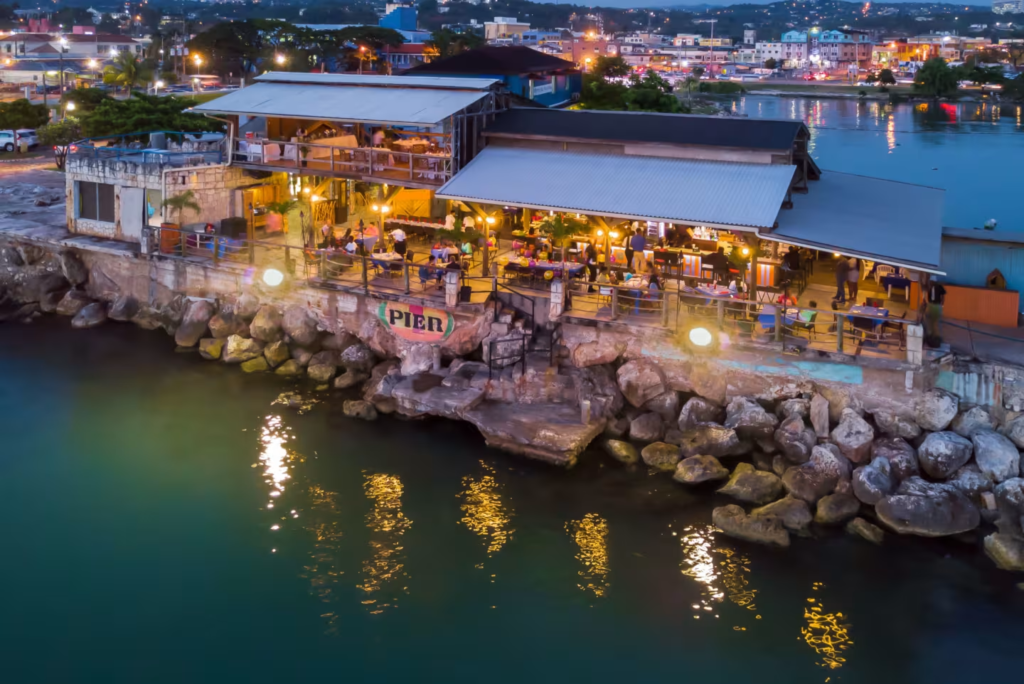
Pier 1 sits south of the Hip Strip on Howard Cooke Boulevard. The restaurant has operated on Montego Bay’s waterfront since 1986, serving seafood, drinks and entertainment from a deck extending over the harbour. Its longevity matters in a city where hospitality concepts change quickly.
During dinner, the water sets the room’s pace. Later, scheduled entertainment can turn the same deck into a dance floor. The location is not an extension of the Hip Strip so much as a different view of Montego Bay’s waterfront.
How to Use the Strip
The useful way to approach the Hip Strip is not as a checklist. Margaritaville, Marguerites and Blue Beat occupy almost the same piece of waterfront while offering three entirely different evenings. The Pork Pit and Pelican Grill are more practical stops, shaped by meals rather than occasion. The Brewery depends on the night’s programme.
Peppa’s, Scotchies and Pier 1 require leaving the walk. Each gives a reason to do so.
The road itself explains part of Montego Bay. Visitor-facing businesses sit beside institutions that have outlasted several tourism cycles. Music passes between open doors. Smoke from a jerk grill reaches jewellery shops and hotel entrances. The sea keeps appearing in the gaps.
Jimmy Cliff Boulevard is not the whole of Montego Bay’s food culture. It is the part compressed into one visible stretch, with the rest waiting a short drive beyond it.
Past the resort strip and the cruise-ship crowds, the island keeps its best coastline quiet.
If you’re searching for hidden beaches in Jamaica, they’re rarely the ones filling Instagram feeds. Locals have been visiting them for generations. They’re simply places many visitors never make time to see.
Hidden Beaches in Jamaica Worth the Drive
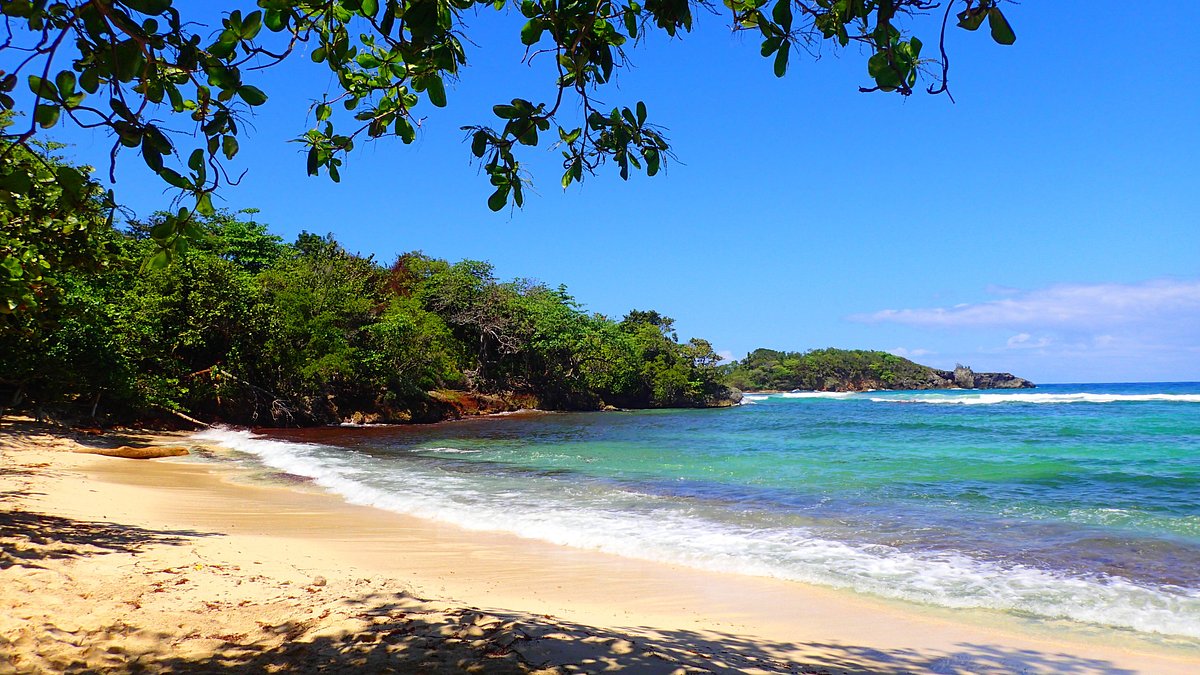
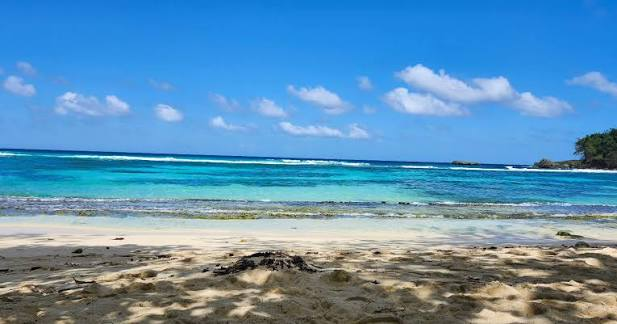
Winnifred Beach, Portland
No resort touches it, and the community that runs it keeps it exactly as unpolished as it should be, having repeatedly fought off attempts to privatize or restrict access. Fresh fish from the vendors on the sand, water that goes from turquoise to navy within a few strokes of swimming out. Go on a weekday if quiet is the point.
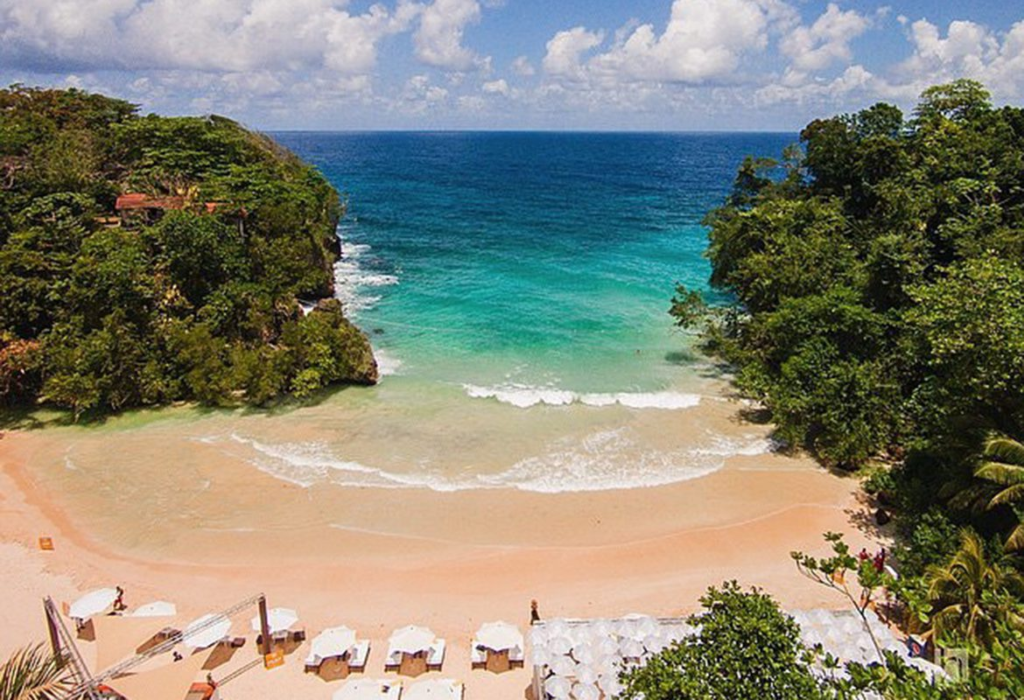
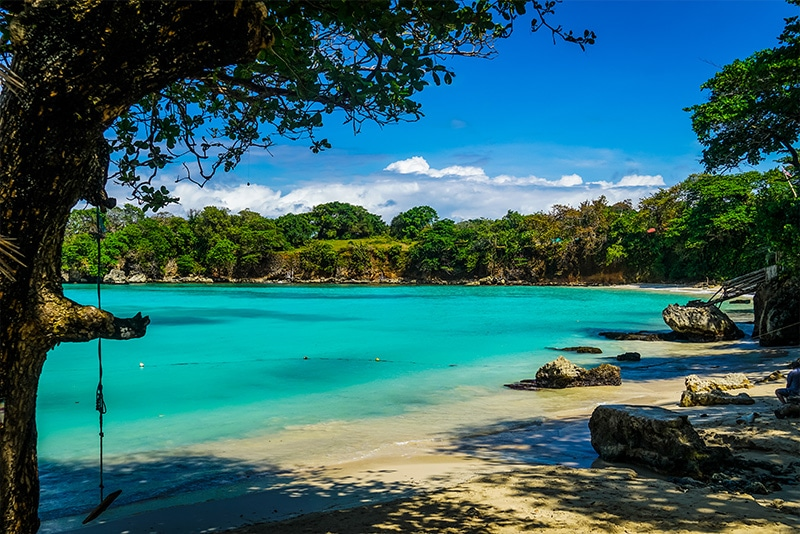
Frenchman’s Cove, Port Antonio
A private river runs straight into the sea here, so the water temperature shifts as you wade in. There’s an admission fee, and it’s worth it. Portland moves at a slower pace than most of Jamaica’s tourism corridor, and this cove is the reason people who know the island well keep coming back to it.
Boston Bay, Portland
One of Jamaica’s best-known surfing beaches, though the jerk stands up the road draw the bigger crowd. The waves here are consistent enough to have built a real surfing culture, and the beach itself stays uncrowded even when the jerk stands are three deep.
Treasure Beach, St. Elizabeth
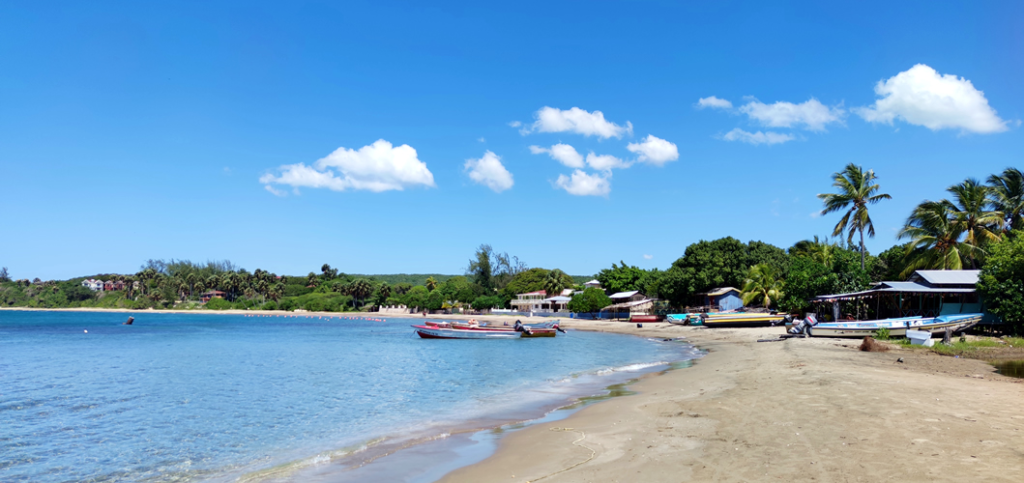
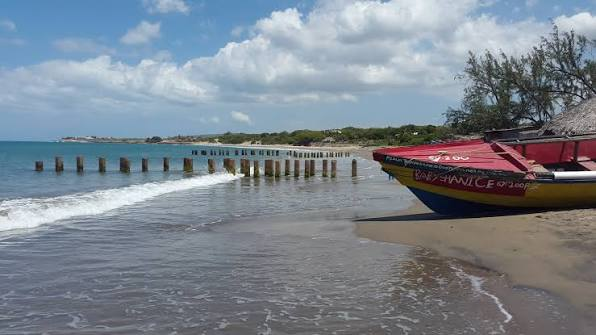
The south coast has never chased the pace of the north. A string of coves rather than one continuous stretch, fishing boats pulled up on the sand instead of sunloungers, and a community that has kept tourism on its own terms rather than the other way around.
“These are not secret beaches in the literal sense. Locals have been visiting them for generations. They’re simply places many visitors never make time to see.”
Great Bay Beach, St. Elizabeth
Further along the same coast, and quieter for a specific reason: development here has stayed minimal, just a handful of structures along the shore. Many visitors stop at Treasure Beach. Few continue this far.
Bluefields Beach, Westmoreland
About an hour from Negril on the A2, easy to find and easy to park at, free. The bay stays sheltered and the water calm enough for wading rather than swimming laps. Small fee for the changing rooms and showers if you want them; the beach itself costs nothing. A fishing community runs alongside it, and the food stalls serve what they catch.
Hellshire Beach, St. Catherine
The road narrows as Kingston gives way to the fishing villages around Hellshire. What’s waiting is some of the best fried and grilled fish on the island, shack after shack of it, and a beach day that has nothing to do with resort culture.
Fort Clarence Beach, St. Catherine
A managed public beach close enough to Kingston for a practical afternoon rather than a full day trip. Weekdays often feel surprisingly empty considering Kingston is less than an hour away.
Lime Cay, Kingston
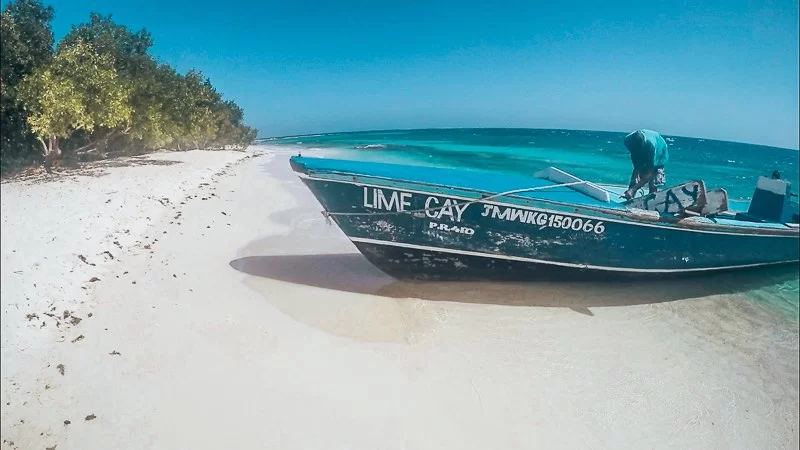
Boats leave from Port Royal when there are enough passengers and the weather cooperates. Numbers stay down even on a good weekend, the kind of place that rewards asking the right person at the dock.
“Fishing boats still outnumber beach chairs. That tells the story better than any description could.”
Long Bay Beach, Portland
A mile-long crescent on the east coast, known for consistent surf. Guest houses line the road rather than resorts, and the food comes from cook shops, not beach bars. The Long Bay Gala runs every Independence Day, August 6th, if timing lines up.
Gordon’s Beach, St. Thomas
Most visitors pass through St. Thomas on their way somewhere else. Fishing boats still outnumber beach chairs. That tells the story.
None of these require abandoning the beaches Jamaica is known for. For travellers looking for off-the-beaten-path beaches in Jamaica, they’re simply worth planning around.
COVID-19 is a contagious disease caused by the coronavirus SARS-CoV-2. In January 2020, the disease spread worldwide, resulting in the COVID-19 pandemic.
The symptoms of COVID‑19 can vary but often include fever,[7] fatigue, cough, breathing difficulties, loss of smell, and loss of taste.[8][9][10] Symptoms may begin one to fourteen days after exposure to the virus. At least a third of people who are infected do not develop noticeable symptoms.[11][12] Of those who develop symptoms noticeable enough to be classified as patients, most (81%) develop mild to moderate symptoms (up to mild pneumonia), while 14% develop severe symptoms (dyspnea, hypoxia, or more than 50% lung involvement on imaging), and 5% develop critical symptoms (respiratory failure, shock, or multiorgan dysfunction).[13] Older people have a higher risk of developing severe symptoms. Some complications result in death. Some people continue to experience a range of effects (long COVID) for months or years after infection, and damage to organs has been observed.[14] Multi-year studies on the long-term effects are ongoing.[15]
COVID‑19 transmission occurs when infectious particles are breathed in or come into contact with the eyes, nose, or mouth. The risk is highest when people are in close proximity, but small airborne particles containing the virus can remain suspended in the air and travel over longer distances, particularly indoors. Transmission can also occur when people touch their eyes, nose, or mouth after touching surfaces or objects that have been contaminated by the virus. People remain contagious for up to 20 days and can spread the virus even if they do not develop symptoms.[16]
Testing methods for COVID-19 to detect the virus’s nucleic acid include real-time reverse transcription polymerase chain reaction (RT‑PCR),[17][18] transcription-mediated amplification,[17][18][19] and reverse transcription loop-mediated isothermal amplification (RT‑LAMP)[17][18] from a nasopharyngeal swab.[20]
Several COVID-19 vaccines have been approved and distributed in various countries, many of which have initiated mass vaccination campaigns. Other preventive measures include physical or social distancing, quarantining, ventilation of indoor spaces, use of face masks or coverings in public, covering coughs and sneezes, hand washing, and keeping unwashed hands away from the face. While drugs have been developed to inhibit the virus, the primary treatment is still symptomatic, managing the disease through supportive care, isolation, and experimental measures.