


9 Caribbean and Diaspora Designers to Know in 2026

Models in tailored looks on an indoor runway.

Crochet, tailoring, experimental knitwear and jewellery reveal the different ways these designers work with Caribbean experience and heritage.

Caribbean fashion cannot be reduced to one silhouette. In this selection, a crocheted garment made in Jamaica sits alongside a New York handbag, a Trinidadian resort-wear label and experimental knitwear produced in Mexico City. The connection is personal history; the work takes different forms.

Some of these designers were born in the region. Others grew up elsewhere with Caribbean parents or grandparents. Those distinctions matter. Heritage is part of their stories, rather than a reason to treat separate practices as interchangeable.

Here is a closer look at the people, labels and craft behind the names.

Edvin Thompson — Theophilio

Jamaica / Brooklyn

Kingston-born Edvin Thompson is the designer behind Brooklyn-based Theophilio. His label connects memories of Jamaica with the city in which he works, drawing on dancehall, colour and the ways people express themselves through clothes. The CFDA named him American Emerging Designer of the Year in 2021. Theophilio’s interest in Jamaican experience is explicit in the brand’s own account of its work; it is a useful starting point for looking beyond a runway image to the designer behind it. CFDA, Theophilio

Rachel Scott — Diotima

Jamaica / New York

Rachel Scott founded Diotima in 2021 with a practice developed between Jamaica and New York. Crochet made in Jamaica sits alongside tailoring in tweed and wool, bringing different kinds of workmanship into the same wardrobe. The Jamaican-born designer also serves as creative director of Proenza Schouler. The two labels offer distinct settings for a career grounded in construction and craft. At Diotima, the relationship with Jamaican makers is central to the work, not simply a reference in its presentation. CFDA, Proenza Schouler

Anya Ayoung-Chee

Trinidad and Tobago

Anya Ayoung-Chee’s work extends from resort wear to creative enterprise. The Trinidadian designer won the ninth season of Project Runway, then developed an eponymous womenswear label with a resort focus. Her work also includes Spöol, a social enterprise providing garment-construction training for women. That combination gives her profile a practical dimension: alongside the clothes is an interest in how skills are taught and how creative livelihoods are built. Bocas Lit Fest

Brandon Blackwood

Brooklyn / Jamaican and Chinese heritage

Brandon Blackwood’s accessories carry personal associations. His CFDA biography traces the beginning of the label to the Portmore backpack he made for himself, and describes bags named for friends, relatives and places he has lived. Born and raised in Brooklyn to Jamaican and Chinese parents, Blackwood launched his namesake business in 2015. It has since expanded beyond handbags into footwear, outerwear and eyewear, while the personal references offer another way to read the names attached to the bags. CFDA

Felisha “Fe” Noel — Fe Noel

Brooklyn / Grenadian heritage

Fe Noel’s brand biography places Grenadian heritage, family, vibrant colour and bold prints at the centre of her womenswear. Her route into design began with a Brooklyn boutique she opened at nineteen, an experience that helped shape the namesake label. She also supports young women interested in entrepreneurship through the Fe Noel Foundation. Her story connects the development of a fashion business with the experience of helping others begin one. Fe Noel
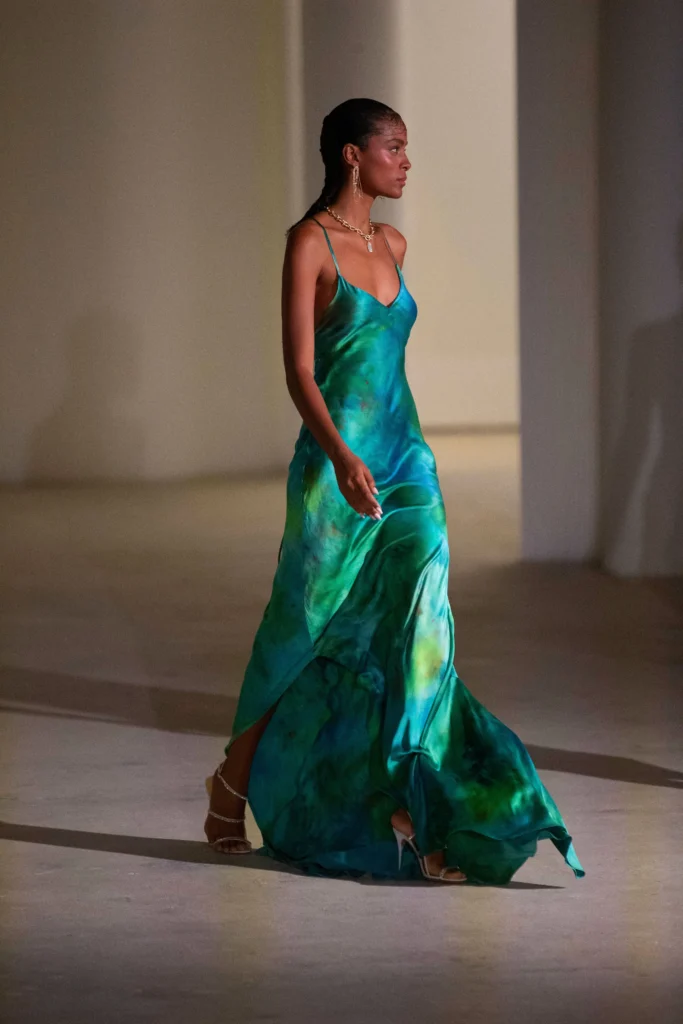
A model wearing a blue-green flowing slip dress on the runway.
A look from Fe Noel’s Spring 2023 collection.

Grace Wales Bonner — Wales Bonner

London / Jamaican heritage

Grace Wales Bonner’s label brings tailoring into conversation with cultural research. Launched in 2014, it began in menswear and expanded into womenswear. The British designer’s Jamaican heritage is documented in the Fédération de la Haute Couture et de la Mode’s interview with her. She is also creative director of men’s ready-to-wear at Hermès; the house has announced her first collection for January 2027. Wales Bonner, FHCM, Hermès press release

Shanel Campbell — Bed on Water

Bronx-raised / Jamaican and Saint Lucian heritage

Shanel Campbell’s label is Bed on Water. Born and raised in the Bronx, she has identified her mother as Saint Lucian and her father as Jamaican. ESSENCE Her practice moves between clothing, painting and other visual media. In interviews with ESSENCE and the CFDA, Campbell described turning her paintings into prints and using brown mannequins as a deliberate part of the label’s presentation. These choices offer a concrete way into her work: colour, image and the person represented by the clothes are considered together. CFDA

Krystal Paniagua

Puerto Rican / Mexico City

Krystal Paniagua works with knitwear that can shift shape and use. Her March 2026 collection notes describe a piece designed to function as either a top or a skirt, while the label’s studio and production are based in Mexico City. In a May 2026 interview, the Puerto Rican designer described moving her life and operations there in 2022. Her current location is an important part of the story, alongside the Puerto Rican upbringing she identifies as an influence on her approach to making. Krystal Paniagua, Studio information, Local.mx interview

Matthew Harris — Mateo

Jamaica / New York

Matthew Harris grew up in Montego Bay, the son of a seamstress, and learned jewellery-making in New York. He launched Mateo in 2009, beginning with men’s jewellery before developing a women’s fine-jewellery collection. The brand describes modern art, simplicity and minimalism as important to its approach, working with precious metals, diamonds and gemstones. Harris adds jewellery to this selection’s range of practices, with attention directed to materials and proportion at a smaller scale. Mateo

Looking closely

The useful question is what each designer actually makes, and how. Scott’s work with Jamaican crochet, Paniagua’s adaptable knitwear and Harris’s jewellery offer different answers. These are individual careers, with different relationships to the Caribbean and to the cities in which they work. Looking closely at those differences makes the selection more interesting, and gives readers a better way to discover the clothes and objects for themselves.

Update note

This article has been revised to correct Shanel Campbell's label and Krystal Paniagua's current studio location. Two entries whose inclusion could not be substantiated have been removed. The remaining nine profiles have been updated with linked sources.


white-couple-experiencing-virtual-reality

Excepteur sint occaecat cupidatat non proident, sunt in culpa qui officia deserunt mollit anim id est laborum. Sed ut perspiciatis unde omnis iste natus error sit voluptatem accusantium.

Doloremque laudantium, totam rem aperiam, eaque ipsa quae ab illo inventore veritatis et quasi architecto beatae vitae dicta sunt explicabo.

Excepteur sint occaecat cupidatat non proident, sunt in culpa qui officia deserunt mollit anim id est laborum. Sed ut perspiciatis unde omnis iste natus error sit voluptatem.

Duis aute irure dolor in reprehenderit in voluptate velit esse cillum dolore eu fugiat nulla pariatur.

Excepteur sint occaecat cupidatat non proident, sunt in culpa qui officia deserunt mollit anim id est laborum. Sed ut perspiciatis unde omnis iste natus error sit voluptatem.

Share on

Related Posts

Comments are closed.

Models in tailored looks on an indoor runway.

Crochet, tailoring, experimental knitwear and jewellery reveal the different ways these designers work with Caribbean experience and heritage.

Caribbean fashion cannot be reduced to one silhouette. In this selection, a crocheted garment made in Jamaica sits alongside a New York handbag, a Trinidadian resort-wear label and experimental knitwear produced in Mexico City. The connection is personal history; the work takes different forms.

Some of these designers were born in the region. Others grew up elsewhere with Caribbean parents or grandparents. Those distinctions matter. Heritage is part of their stories, rather than a reason to treat separate practices as interchangeable.

Here is a closer look at the people, labels and craft behind the names.

Edvin Thompson — Theophilio

Jamaica / Brooklyn

Kingston-born Edvin Thompson is the designer behind Brooklyn-based Theophilio. His label connects memories of Jamaica with the city in which he works, drawing on dancehall, colour and the ways people express themselves through clothes. The CFDA named him American Emerging Designer of the Year in 2021. Theophilio’s interest in Jamaican experience is explicit in the brand’s own account of its work; it is a useful starting point for looking beyond a runway image to the designer behind it. CFDA, Theophilio

Rachel Scott — Diotima

Jamaica / New York

Rachel Scott founded Diotima in 2021 with a practice developed between Jamaica and New York. Crochet made in Jamaica sits alongside tailoring in tweed and wool, bringing different kinds of workmanship into the same wardrobe. The Jamaican-born designer also serves as creative director of Proenza Schouler. The two labels offer distinct settings for a career grounded in construction and craft. At Diotima, the relationship with Jamaican makers is central to the work, not simply a reference in its presentation. CFDA, Proenza Schouler

Anya Ayoung-Chee

Trinidad and Tobago

Anya Ayoung-Chee’s work extends from resort wear to creative enterprise. The Trinidadian designer won the ninth season of Project Runway, then developed an eponymous womenswear label with a resort focus. Her work also includes Spöol, a social enterprise providing garment-construction training for women. That combination gives her profile a practical dimension: alongside the clothes is an interest in how skills are taught and how creative livelihoods are built. Bocas Lit Fest

Brandon Blackwood

Brooklyn / Jamaican and Chinese heritage

Brandon Blackwood’s accessories carry personal associations. His CFDA biography traces the beginning of the label to the Portmore backpack he made for himself, and describes bags named for friends, relatives and places he has lived. Born and raised in Brooklyn to Jamaican and Chinese parents, Blackwood launched his namesake business in 2015. It has since expanded beyond handbags into footwear, outerwear and eyewear, while the personal references offer another way to read the names attached to the bags. CFDA

Felisha “Fe” Noel — Fe Noel

Brooklyn / Grenadian heritage

Fe Noel’s brand biography places Grenadian heritage, family, vibrant colour and bold prints at the centre of her womenswear. Her route into design began with a Brooklyn boutique she opened at nineteen, an experience that helped shape the namesake label. She also supports young women interested in entrepreneurship through the Fe Noel Foundation. Her story connects the development of a fashion business with the experience of helping others begin one. Fe Noel

A model wearing a blue-green flowing slip dress on the runway.
A look from Fe Noel’s Spring 2023 collection.

Grace Wales Bonner — Wales Bonner

London / Jamaican heritage

Grace Wales Bonner’s label brings tailoring into conversation with cultural research. Launched in 2014, it began in menswear and expanded into womenswear. The British designer’s Jamaican heritage is documented in the Fédération de la Haute Couture et de la Mode’s interview with her. She is also creative director of men’s ready-to-wear at Hermès; the house has announced her first collection for January 2027. Wales Bonner, FHCM, Hermès press release

Shanel Campbell — Bed on Water

Bronx-raised / Jamaican and Saint Lucian heritage

Shanel Campbell’s label is Bed on Water. Born and raised in the Bronx, she has identified her mother as Saint Lucian and her father as Jamaican. ESSENCE Her practice moves between clothing, painting and other visual media. In interviews with ESSENCE and the CFDA, Campbell described turning her paintings into prints and using brown mannequins as a deliberate part of the label’s presentation. These choices offer a concrete way into her work: colour, image and the person represented by the clothes are considered together. CFDA

Krystal Paniagua

Puerto Rican / Mexico City

Krystal Paniagua works with knitwear that can shift shape and use. Her March 2026 collection notes describe a piece designed to function as either a top or a skirt, while the label’s studio and production are based in Mexico City. In a May 2026 interview, the Puerto Rican designer described moving her life and operations there in 2022. Her current location is an important part of the story, alongside the Puerto Rican upbringing she identifies as an influence on her approach to making. Krystal Paniagua, Studio information, Local.mx interview

Matthew Harris — Mateo

Jamaica / New York

Matthew Harris grew up in Montego Bay, the son of a seamstress, and learned jewellery-making in New York. He launched Mateo in 2009, beginning with men’s jewellery before developing a women’s fine-jewellery collection. The brand describes modern art, simplicity and minimalism as important to its approach, working with precious metals, diamonds and gemstones. Harris adds jewellery to this selection’s range of practices, with attention directed to materials and proportion at a smaller scale. Mateo

Looking closely

The useful question is what each designer actually makes, and how. Scott’s work with Jamaican crochet, Paniagua’s adaptable knitwear and Harris’s jewellery offer different answers. These are individual careers, with different relationships to the Caribbean and to the cities in which they work. Looking closely at those differences makes the selection more interesting, and gives readers a better way to discover the clothes and objects for themselves.

Update note

This article has been revised to correct Shanel Campbell's label and Krystal Paniagua's current studio location. Two entries whose inclusion could not be substantiated have been removed. The remaining nine profiles have been updated with linked sources.

white-couple-experiencing-virtual-reality

Excepteur sint occaecat cupidatat non proident, sunt in culpa qui officia deserunt mollit anim id est laborum. Sed ut perspiciatis unde omnis iste natus error sit voluptatem accusantium.

Doloremque laudantium, totam rem aperiam, eaque ipsa quae ab illo inventore veritatis et quasi architecto beatae vitae dicta sunt explicabo. 

Excepteur sint occaecat cupidatat non proident, sunt in culpa qui officia deserunt mollit anim id est laborum. Sed ut perspiciatis unde omnis iste natus error sit voluptatem.

Duis aute irure dolor in reprehenderit in voluptate velit esse cillum dolore eu fugiat nulla pariatur.

Excepteur sint occaecat cupidatat non proident, sunt in culpa qui officia deserunt mollit anim id est laborum. Sed ut perspiciatis unde omnis iste natus error sit voluptatem.

Share on

Related Posts

Comments are closed.