

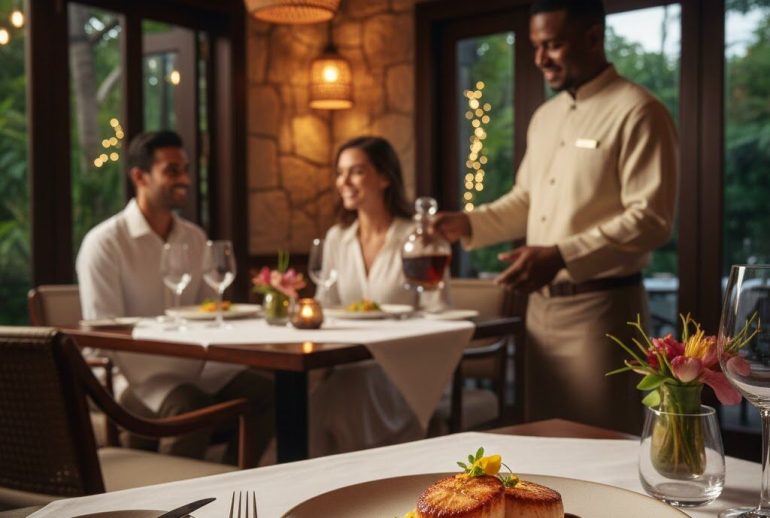
Caribbean hospitality travels well because it is human.
It does not rely on scripts or spectacle. It is grounded in rhythm, familiarity, and an intuitive understanding of how people want to be treated. As global hospitality recalibrates away from performance and toward atmosphere, the Caribbean finds itself less exported than recognized.
What the world is adopting now is not new.
It is simply ready.
Hospitality as Relationship, Not Theater
In the Caribbean, hospitality has never been transactional.
Service emerges from proximity. From knowing how close to stand. When to speak. When to leave space. Warmth is offered without insistence. Care is present without narration.
This is why Caribbean hospitality feels disarming in global contexts. It does not ask to be evaluated. It does not perform enthusiasm. It operates on attunement.
As international hospitality grows more formalized, this relational intelligence feels increasingly rare.
Rum Grows Up Without Losing Its Grounding
Rum has always been more than a product.
It is a social language.
What is changing now is not its meaning but its positioning. Caribbean rum is entering a more premium global conversation without abandoning its cultural roots. Aging statements, terroir, and craft processes are being articulated with clarity rather than disguise.
The maturation feels natural because rum was never casual in context. It was communal. Ceremonial. Integrated into daily life.
The global market is catching up to what the region has always understood.
Cuisine as Craft, Not Reinvention
Caribbean cuisine is also being reframed, often incorrectly, as discovery.
In reality, the elevation happening now is about articulation, not alteration. Techniques are refined. Sourcing is clarified. Presentation becomes more intentional. The core remains intact.
Flavor is still primary. Memory still matters. Meals are still built to be shared.
What global dining increasingly values—honesty, specificity, restraint—is already embedded in Caribbean food culture.
Restaurants That Feel Lived In
Caribbean hospitality does not aim for polish first.
Spaces are meant to feel occupied rather than staged. Music is present but not curated for effect. Staff move with familiarity rather than formality. Time stretches.
As restaurants around the world move away from rigid concepts and toward lived-in atmospheres, Caribbean sensibilities quietly shape the model.
Comfort becomes sophistication.
Atmosphere as the Real Export
The Caribbean’s most influential export is not a menu, a bottle, or a service style.
It is an atmosphere.
The understanding that rhythm matters. That generosity cannot be rushed. That people feel most welcome when they are not managed too closely.
Global hospitality is shifting toward exactly this. Less instruction. More intuition.
What looks like innovation elsewhere has long been baseline here.
Closing Reflection
Caribbean hospitality is not scaling because it was not designed to.
It is scaling because it aligns with what the world now needs.
As hospitality moves away from performance and back toward presence, the Caribbean does not need to adapt. It only needs to continue.
The warmth was always real.
The rhythm was always there.
FAQs
Q1: Why does Caribbean hospitality translate globally?
Because it is rooted in human connection, not scripts.
Q2: How is rum evolving on the global stage?
Through premium positioning that respects origin and craft.
Q3: Is Caribbean cuisine being changed for global audiences?
No. It is being articulated, not reinvented.
Q4: What distinguishes Caribbean service style?
Warmth without performance or intrusion.
Q5: What is the region’s most influential hospitality export?
Atmosphere shaped by rhythm, generosity, and ease.