


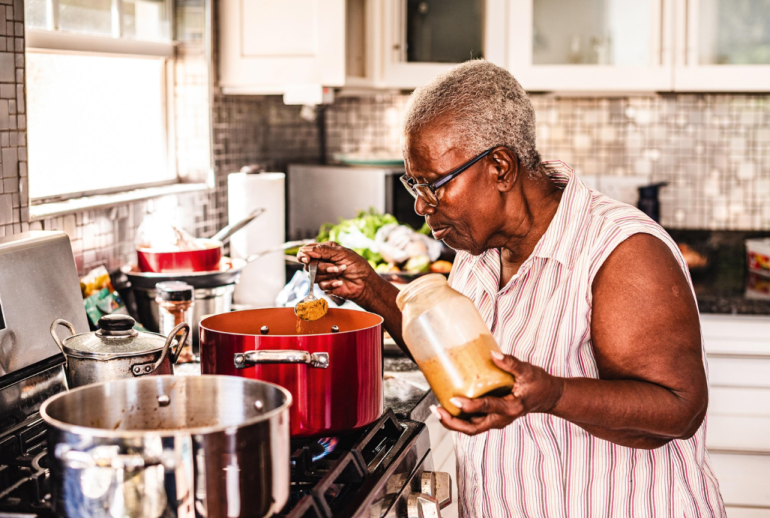
Jamaican cooking traditions were built around judgment, memory and repetition long before recipes came with measuring cups.
Ask a Jamaican cook for the recipe behind a pot of rice and peas, a Sunday curry or a brown stew that tastes exactly the way it should, and the answer may not arrive in cups and tablespoons.
A handful of this.
A little more of that.
Season it until it tastes right.
Let it cook until it is ready.
For generations, that was not a failure to document a recipe. It was the recipe.
Jamaican cooking traditions developed through knowledge that was learned by watching, listening and doing. A cook learned how much thyme belonged in a pot by seeing it added. She learned when the oil was hot enough by watching it move. She learned when the meat had taken enough seasoning by touch, smell and experience.
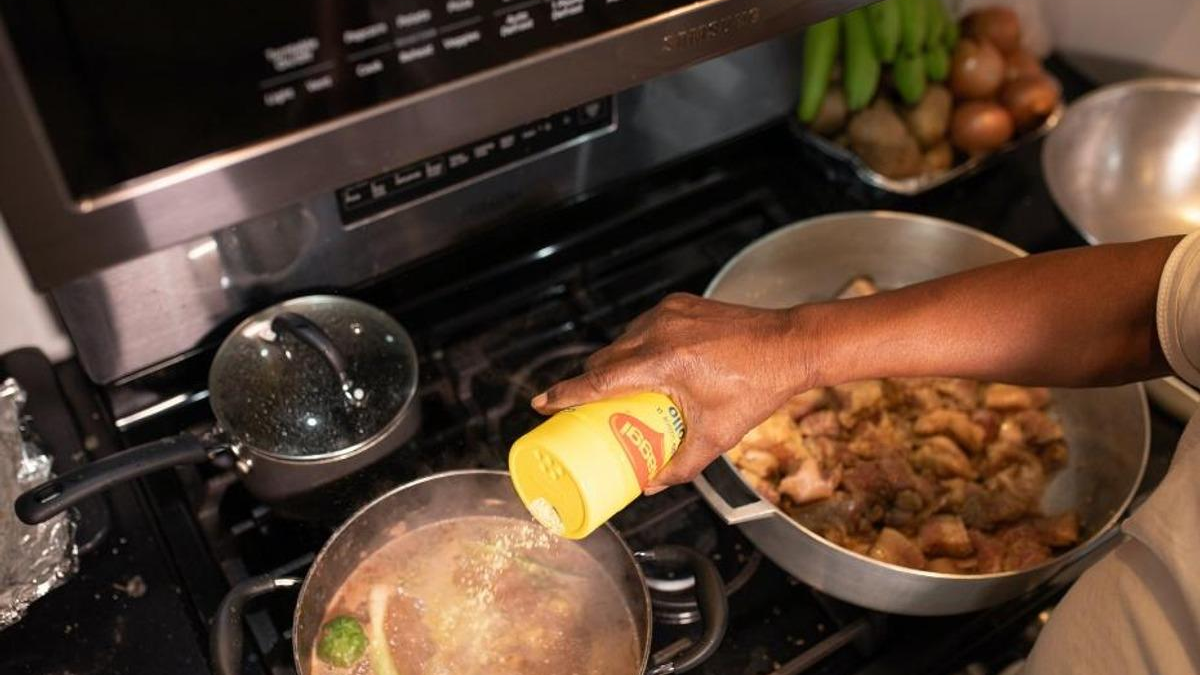
The measurements existed. They simply were not always written down.
Jamaican cooking traditions were learned in the kitchen
The distinction matters because Jamaican food did not emerge from a cookbook culture.
Barry Higman, in Jamaican Food: History, Biology, Culture, describes Jamaican cooks’ knowledge as rooted in experience, demonstration, observation and listening to lore. Precise measurements of weight, cooking time and temperature were historically difficult to maintain, and dishes carrying the same name could vary in both ingredients and taste.
That makes the kitchen less like a place where instructions are followed and more like a place where knowledge is accumulated.
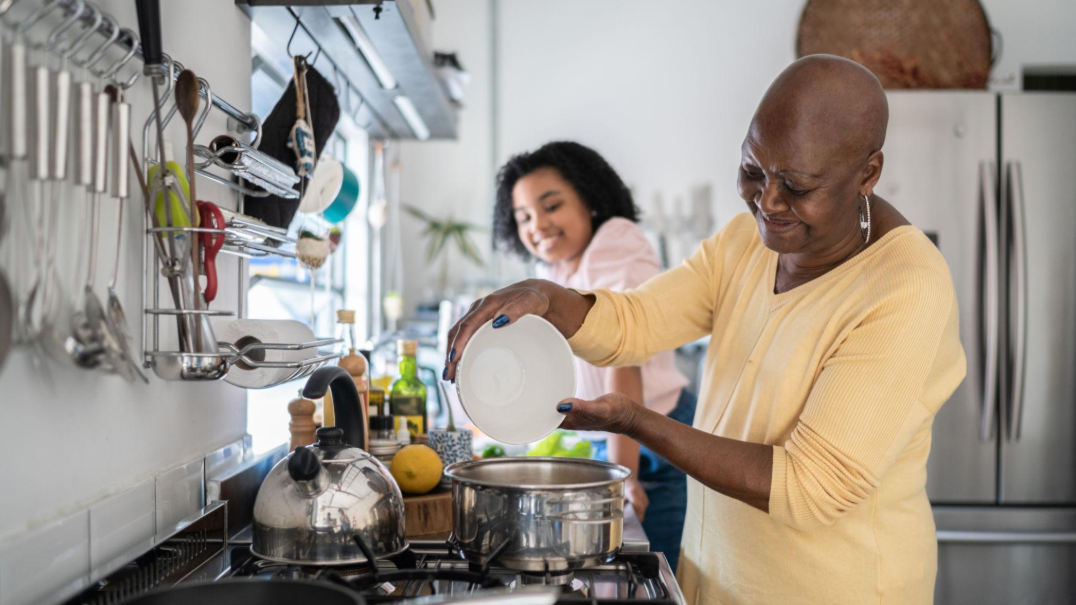
A child standing beside a grandmother might not have been given a written recipe for soup. She watched the pumpkin go into the pot. She saw the scallion cut. She learned how much yam was enough for the number of people coming to dinner. She noticed what happened when the dumplings were too soft.
The lesson was repeated until it became instinct.
That kind of knowledge is difficult to reduce to a page because some of it lives in the senses.
A recipe can say “season to taste.” A cook has to know what that means.
The Jamaican kitchen has always been a place of adaptation
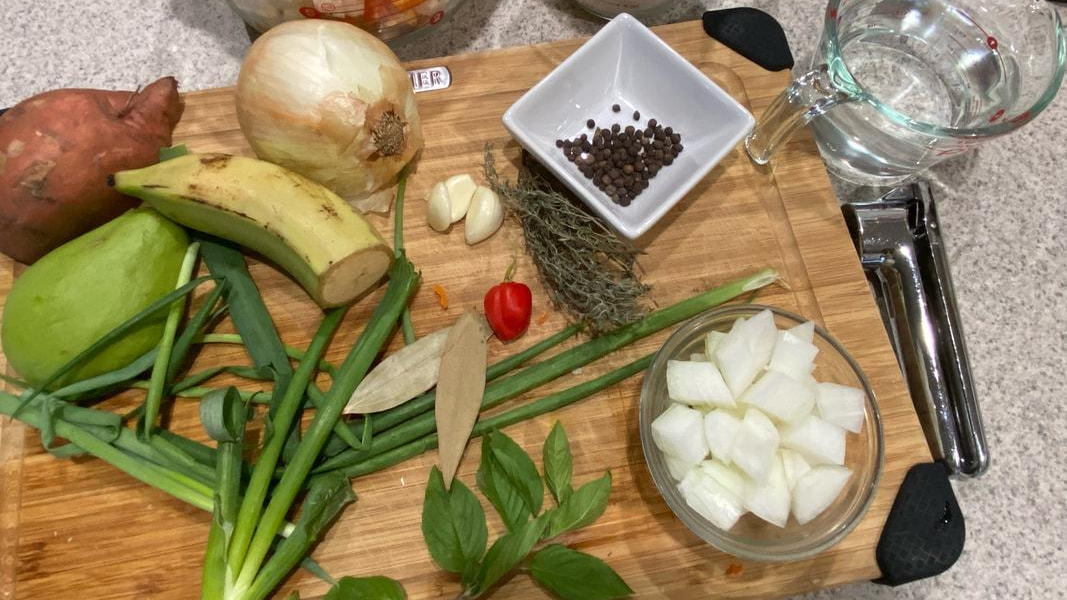
There is another reason Jamaican recipes resist neat measurement: Jamaican food itself is the product of adaptation.
The island’s culinary heritage draws from Taino, African, European, Chinese and Indian influences, among others. Each brought ingredients, techniques and habits that were absorbed into local cooking. The result was not a fixed system but a cuisine capable of changing with what was available.
That history can be seen in the ingredients that now feel inseparable from Jamaican food.
Cassava connects contemporary Jamaican cooking to Taino foodways. African cooking traditions contributed ingredients, methods and the one-pot approach that became part of Jamaican domestic cuisine. Indian migration brought culinary influences including curry and roti. Chinese migration added techniques and ingredients that became part of the island’s repertoire.
A cook working inside that tradition did not necessarily begin with a fixed formula.
She began with what was in the kitchen.
If the pumpkin was large, the soup changed. If the fish was bigger, the seasoning changed. If there were twelve people at the table instead of six, the pot changed.
The cook adjusted.
That ability to adjust is part of the knowledge.
Even the old recipes leave room for judgment
The written record tells an interesting story.
One of the earliest known Jamaican cookbooks is Caroline Sullivan’s The Jamaica Cookery Book, first published in Kingston in 1893. The book contained hundreds of recipes and household instructions, making clear that written Jamaican recipes existed well before the modern cookbook era.
But look closely at historical recipes and the precision familiar to a modern home cook often disappears.
Some instructions rely on quantities that are difficult to reproduce exactly. Others use practical judgments rather than modern timings. A historical mango pickle recipe, for example, gives detailed quantities in some places but also relies on instructions such as waiting until the fruit changes colour and using enough vinegar to cover it.
That is not unusual in older cooking traditions.
The written recipe records part of the knowledge. The cook supplies the rest.
“A little” can mean years of experience
This is where the Jamaican habit of cooking “by eye” is often misunderstood.
It can sound casual, even careless, to someone accustomed to following a recipe exactly. In practice, it can represent a sophisticated form of sensory judgment.
Experienced cooks know what a properly seasoned pot should smell like before it tastes right. They know when onions have cooked enough without needing a timer. They know how a piece of meat should feel when it has been handled enough. They can look at a pot and understand whether it needs more liquid.
None of that knowledge is particularly easy to measure.
A teaspoon cannot tell you whether a particular tomato is unusually acidic. A timer cannot tell you whether a pot has reduced enough. A cup cannot account for the strength of a particular pepper.
The cook does.
That is why two people can follow the same recipe and produce food that tastes completely different.
Sunday dinner is where the knowledge becomes visible
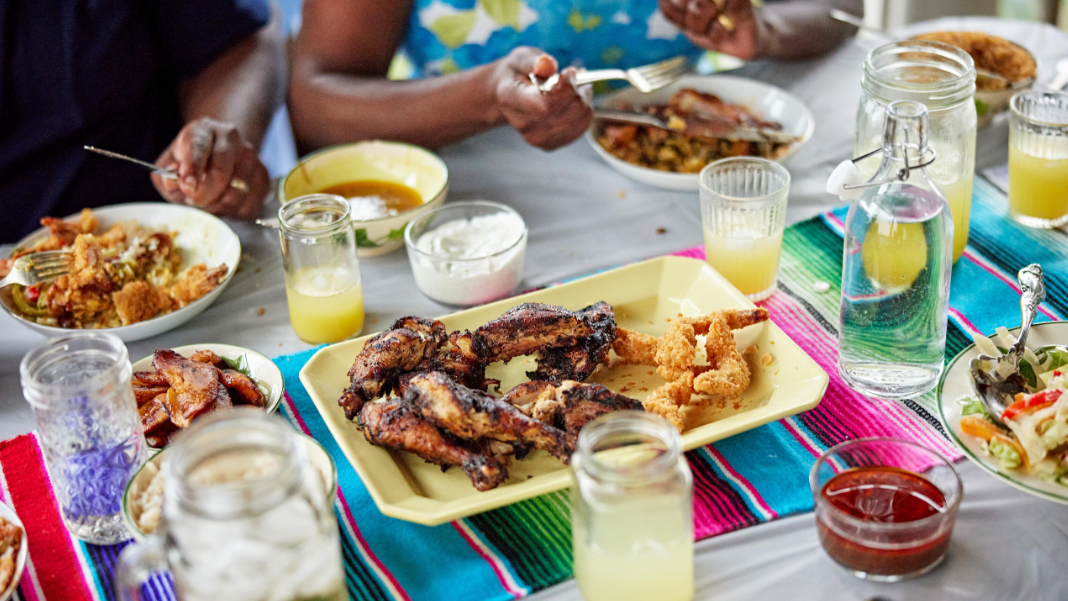
The clearest example may be the Jamaican Sunday table.
Sunday dinner is not one recipe. It is a collection of decisions made across an afternoon.
Rice and peas.
Chicken, beef or fish.
Potato salad.
Fried plantain.
Steamed cabbage.
Macaroni and cheese.
Gravy.
The exact combination changes from household to household.
So does the method.
One family may insist on coconut milk in the rice. Another may use a different proportion of peas. One cook seasons meat the night before. Another does it shortly before cooking. One household wants the gravy thick. Another wants it loose enough to run into the rice.
None of these variations necessarily means one cook has forgotten the “real” recipe.
They are evidence of a living cooking tradition.
The National Library of Jamaica describes food as part of the cultural inheritance shaped by the island’s different communities and migration histories. Its account of Jamaican foodways traces techniques and ingredients through Taino, African, European, Chinese and Indian contributions.
The family kitchen is where those broad histories become personal.
The coal stove, the Dutch pot and the knowledge of heat
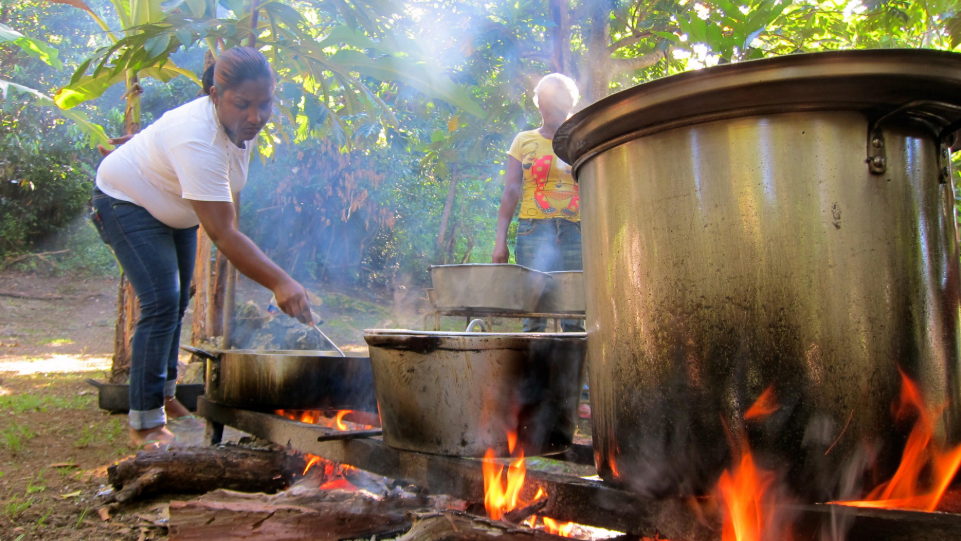
Cooking knowledge is also tied to equipment.
The Dutch pot remains a familiar piece of Jamaican kitchen equipment, while the coal stove, once far more common, still has a place in some Jamaican households. The Jamaica Information Service notes that traditional preparation methods and tools have persisted alongside gas and electric cooking.
That matters because equipment changes how food behaves.
A cook accustomed to a coal stove develops an understanding of heat that does not translate perfectly to a modern electric range. A Dutch pot holds and distributes heat differently from a lightweight saucepan. A cook who has spent decades working with those tools learns their habits.
The recipe alone cannot carry all of that information.
The hand has to learn it.
Oral tradition does not mean the knowledge was never recorded
There is a temptation to romanticise the unwritten recipe as something purely Jamaican, passed unchanged from grandmother to granddaughter.
The reality is more complicated.
Jamaicans have written cookbooks, shared recipes in newspapers, taught cooking classes, documented family dishes and built entire businesses around preserving recipes. The existence of The Jamaica Cookery Book in 1893 alone makes it clear that Jamaican cooking was being documented more than a century ago.
What has persisted alongside the written record is oral transmission.
That is part of a much broader Jamaican tradition of passing knowledge through speech, demonstration and memory. The Jamaica Information Service describes storytelling as an important means through which knowledge and heritage have been transmitted across generations.
Cooking belongs to that same world of learned practice.
A recipe can be written down after the fact. The original learning may still have happened beside a stove.
Why the recipe changes when someone finally writes it down
This is the great frustration for anyone trying to document a family dish.
The cook finally agrees to share the recipe.
Then comes the interrogation.
How much thyme?
“Enough.”
How much browning?
“Until it looks right.”
How long should it cook?
“Until it is done.”
For the person writing the recipe, this is maddening.
For the cook, it can be perfectly precise.
The problem is that the cook is describing a visual, sensory or experiential measurement rather than a numerical one.
“Enough” may mean a quantity learned over years.
“Until it looks right” may refer to a very specific colour.
“Until it is done” may involve the texture of the meat, the thickness of the gravy and the smell coming from the pot.
The cook is not withholding information.
She may simply be speaking a different measurement system.
The recipe is sometimes the person
That may be the deeper reason some Jamaican cooks resist writing everything down.
A dish is rarely just a list of ingredients. It carries the memory of the person who taught it, the kitchen where it was learned and the occasions when it was served.
The same soup can taste different when made by a mother, an aunt or a grandmother because each person has accumulated a different set of decisions.
That is not inconsistency.
It is authorship.
Jamaican cooking traditions have survived precisely because they were flexible enough to move between people, households, ingredients and circumstances. The cuisine has absorbed outside influences without becoming a fixed museum piece.
The handwritten recipe can preserve a dish.
The person preserves the knowledge behind it.
The modern recipe has a different job
Today, there is good reason to write things down.
Recipes allow dishes to travel. They help younger generations recreate food they may have grown up eating. They make it possible for Jamaican cooks in the diaspora to maintain connections with home. They also allow the cuisine to be taught beyond the family kitchen.
Documentation can preserve knowledge that might otherwise disappear.
But a written recipe works best when it acknowledges what cannot be captured in numbers.
It can tell someone how much thyme to start with. It can explain what colour the onions should reach. It can describe the consistency of the gravy. It can say what the meat should feel like when it is ready.
In other words, the strongest Jamaican recipes do not simply replace instinct with measurement.
They teach the reader how to develop the instinct.
That is the difference between following a recipe and learning to cook.
What Jamaican cooking traditions still teach
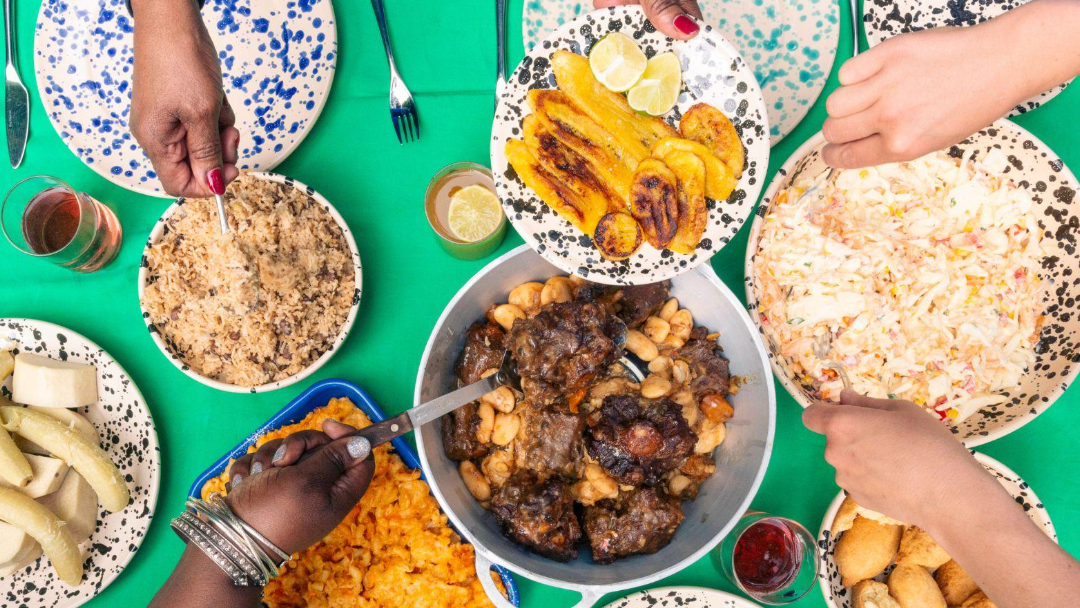
The idea that Jamaica’s best cooks do not write down their recipes is not literally true.
Some do.
Many more have learned to write them down because they understand what is at stake.
But the old habit of cooking without strict measurements reveals something worth preserving.
Jamaican cooking traditions were built around observation, adaptation and memory. The knowledge lived in hands that knew when the pot was ready, eyes that recognised the right colour and noses that could detect when the seasoning had opened up.
The recipe was never only the paper.
It was the person standing over the pot.
And for a cuisine built through generations of watching, listening and doing, that may be the most important ingredient of all.
Frequently Asked Questions
Why are Jamaican recipes often not measured exactly?
Traditional Jamaican cooking has often relied on knowledge acquired through experience, observation, demonstration and oral instruction. Historical accounts of Jamaican cookery note that precise measurements were not always practical or customary.
What are some important Jamaican cooking traditions?
Jamaican cooking traditions include one-pot cooking, jerk preparation, use of a Dutch pot and coal-stove cooking, alongside foodways influenced by Taino, African, European, Chinese and Indian communities.
When was the first Jamaican cookbook published?
One of the earliest known Jamaican cookbooks was Caroline Sullivan’s The Jamaica Cookery Book, published in Kingston in 1893.
Why does Jamaican food vary from household to household?
Jamaican cooking developed through adaptation and the blending of different culinary traditions. Individual households also developed their own methods, proportions and preferences through repeated cooking and family transmission.
Are Jamaican recipes being documented today?
Yes. Jamaican recipes are documented in cookbooks, websites, newspapers, cooking programmes and family archives. Contemporary documentation exists alongside the older tradition of learning through observation and oral instruction.