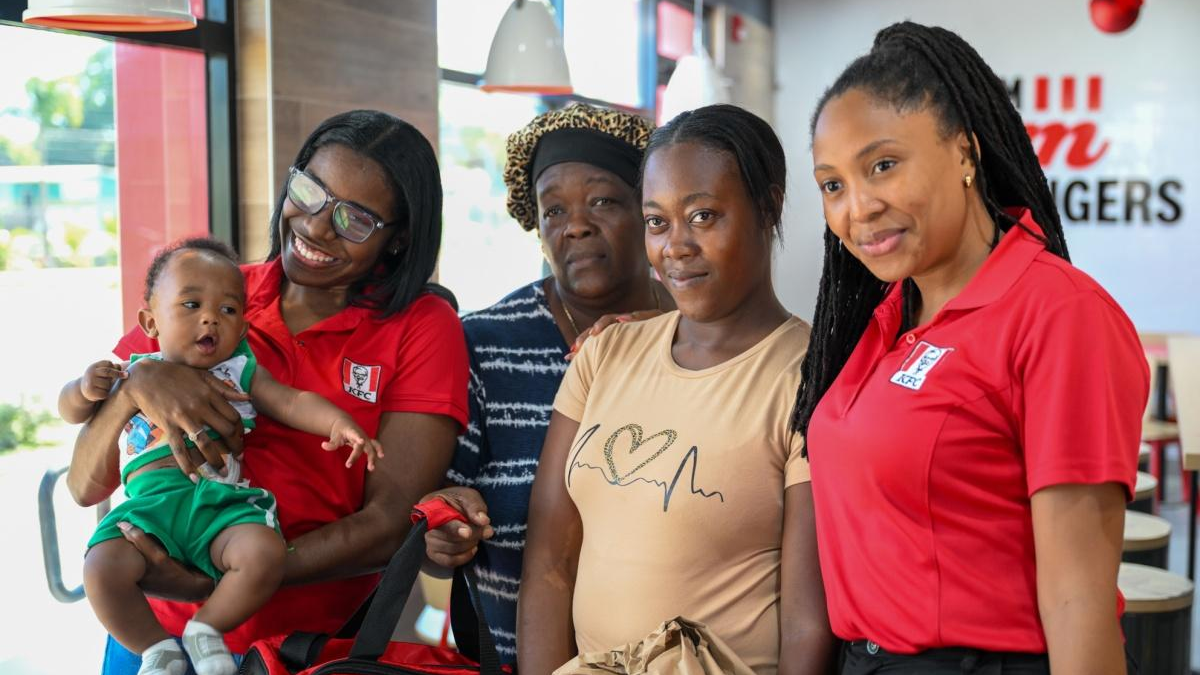
More than a decade after leaving Jamaica, Latoya Cosbey has built a life in Los Angeles with her husband, Chris, and their three sons.
Home, however, was never something she left behind. It lives in the records playing through the house, the meals cooked in the kitchen, and the flights back to the island that have become part of the family’s rhythm.
Latoya moved to the United States in 2014, living first in Florida, then Connecticut, then New York before settling in Los Angeles three years later. She met Chris in 2019. Their relationship began with music.
Chris had spent years building a reggae vinyl collection that now numbers well over a thousand records. When he played her one of his favourite Dennis Brown recordings, Latoya knew there was only one place to take him.
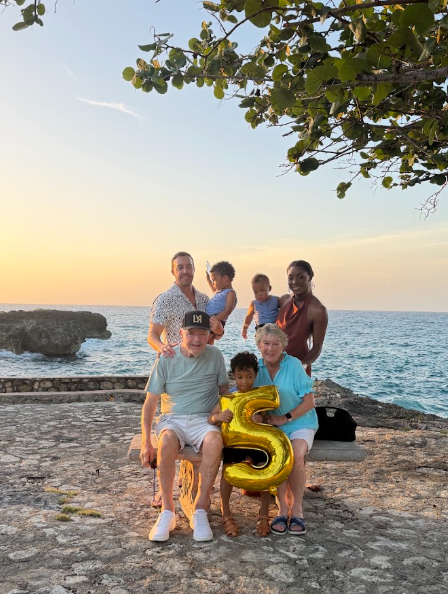
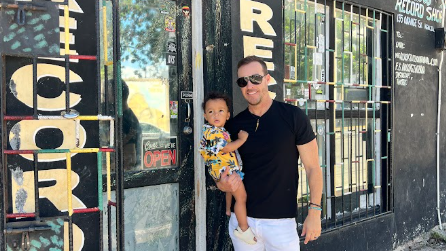
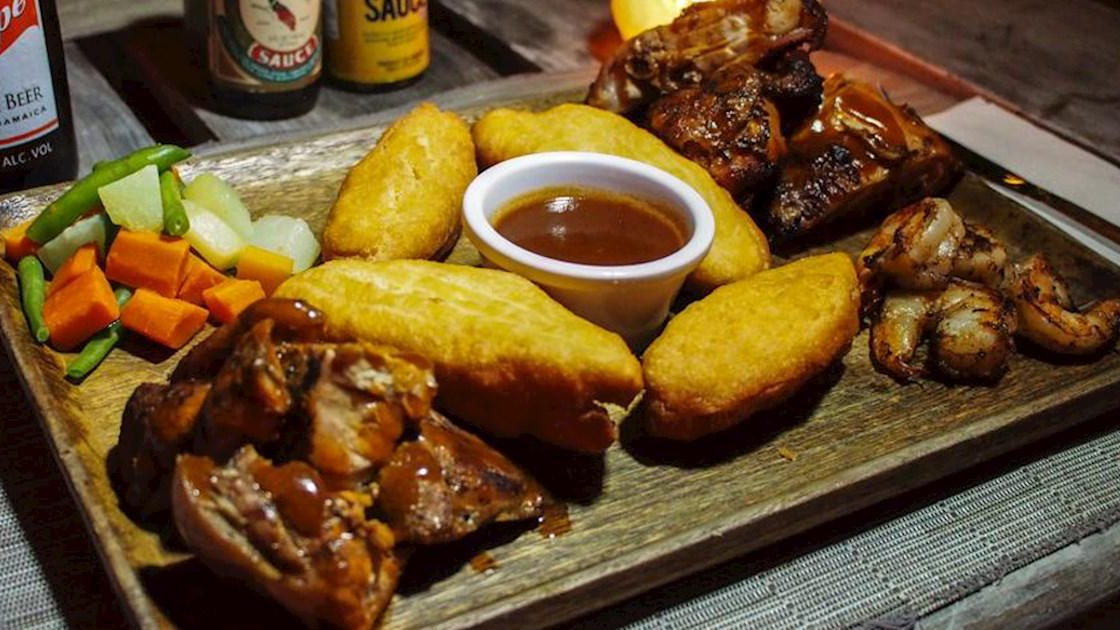
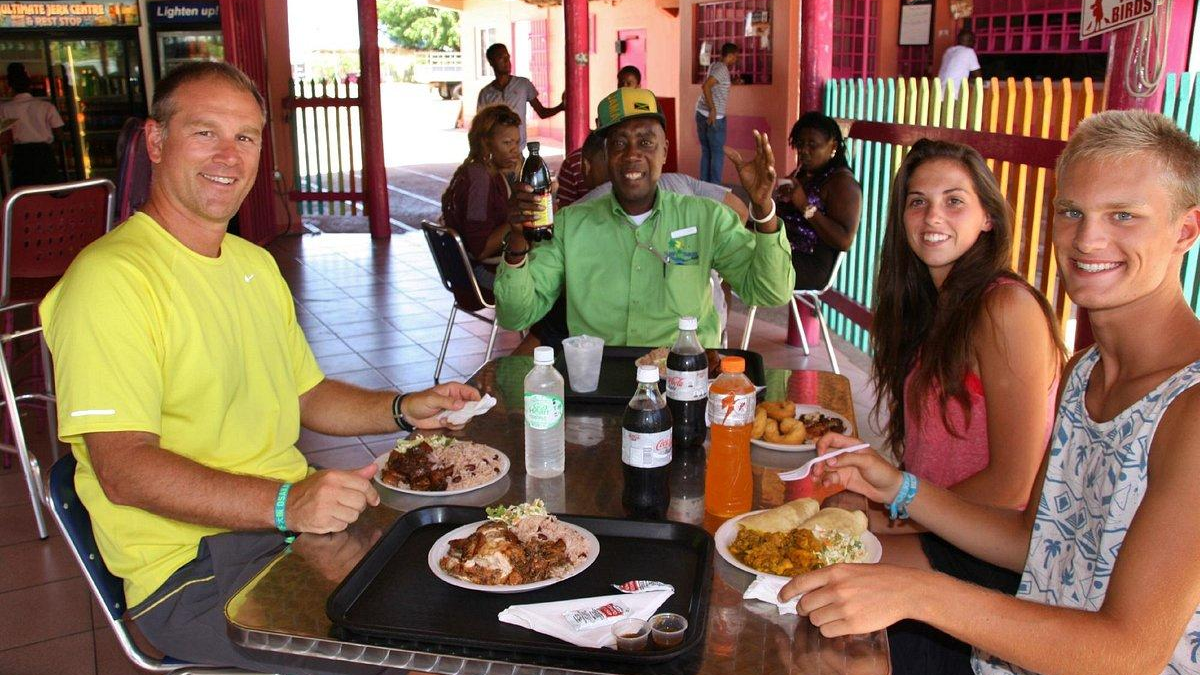
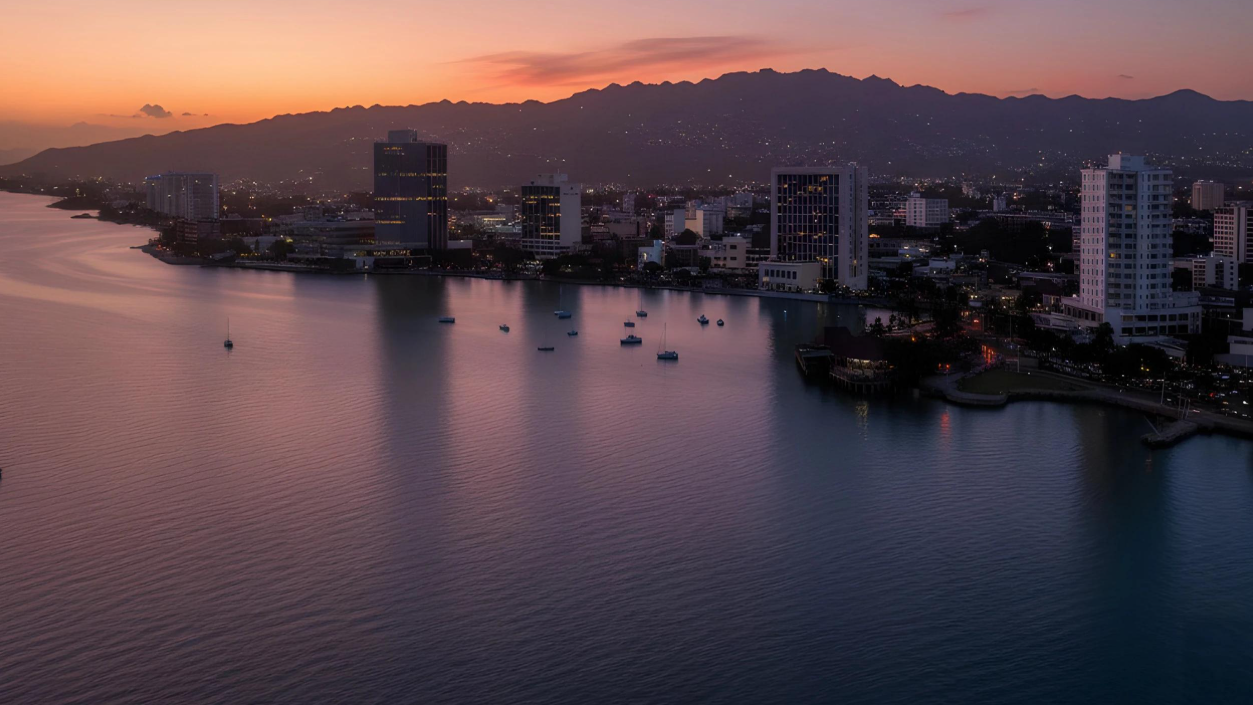
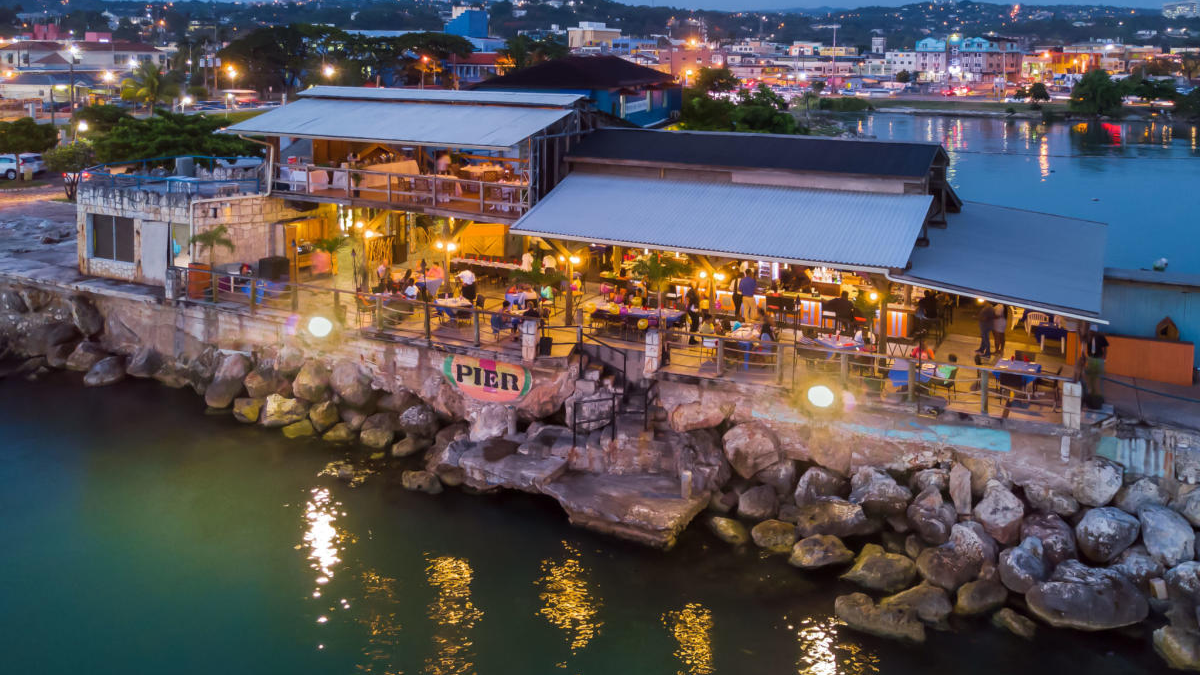
Their first evening was spent at I Love Soca in Kingston. Chris disappeared into the crates at Rockers Record Shop on Orange Street. They lingered over vegan food at Ibo Spice, where conversations with Rastafarian elders stretched far longer than either of them expected. They visited the Bob Marley Museum. Before the trip ended, Chris proposed on the pier at S Hotel in Montego Bay.
By then, Jamaica had already done what Latoya hoped it would. It had helped him understand the place that shaped her.
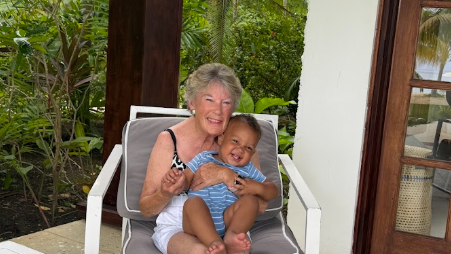
Today, the couple are raising three boys in Los Angeles. Jamaica is not simply part of the family’s history. It remains part of everyday life.
Jamaica still feels central to your life, even after more than a decade abroad. How have you managed to keep that connection so strong?
No matter where I’ve lived, Jamaica has always been home in my heart. I moved to the United States in 2014, but I made it a priority to go back at least twice a year to spend time with my dad and reconnect with the island.
Every trip reminded me where I came from, whether I was relaxing on a beach in Negril, floating down a river, exploring Kingston, or discovering another parish. Those visits kept me grounded.
Now that I have a family of my own, staying connected isn’t just for me anymore. It’s about making sure my children know and love the place that shaped me.
When you brought Chris to Jamaica for the first time, what were the places and experiences you knew he had to see?
Chris had a huge love for Jamaica long before we met, especially through reggae music. He’s collected hundreds of reggae vinyl records over the years, so when I finally brought him home, I wanted him to experience the places that meant so much to him.
One stop at the top of his list was Rockers Record Shop on Orange Street in downtown Kingston. Watching him dig through records in such an iconic place was really special.
From there we walked to Ibo Spice, where he spent time talking with the Rastafarians and learning more about their beliefs, culture and way of life. Those conversations meant just as much to him as visiting the landmarks.
We also visited the Bob Marley Museum , which was another unforgettable experience. He hoped to visit the Peter Tosh Museum too, but we ran out of time. That’s at the top of our list for our next trip.
What made that trip so meaningful for me was seeing Jamaica through Chris’s eyes. Watching him connect so deeply with the music, history, culture and people reminded me just how special home really is.
Your boys are growing up in Los Angeles, but with Jamaica woven into everyday life. What does that actually look like at home?
Jamaica is simply part of everyday life in our house.
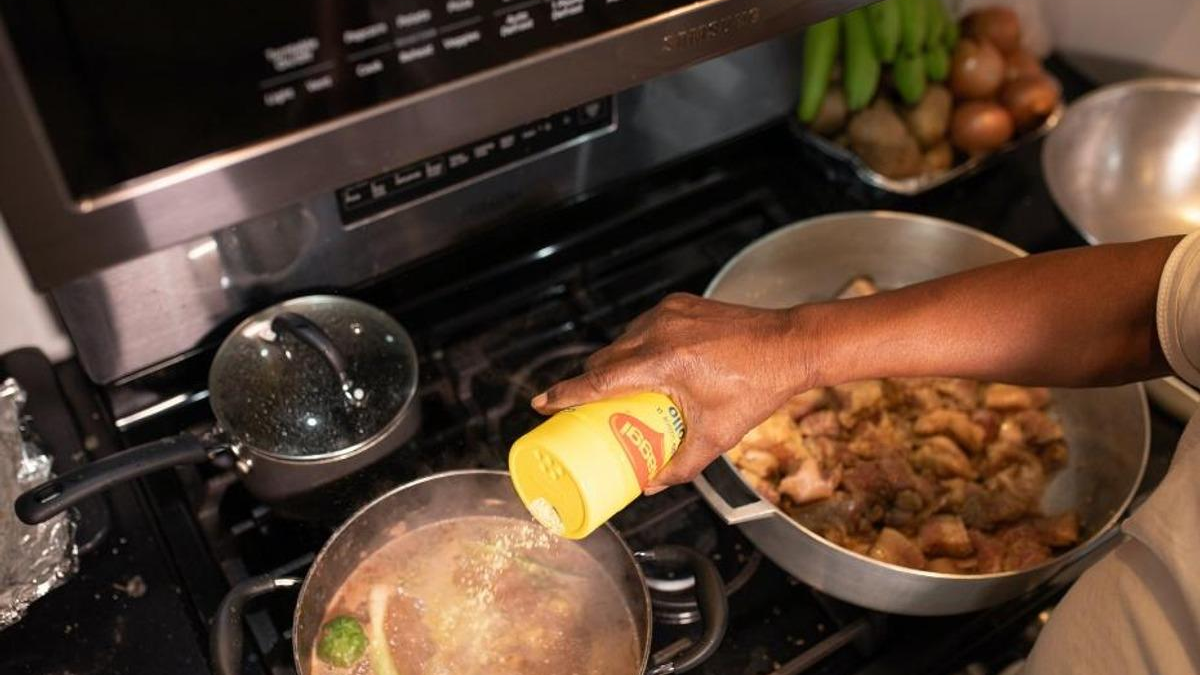
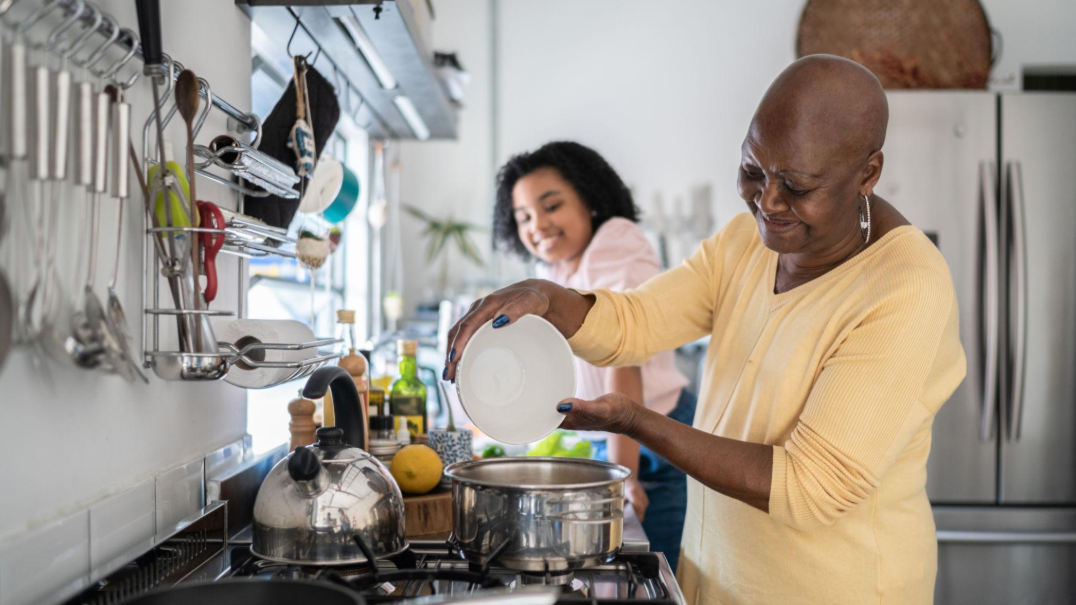
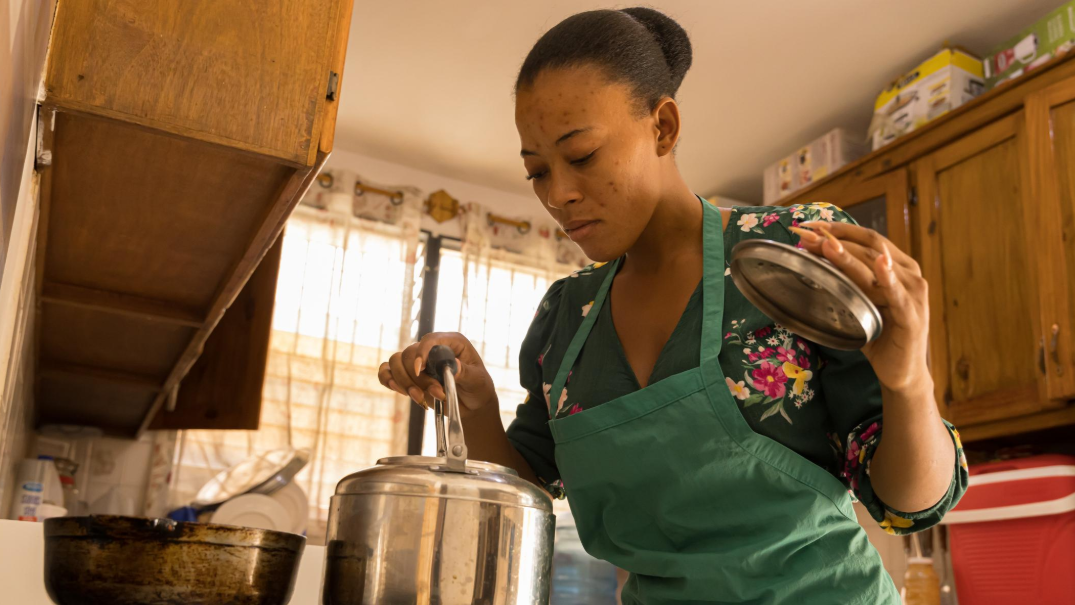
We listen to reggae music around the house, cook Jamaican meals, celebrate our traditions, and talk about Jamaica often. My boys know where Mommy is from, and they proudly tell people they’re Jamaican too.
We read books about Jamaica, play Jamaican music while we’re cleaning or cooking, and I make sure they hear stories about my childhood growing up there. Most importantly, we take them back to Jamaica so they can build memories with family instead of only hearing stories about home.
If another Jamaican family living overseas asked how to keep their children connected to home, what’s the first piece of advice you’d give them?
Take them home as often as you can.
There’s only so much you can teach through stories or videos. Let them feel the warmth of the people, hear the accents, eat the food, swim in the rivers, and spend time with grandparents, cousins and relatives.
Those experiences create a connection that lasts a lifetime. Culture isn’t something you simply tell your children about. It’s something they need to experience.
What’s one Jamaican tradition your children have embraced that you hope they’ll pass on to their own families one day?
I hope they always value family the way we do in Jamaica.
Growing up, family wasn’t something reserved for holidays. It was part of everyday life. We looked out for each other, gathered together often, and everyone helped raise the children.
I want my boys to carry that same sense of community and togetherness into their own families one day. That’s one of the greatest gifts Jamaica gave me.
What’s one place in Jamaica you’ll never stop bringing people to, and why?
Every parish has something special, but if I had to choose one place, it would be Negril
There’s just something about Seven Mile Beach, the sunsets, and the laid-back atmosphere that makes people instantly fall in love with Jamaica.
At the same time, I always encourage people to go beyond the beaches. Visit the rivers, explore the Blue Mountains, spend time in Kingston and experience the culture.
Jamaica is much more than a vacation destination. It’s a place built on history, community and people who make you feel welcome.
When people finish watching your content, what do you hope they understand about being Jamaican abroad?
I hope people understand that no matter where life takes you, your roots can remain part of who you are.
Being Jamaican isn’t just about where I was born. It’s something I carry with me every day.
I also hope people see the richness of our culture beyond the stereotypes. Jamaica is filled with kindness, resilience, creativity, incredible food, music and people who make you feel like family.
If my content encourages someone to visit the island, reconnect with their own heritage, or simply appreciate Jamaican culture a little more, then I’ve accomplished what I set out to do.
Jamaican cooking traditions were built around judgment, memory and repetition long before recipes came with measuring cups.
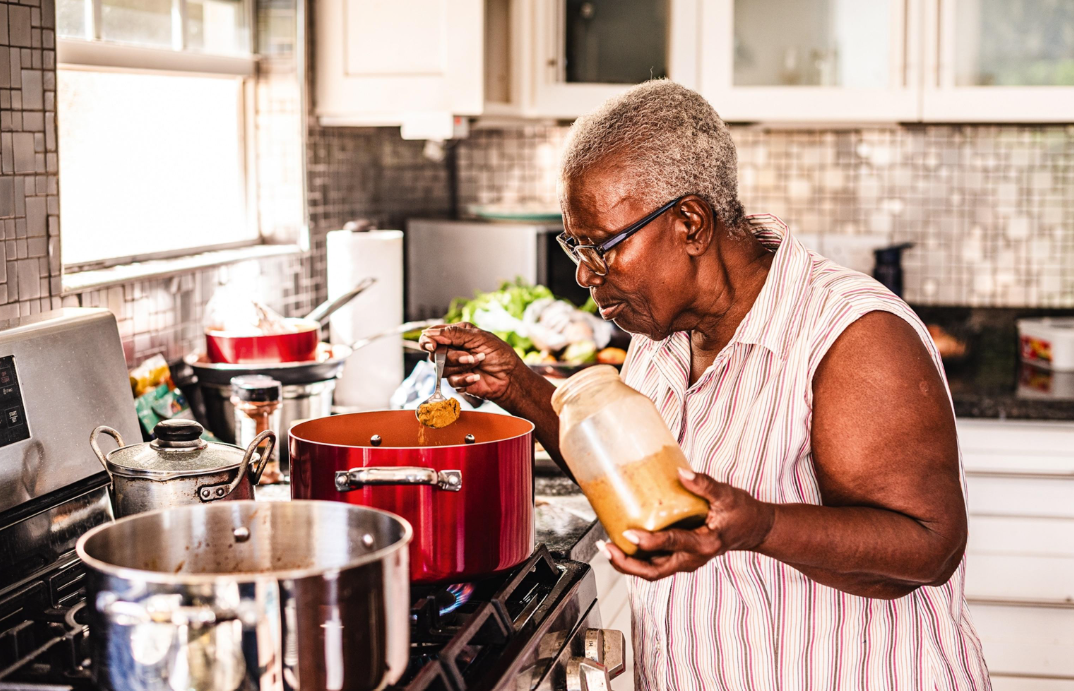
Ask a Jamaican cook for the recipe behind a pot of rice and peas, a Sunday curry or a brown stew that tastes exactly the way it should, and the answer may not arrive in cups and tablespoons.
A handful of this.
A little more of that.
Season it until it tastes right.
Let it cook until it is ready.
For generations, that was not a failure to document a recipe. It was the recipe.
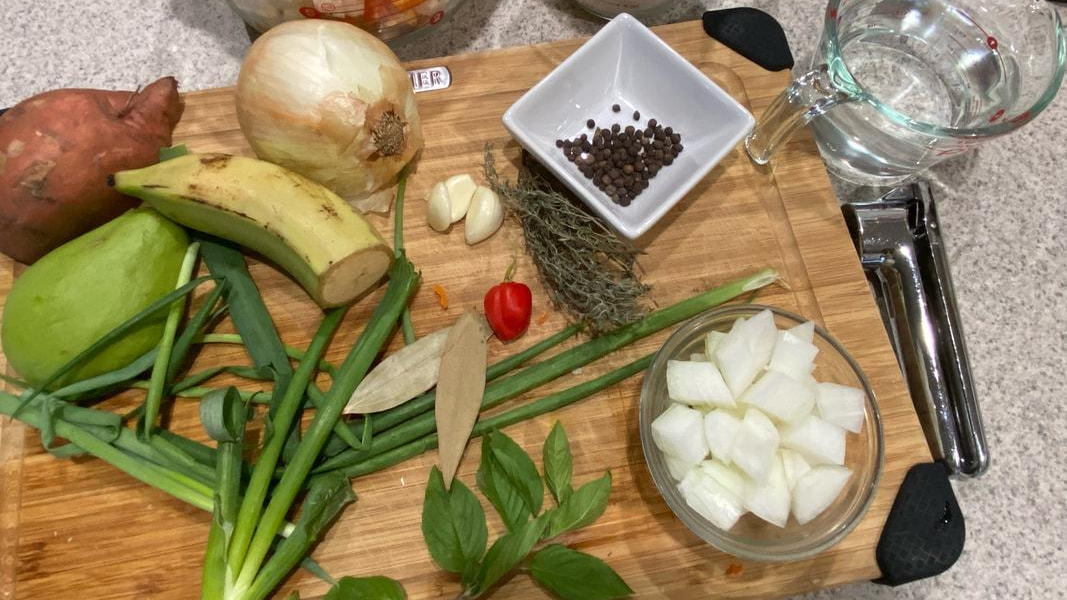
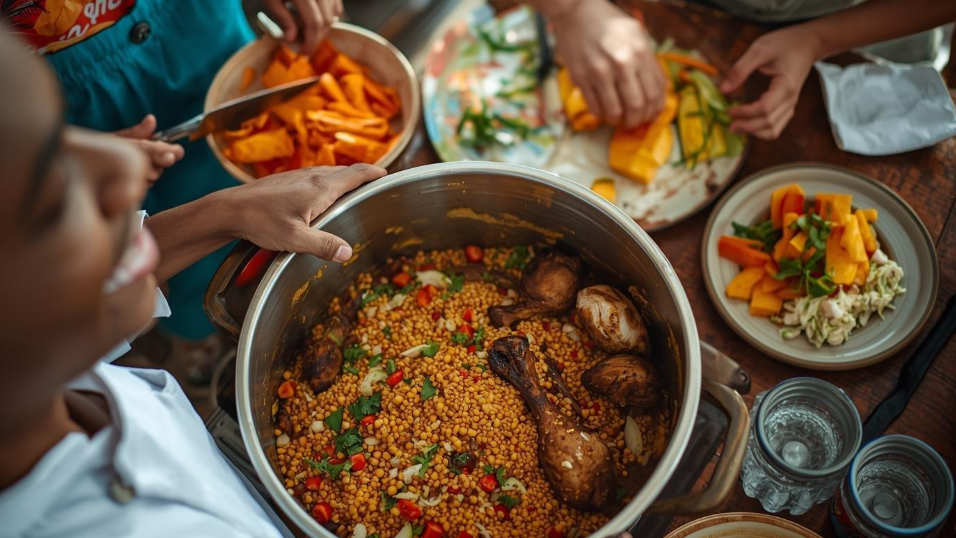
Jamaican cooking traditions developed through knowledge that was learned by watching, listening and doing. A cook learned how much thyme belonged in a pot by seeing it added. She learned when the oil was hot enough by watching it move. She learned when the meat had taken enough seasoning by touch, smell and experience.
The measurements existed. They simply were not always written down.
Jamaican cooking traditions were learned in the kitchen
The distinction matters because Jamaican food did not emerge from a cookbook culture.
Barry Higman, in Jamaican Food: History, Biology, Culture, describes Jamaican cooks’ knowledge as rooted in experience, demonstration, observation and listening to lore. Precise measurements of weight, cooking time and temperature were historically difficult to maintain, and dishes carrying the same name could vary in both ingredients and taste.
That makes the kitchen less like a place where instructions are followed and more like a place where knowledge is accumulated.
A child standing beside a grandmother might not have been given a written recipe for soup. She watched the pumpkin go into the pot. She saw the scallion cut. She learned how much yam was enough for the number of people coming to dinner. She noticed what happened when the dumplings were too soft.
The lesson was repeated until it became instinct.
That kind of knowledge is difficult to reduce to a page because some of it lives in the senses.
A recipe can say “season to taste.” A cook has to know what that means.
The Jamaican kitchen has always been a place of adaptation
There is another reason Jamaican recipes resist neat measurement: Jamaican food itself is the product of adaptation.
The island’s culinary heritage draws from Taino, African, European, Chinese and Indian influences, among others. Each brought ingredients, techniques and habits that were absorbed into local cooking. The result was not a fixed system but a cuisine capable of changing with what was available.
That history can be seen in the ingredients that now feel inseparable from Jamaican food.
Cassava connects contemporary Jamaican cooking to Taino foodways. African cooking traditions contributed ingredients, methods and the one-pot approach that became part of Jamaican domestic cuisine. Indian migration brought culinary influences including curry and roti. Chinese migration added techniques and ingredients that became part of the island’s repertoire.
A cook working inside that tradition did not necessarily begin with a fixed formula.
She began with what was in the kitchen.
If the pumpkin was large, the soup changed. If the fish was bigger, the seasoning changed. If there were twelve people at the table instead of six, the pot changed.
The cook adjusted.
That ability to adjust is part of the knowledge.
Even the old recipes leave room for judgment
The written record tells an interesting story.
One of the earliest known Jamaican cookbooks is Caroline Sullivan’s The Jamaica Cookery Book, first published in Kingston in 1893. The book contained hundreds of recipes and household instructions, making clear that written Jamaican recipes existed well before the modern cookbook era.
But look closely at historical recipes and the precision familiar to a modern home cook often disappears.
Some instructions rely on quantities that are difficult to reproduce exactly. Others use practical judgments rather than modern timings. A historical mango pickle recipe, for example, gives detailed quantities in some places but also relies on instructions such as waiting until the fruit changes colour and using enough vinegar to cover it.
That is not unusual in older cooking traditions.
The written recipe records part of the knowledge. The cook supplies the rest.
“A little” can mean years of experience
This is where the Jamaican habit of cooking “by eye” is often misunderstood.
It can sound casual, even careless, to someone accustomed to following a recipe exactly. In practice, it can represent a sophisticated form of sensory judgment.
Experienced cooks know what a properly seasoned pot should smell like before it tastes right. They know when onions have cooked enough without needing a timer. They know how a piece of meat should feel when it has been handled enough. They can look at a pot and understand whether it needs more liquid.
None of that knowledge is particularly easy to measure.
A teaspoon cannot tell you whether a particular tomato is unusually acidic. A timer cannot tell you whether a pot has reduced enough. A cup cannot account for the strength of a particular pepper.
The cook does.
That is why two people can follow the same recipe and produce food that tastes completely different.
Sunday dinner is where the knowledge becomes visible
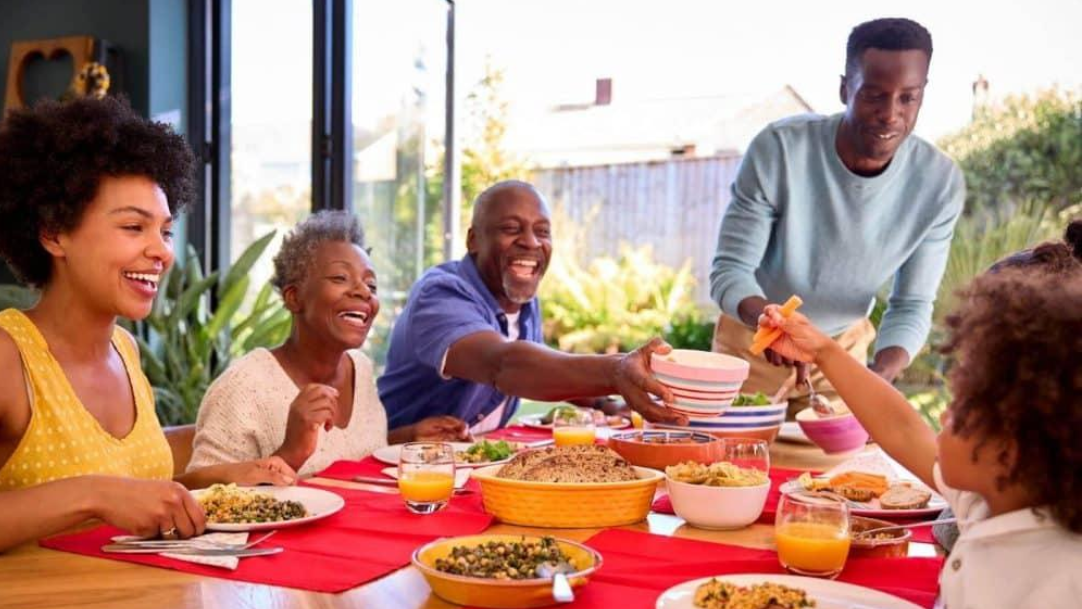
The clearest example may be the Jamaican Sunday table.
Sunday dinner is not one recipe. It is a collection of decisions made across an afternoon.
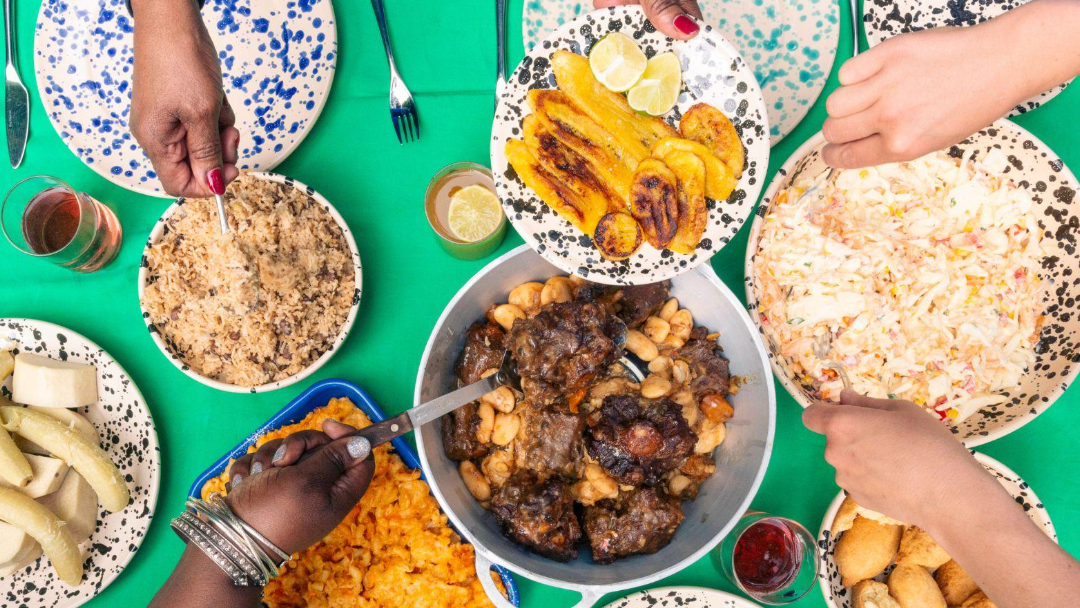
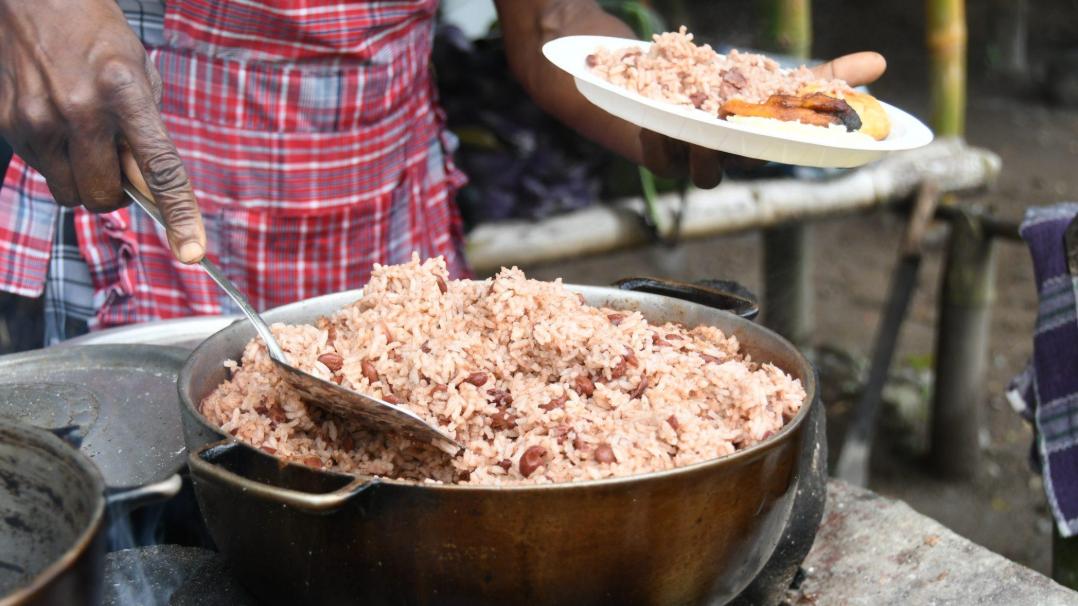
Rice and peas.
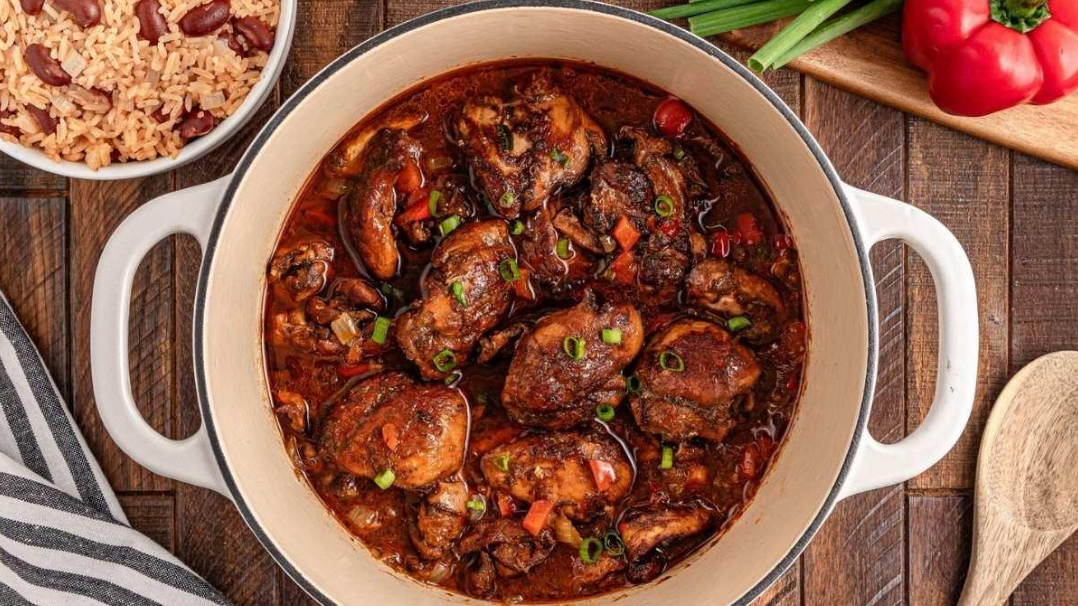
Chicken, beef or fish.
Potato salad.
Fried plantain.
Steamed cabbage.
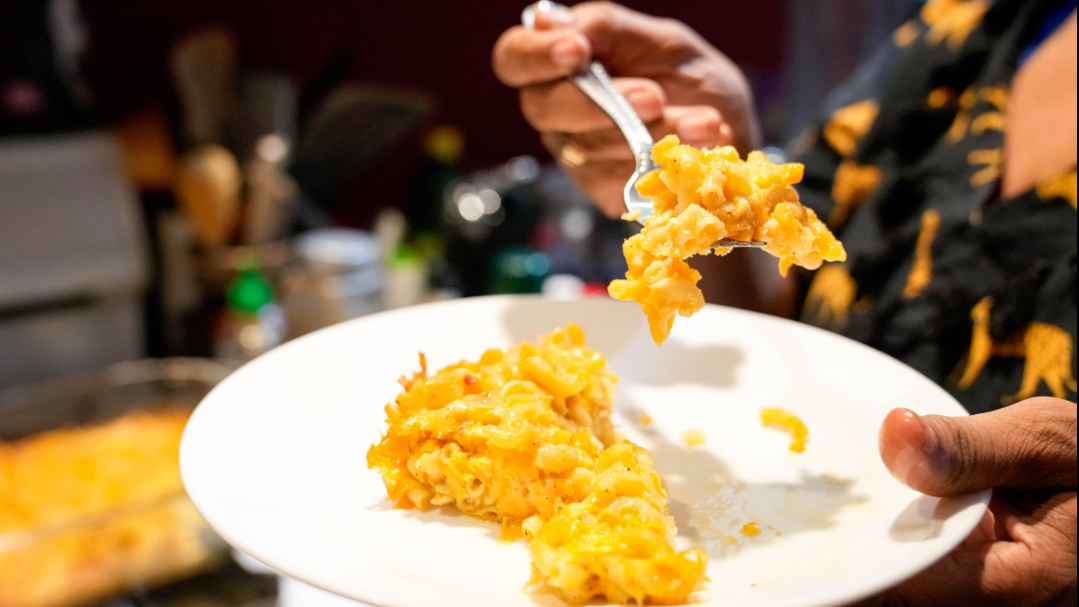
Macaroni and cheese.
Gravy.
The exact combination changes from household to household.
So does the method.
One family may insist on coconut milk in the rice. Another may use a different proportion of peas. One cook seasons meat the night before. Another does it shortly before cooking. One household wants the gravy thick. Another wants it loose enough to run into the rice.
None of these variations necessarily means one cook has forgotten the “real” recipe.
They are evidence of a living cooking tradition.
The National Library of Jamaica describes food as part of the cultural inheritance shaped by the island’s different communities and migration histories. Its account of Jamaican foodways traces techniques and ingredients through Taino, African, European, Chinese and Indian contributions.
The family kitchen is where those broad histories become personal.
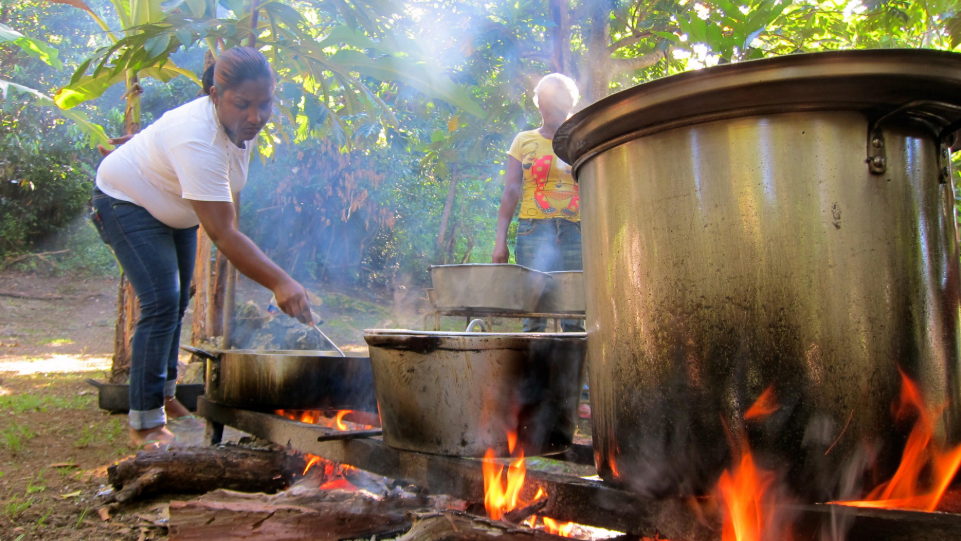
The coal stove, the Dutch pot and the knowledge of heat
Cooking knowledge is also tied to equipment.
The Dutch pot remains a familiar piece of Jamaican kitchen equipment, while the coal stove, once far more common, still has a place in some Jamaican households. The Jamaica Information Service notes that traditional preparation methods and tools have persisted alongside gas and electric cooking.
That matters because equipment changes how food behaves.
A cook accustomed to a coal stove develops an understanding of heat that does not translate perfectly to a modern electric range. A Dutch pot holds and distributes heat differently from a lightweight saucepan. A cook who has spent decades working with those tools learns their habits.
The recipe alone cannot carry all of that information.
The hand has to learn it.
Oral tradition does not mean the knowledge was never recorded
There is a temptation to romanticise the unwritten recipe as something purely Jamaican, passed unchanged from grandmother to granddaughter.
The reality is more complicated.
Jamaicans have written cookbooks, shared recipes in newspapers, taught cooking classes, documented family dishes and built entire businesses around preserving recipes. The existence of The Jamaica Cookery Book in 1893 alone makes it clear that Jamaican cooking was being documented more than a century ago.
What has persisted alongside the written record is oral transmission.
That is part of a much broader Jamaican tradition of passing knowledge through speech, demonstration and memory. The Jamaica Information Service describes storytelling as an important means through which knowledge and heritage have been transmitted across generations.
Cooking belongs to that same world of learned practice.
A recipe can be written down after the fact. The original learning may still have happened beside a stove.
Why the recipe changes when someone finally writes it down
This is the great frustration for anyone trying to document a family dish.
The cook finally agrees to share the recipe.
Then comes the interrogation.
How much thyme?
“Enough.”
How much browning?
“Until it looks right.”
How long should it cook?
“Until it is done.”
For the person writing the recipe, this is maddening.
For the cook, it can be perfectly precise.
The problem is that the cook is describing a visual, sensory or experiential measurement rather than a numerical one.
“Enough” may mean a quantity learned over years.
“Until it looks right” may refer to a very specific colour.
“Until it is done” may involve the texture of the meat, the thickness of the gravy and the smell coming from the pot.
The cook is not withholding information.
She may simply be speaking a different measurement system.
The recipe is sometimes the person
That may be the deeper reason some Jamaican cooks resist writing everything down.
A dish is rarely just a list of ingredients. It carries the memory of the person who taught it, the kitchen where it was learned and the occasions when it was served.
The same soup can taste different when made by a mother, an aunt or a grandmother because each person has accumulated a different set of decisions.
That is not inconsistency.
It is authorship.
Jamaican cooking traditions have survived precisely because they were flexible enough to move between people, households, ingredients and circumstances. The cuisine has absorbed outside influences without becoming a fixed museum piece.
The handwritten recipe can preserve a dish.
The person preserves the knowledge behind it.
The modern recipe has a different job
Today, there is good reason to write things down.
Recipes allow dishes to travel. They help younger generations recreate food they may have grown up eating. They make it possible for Jamaican cooks in the diaspora to maintain connections with home. They also allow the cuisine to be taught beyond the family kitchen.
Documentation can preserve knowledge that might otherwise disappear.
But a written recipe works best when it acknowledges what cannot be captured in numbers.
It can tell someone how much thyme to start with. It can explain what colour the onions should reach. It can describe the consistency of the gravy. It can say what the meat should feel like when it is ready.
In other words, the strongest Jamaican recipes do not simply replace instinct with measurement.
They teach the reader how to develop the instinct.
That is the difference between following a recipe and learning to cook.
What Jamaican cooking traditions still teach
The idea that Jamaica’s best cooks do not write down their recipes is not literally true.
Some do.
Many more have learned to write them down because they understand what is at stake.
But the old habit of cooking without strict measurements reveals something worth preserving.
Jamaican cooking traditions were built around observation, adaptation and memory. The knowledge lived in hands that knew when the pot was ready, eyes that recognised the right colour and noses that could detect when the seasoning had opened up.
The recipe was never only the paper.
It was the person standing over the pot.
And for a cuisine built through generations of watching, listening and doing, that may be the most important ingredient of all.
Frequently Asked Questions
Why are Jamaican recipes often not measured exactly?
Traditional Jamaican cooking has often relied on knowledge acquired through experience, observation, demonstration and oral instruction. Historical accounts of Jamaican cookery note that precise measurements were not always practical or customary.
What are some important Jamaican cooking traditions?
Jamaican cooking traditions include one-pot cooking, jerk preparation, use of a Dutch pot and coal-stove cooking, alongside foodways influenced by Taino, African, European, Chinese and Indian communities.
When was the first Jamaican cookbook published?
One of the earliest known Jamaican cookbooks was Caroline Sullivan’s The Jamaica Cookery Book, published in Kingston in 1893.
Why does Jamaican food vary from household to household?
Jamaican cooking developed through adaptation and the blending of different culinary traditions. Individual households also developed their own methods, proportions and preferences through repeated cooking and family transmission.
Are Jamaican recipes being documented today?
Yes. Jamaican recipes are documented in cookbooks, websites, newspapers, cooking programmes and family archives. Contemporary documentation exists alongside the older tradition of learning through observation and oral instruction.
Jamaican Sunday dinner is less a fixed menu than a weekly negotiation over what belongs on the table, who makes it properly and whether anybody else has the right answer.
By Sunday morning, the argument may already have started.
Rice and peas or plain rice? Fried chicken or brown stew? Curry goat if there are enough people to eat it? And, perhaps most seriously, who is responsible for the macaroni and cheese?
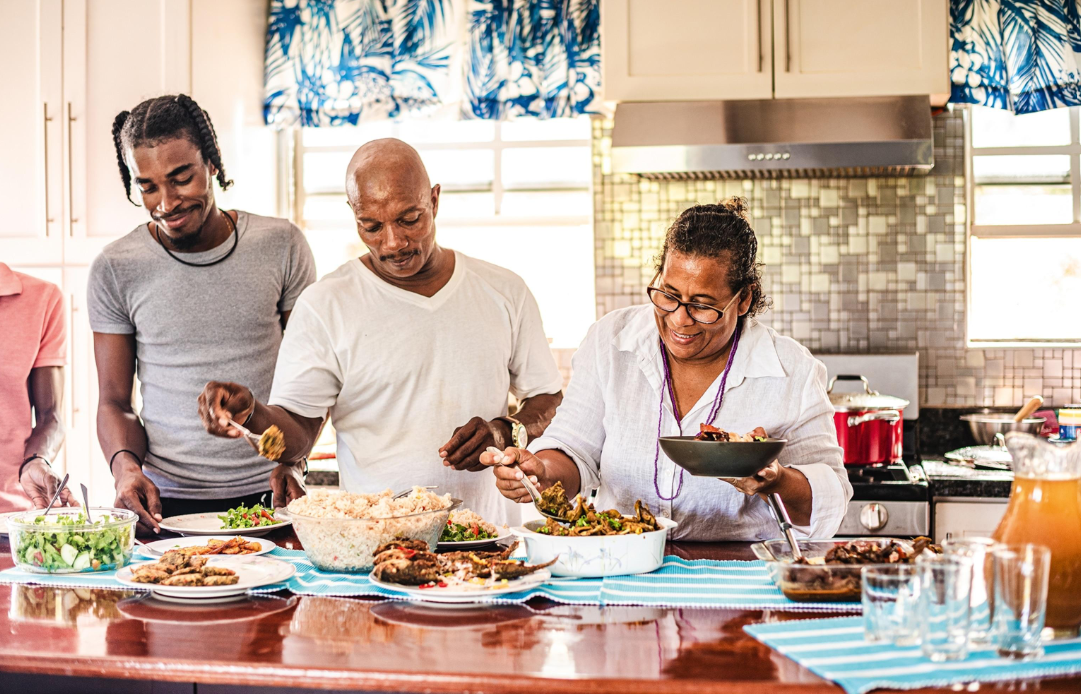
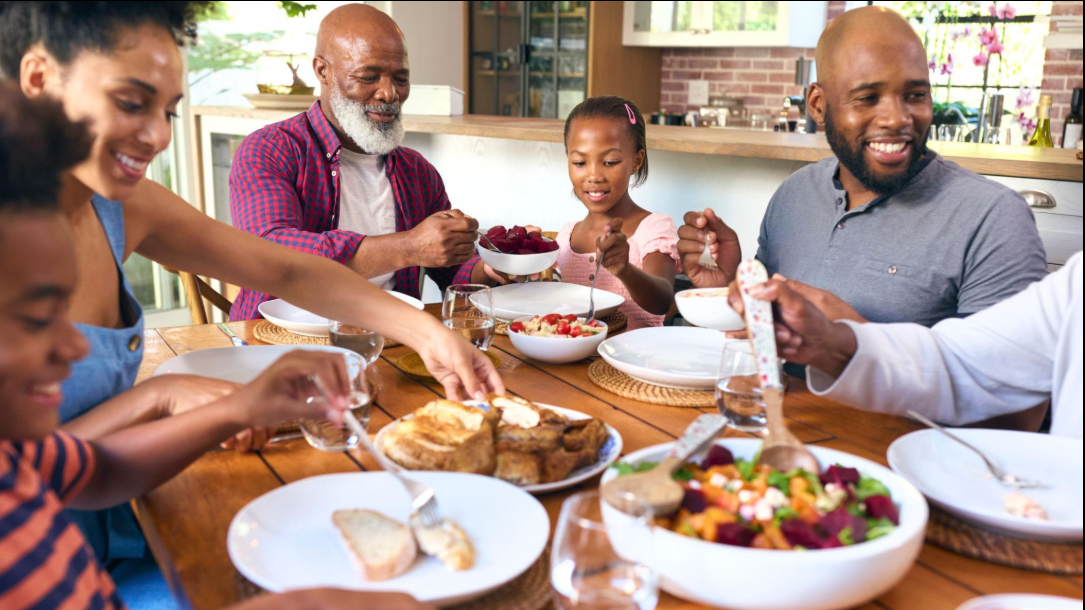
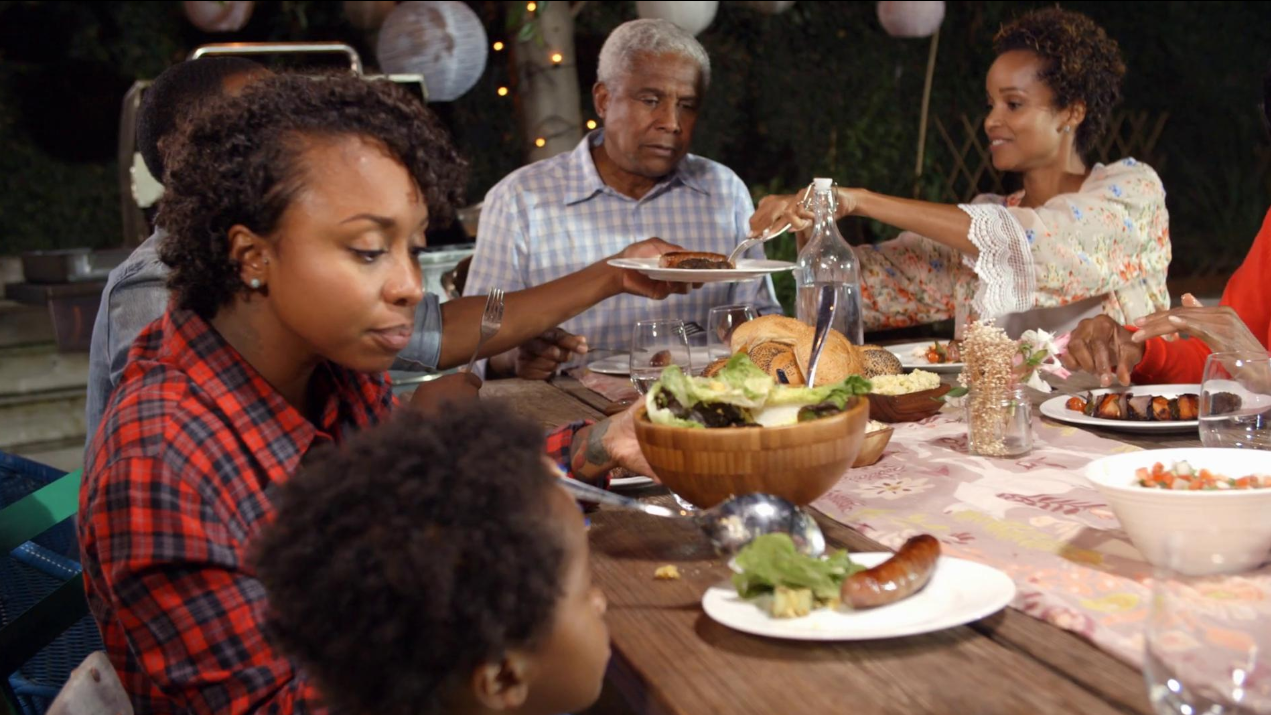
The questions are familiar because Sunday dinner in Jamaica has never been only about food. It is a weekly ritual built around preparation, family, memory and the particular authority of the person standing over the pot.
There is no single Sunday dinner that every Jamaican household prepares. There is something more interesting instead: a shared idea of what Sunday dinner is supposed to feel like, expressed differently from kitchen to kitchen.
That is where the arguments begin.
Jamaican Sunday dinner is a ritual, not a recipe
The meal traditionally sits at the end of a particular kind of Sunday. Church. Family. A slower afternoon. Food prepared early enough to be ready when everyone gets home.
In earlier generations, Sunday was a quieter day commercially, with shops often keeping shorter hours and households organizing the day around church and a home-cooked meal. The meal itself could be substantial without being elaborate: rice and peas, chicken, vegetables, plantain, and perhaps another meat if the household had the means and the appetite.
In rural Jamaica and in parts of Kingston, raising chickens for household use was common in earlier decades, with the Sunday bird prepared fried, curried or as brown stew depending on the family.
The details have changed. The ritual has been harder to dislodge.
There is no official Sunday dinner
This is where the family argument gets interesting.
Ask ten Jamaicans what belongs on a Sunday dinner plate and there will probably be considerable agreement about the general shape of the meal, followed quickly by disagreement about everything else.
Rice and peas is a strong contender. So is chicken. After that, the boundaries become less reliable.
The familiar spread often centers on rice and peas, chicken and a plantain side, with some households turning Sunday into a “two-meat” occasion with curry goat, oxtail or another meat added to the table.
Neither version is the definitive one. That is the point. The Jamaican Sunday dinner changes with parish, household, generation, budget and whoever happens to be cooking.
Who makes the rice and peas?
Every family has somebody who believes this question has already been settled.
Rice and peas is one of the dishes that exposes the difference between a recipe and a tradition.
The argument might be about the peas. Kidney beans or gungo peas? It might be about the liquid. Coconut milk or no coconut milk? It might be about the seasoning. Scallion. Thyme. Pimento. Garlic. Pepper. Or it might simply be about texture. Some cooks want the grains separate. Others prefer a softer pot with the seasoning fully absorbed.
The disagreement can sound absurd to anyone outside the family. Inside it, the stakes are perfectly clear. The rice is being judged against memory. It has to taste like Sunday.
Then comes the question of the chicken
Chicken is not one dish in a Jamaican Sunday kitchen. It is a decision.
Fried chicken has its defenders. Brown stew has its own constituency. Curry chicken enters the conversation with the confidence of something that knows it has been invited before.
The choice can depend on time, ingredients, family preference and the person cooking. Fried, brown-stewed and curried chicken have all long been established household options, particularly when chicken was raised or bought specifically for the Sunday meal.
There is also the question of preparation. Was the chicken seasoned the night before? Was the gravy made separately? Should the pieces be browned first? How much browning is enough?
These are not questions that a family necessarily settles once. They are inherited arguments.
The second meat changes the entire afternoon
There are Sundays when chicken is enough. Then there are Sundays when somebody announces that there is also curry goat. Or oxtail.
The phrase “two-meat Sunday” captures the particular escalation. A regular Sunday meal becomes an occasion.
It is not necessarily about extravagance. Sometimes it is about having enough food for the people who are expected to arrive. And in Jamaica, the number of people expected at Sunday dinner has always been somewhat difficult to predict. A household of five can become twelve without anyone having formally issued an invitation.
The table expands faster than the recipe
This may be one of the defining features of Jamaican Sunday dinner. Food has to stretch.
There is a familiar shape to this story in almost every Jamaican family: one pot of rice and peas, one pot of chicken, prepared before church, somehow feeding whoever turns up after. That ability to feed whoever arrives is its own form of cooking knowledge.
The cook looks at the pot and calculates. More rice? Another side? Slice more plantain? Make some gravy? There is rarely a spreadsheet. There is simply the understanding that Sunday dinner is not meant to end with one person being left without a plate.
Then someone criticises the gravy
This is where the friendly conflict becomes personal.
Too thick. Too thin. Too dark. Not enough seasoning. Too much seasoning. The cook says it is fine. Someone else says it needs another five minutes. Nobody asked for the opinion. The opinion arrives anyway.
This is not unique to Jamaica, of course. Families everywhere argue about food. But the Jamaican Sunday dinner gives those arguments a weekly stage.
Because the meal is repeated so often, everyone has a reference point. Everyone remembers how Auntie’s chicken tasted. Everyone knows which grandmother made the best rice. Everyone has eaten a version of macaroni and cheese that they consider correct. Memory becomes the judge.
Macaroni and cheese has entered the family court
Macaroni and cheese is not necessarily the oldest element of the Jamaican Sunday table, but it has become firmly associated with the modern spread in many households.
And it is an especially dangerous dish to get wrong. Too dry. Too soft. Not cheesy enough. Too much cheese. The wrong cheese. The wrong topping. The family member who normally cooks the dish is suddenly unavailable, and someone else volunteers.
This is how Sunday dinner produces its most consequential disputes. Not because anyone dislikes the food. Because everyone thinks they know how it should be made.
The vegetables are not innocent either
Cabbage, callaloo, carrots, peas, mixed vegetables and other sides can occupy the same territory.
The argument is rarely about whether vegetables belong. It is about how they should be prepared. Steamed or sautéed? Soft or still firm? Seasoned heavily or left clean?
And then there is potato salad. Some families would consider it essential. Others can take it or leave it. That difference alone can tell you something about the household.
The plantain argument is quieter
Plantain tends to inspire less philosophical debate, but even here there are choices. Green or ripe? Fried or boiled? How dark should the edges be? How sweet is too sweet?
The plate may look settled to an outsider. It is not. The Jamaican Sunday dinner is a collection of small decisions, each one carrying the memory of other Sundays.
The person cooking has the final word
For all the arguments, there is usually an understood hierarchy. The person cooking gets the final word. This is one of the quiet rules of Jamaican home cooking.
Everyone can comment. Not everyone can take over the pot.
That authority is often built over years. The cook has made the meal enough times to know what the family expects. She knows how much rice disappears. She knows who does not eat pepper. She knows which child will refuse cabbage. She knows that the person who said they were not hungry will arrive when the food is served.
This is cooking as logistics, memory and instinct. It is also why family recipes are so difficult to standardise. The written recipe might tell you how much rice to use. The cook knows how many people are coming.
Sunday dinner has changed
The ritual is not frozen in time. Modern Jamaican life has changed how families eat.
More people work on Sundays. Families are more dispersed. Prepared food is easier to buy. Refrigeration and supermarkets have changed how meat is sourced and stored. The old pattern of spending much of Sunday preparing a meal at home is not possible for everyone.
Changing work patterns and modern life have made it harder for some families to maintain the traditional Sunday cooking routine in full.
But the idea persists. Sometimes dinner is cooked at home. Sometimes someone brings food from elsewhere. Sometimes the family meets at a restaurant. Sometimes Sunday dinner happens on Saturday because everyone is working on Sunday. The ritual can move without disappearing.
The argument is part of the tradition
That may be the thing outsiders miss when they reduce Jamaican Sunday dinner to a list of dishes.
The food matters. But so does the conversation around it. Who makes the best rice? Who puts too much pepper in the chicken? Who insists on curry goat? Who still cooks everything from scratch? Who has abandoned the old way? Who learned the recipe from Granny? And, inevitably, who thinks their version is better?
The answers shift from family to family. There is no national committee deciding what counts. There does not need to be. Jamaican food has always made room for variation. The Sunday table simply gives that variation a regular appointment.
The argument is evidence that the tradition is still alive.
What makes a Jamaican Sunday dinner?
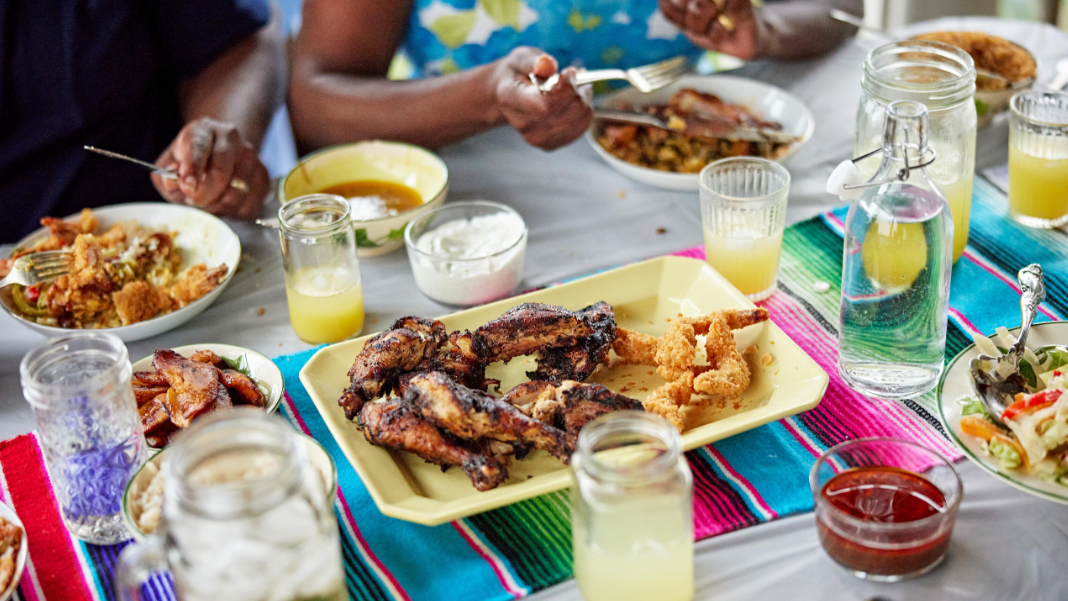
There is no single plate that can answer the question. A Jamaican Sunday dinner might be rice and peas with brown stew chicken. It might be fried chicken and vegetables. It might include curry goat, oxtail, plantain, macaroni and cheese or potato salad. It might be a simpler meal built around whatever the household has available.
What makes it Sunday dinner is not the exact menu. It is the gathering. It is the anticipation. It is the person in the kitchen who knows what everybody likes. It is the relative who arrives hungry. It is the plate that somehow becomes larger than expected. And it is the inevitable disagreement over whether the food was done properly.
The arguments will change. The table will change. The people around it will change. But as long as someone is standing over a pot on Sunday afternoon insisting that this is how it is supposed to be done, the ritual has not gone anywhere.
Frequently Asked Questions
What is a traditional Jamaican Sunday dinner?
There is no single fixed menu, but common dishes include rice and peas, chicken, vegetables and plantain. Some households also serve curry goat, oxtail, macaroni and cheese or other sides and meats. The exact combination varies by household and circumstance.
What time is Jamaican Sunday dinner usually eaten?
There is no universal time. Many households eat in the afternoon, often after church, though this varies with work, church schedules and family routines.
Why is Sunday dinner important in Jamaica?
Sunday dinner has traditionally provided a regular occasion for families to gather and eat together, a recurring ritual rather than simply another daily meal.
What meat is usually served for Jamaican Sunday dinner?
Chicken is a common choice, prepared fried, brown stew or curry. Some households add curry goat, oxtail or another meat, particularly for larger gatherings or “two-meat” Sundays.
Is rice and peas always part of Jamaican Sunday dinner?
Rice and peas is strongly associated with the traditional Jamaican Sunday table, but it is not an absolute requirement for every household or every Sunday.
Has Jamaican Sunday dinner changed?
Yes. Work schedules, changing family structures and the wider availability of prepared meals have altered how some households approach Sunday cooking. The tradition of gathering around a Sunday meal, however, remains present in many Jamaican families.
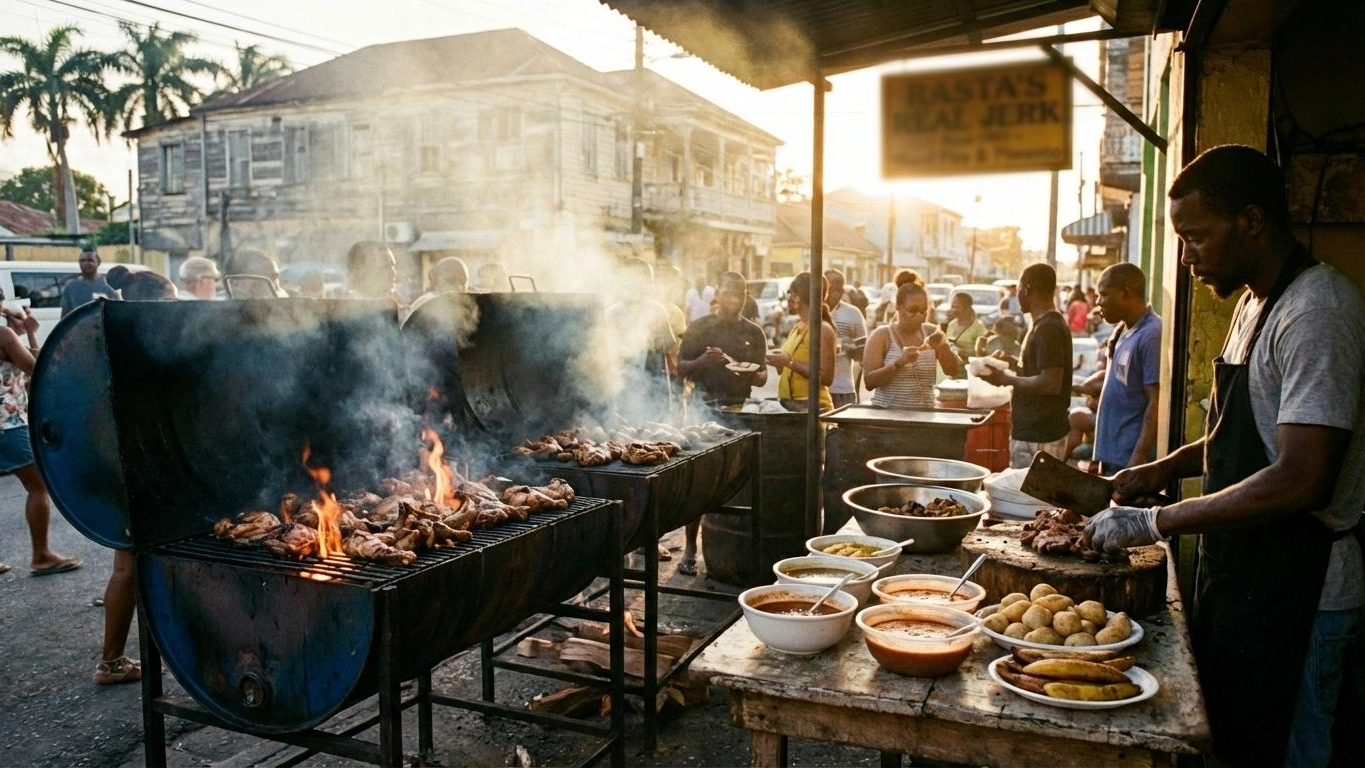
Jamaican street food has spent years being treated as something you grab on the roadside. Now some of the island’s most ambitious kitchens are taking notes from the vendors who figured it out first.
There is a particular kind of Jamaican food that does not need a reservation.
You smell it before you see it.
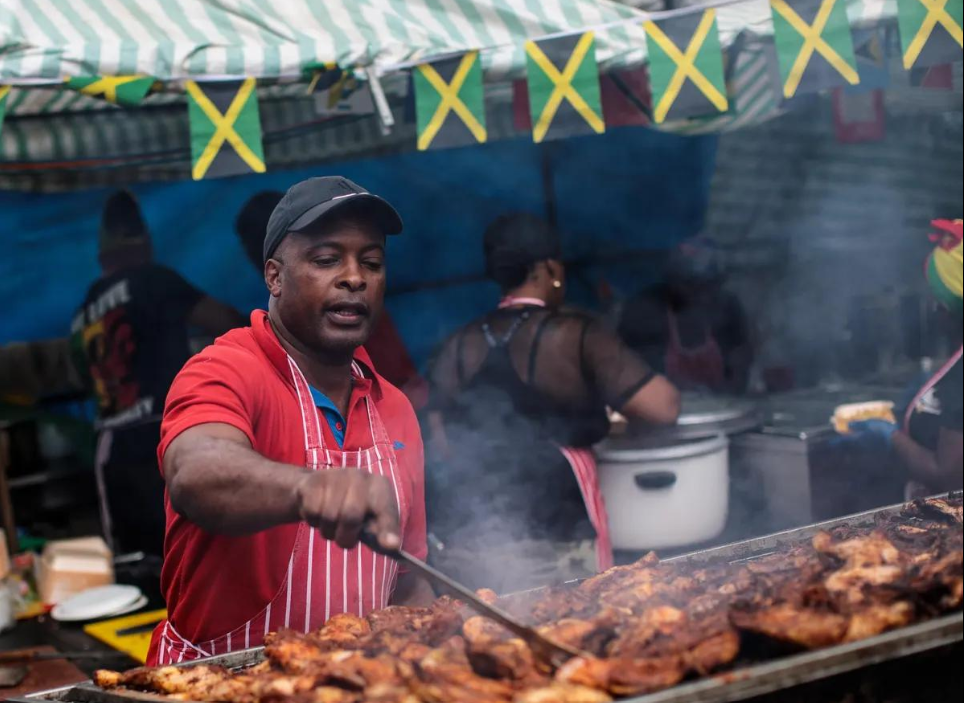
Smoke hanging over the road. A griddle working. Oil crackling. A vendor calling out what is ready. Someone standing nearby with a paper plate, eating before the food has had time to cool.
Then, somewhere else on the island, a chef puts a version of the same idea on a ceramic plate.
That reversal is becoming harder to ignore.
Jamaican street food has always been about immediacy, flavour and making something satisfying with what is available. It is food designed to be eaten, not explained.
The country’s restaurant scene has increasingly recognised the value of that instinct.
Not by simply reproducing roadside dishes, but by borrowing the things that made them work in the first place: bold seasoning, smoke, texture, portability, local ingredients and the confidence to let one good idea carry the plate.
The funny part is that the roadside vendors were already there.
Street food did not need a chef’s permission
Jamaican street food is not one neat category.
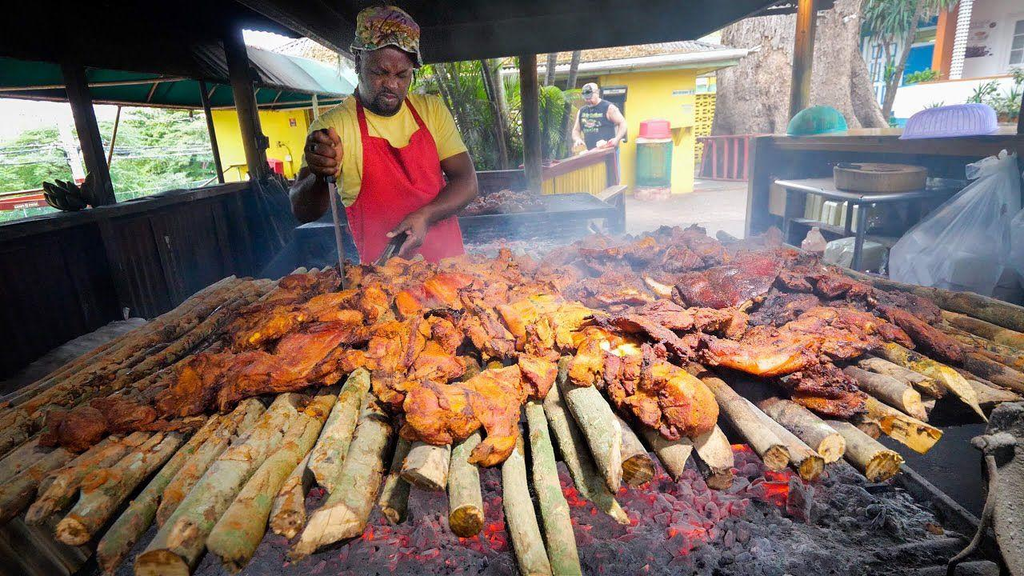
It includes jerk chicken and pork, roast yam and saltfish, patties, corn, soup, fried fish, festival, bammy, roasted breadfruit and a long list of snacks and meals that change according to where you are and who is cooking.
Some are closely associated with particular places. Others have become national favourites.
What they share is less about a recipe than a way of cooking.
Food is prepared close to the customer.
Flavour has to arrive immediately.
The cooking often happens in full view.
And the person selling it has very little room for unnecessary complication.
That is an important lesson for a modern restaurant.
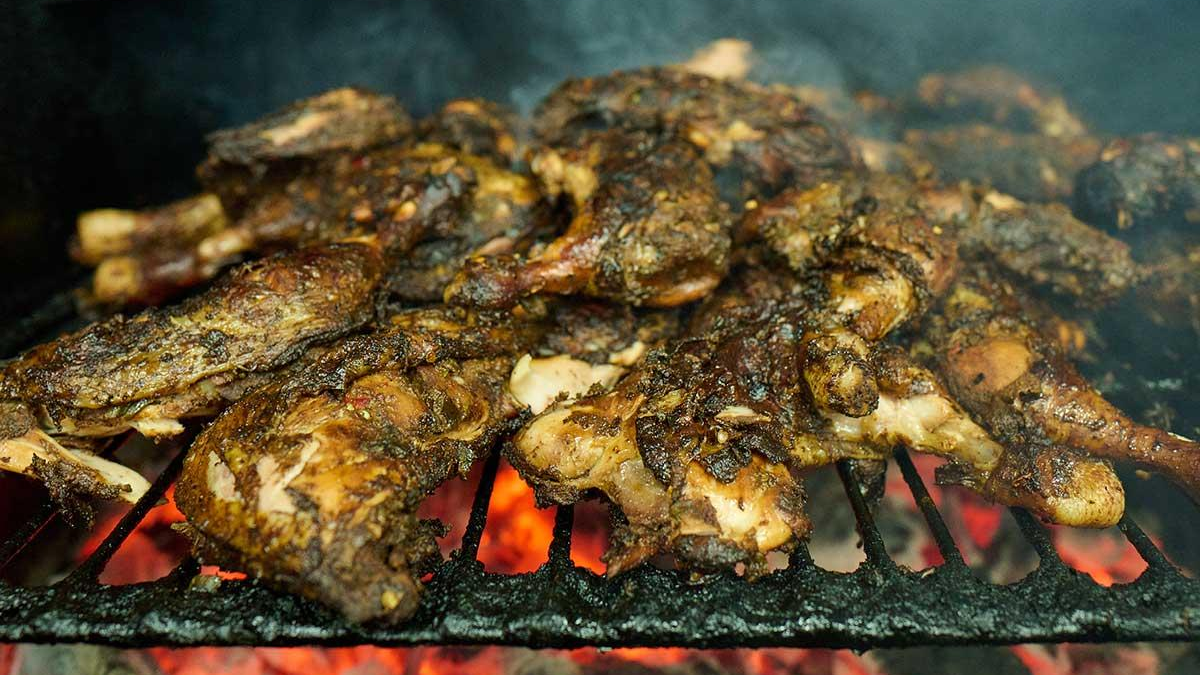
Jerk is the obvious example
If Jamaican street food has an international ambassador, it is jerk.
The technique is older than the tourism industry that eventually helped turn it into a global Jamaican export. Today, jerk is served everywhere from roadside stands to hotel restaurants and international kitchens.
The basic appeal is difficult to improve upon.
Heat.
Smoke.
Seasoning.
Char.
Juiciness.
The combination creates a flavour profile that travels remarkably well.
Jerk has also become a point of creative experimentation in restaurants, appearing in different preparations and alongside ingredients that would not necessarily appear at a traditional roadside cookout.
But the best versions still understand the original logic.
The smoke should matter.
The seasoning should matter.
The meat should taste like itself.
And the fire should leave evidence.
The restaurant trick is often to stop overcomplicating it
High-end cooking has a habit of adding things.
Another sauce.
Another garnish.
Another texture.
Another explanation.
Street food often does the opposite.
It identifies what people want and gets out of the way.
Take roast yam and saltfish.
The ingredients are straightforward. The experience is not.
The smoky, starchy yam meets saltfish seasoned with aromatics, pepper and other ingredients. It is filling, portable and deeply tied to Jamaican food culture.
A restaurant can reinterpret that combination, but it cannot improve it simply by making the ingredient list longer.
That is one reason street food is such useful inspiration for chefs.
It imposes discipline.
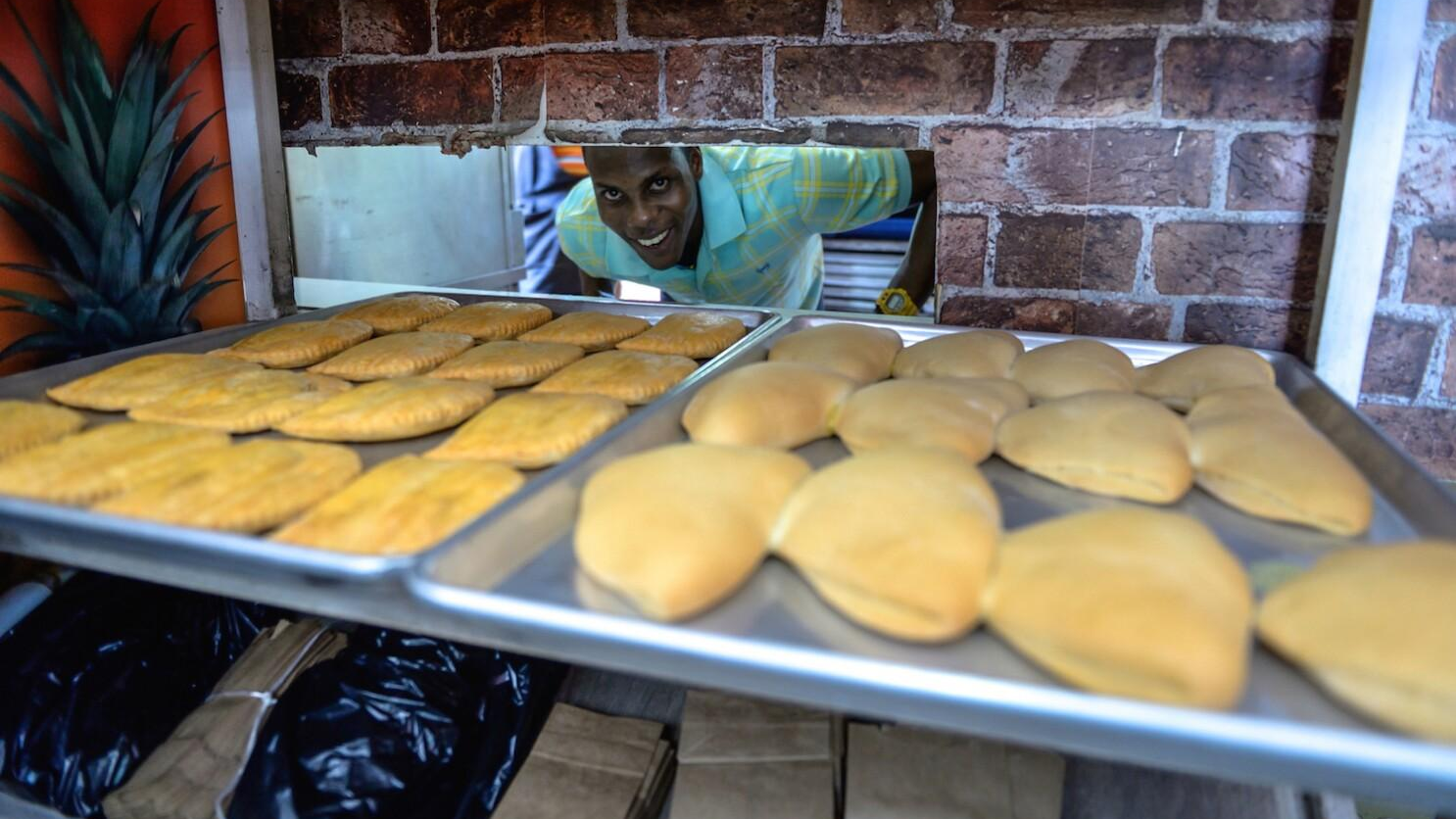
The patty understood convenience before restaurants discovered “grab and go”
Jamaican patties are another example of a food that solved several problems at once.
They are portable.
They are inexpensive relative to a full sit-down meal.
They can be filled with different proteins and vegetables.
And they are designed around the reality that people have somewhere else to be.
The Jamaican patty’s history is also a reminder that street food is rarely culturally isolated. Jamaica’s cuisine developed through layers of African, European, Asian and Indigenous influences, and the patty itself reflects a particularly interesting combination of Jamaican and British culinary history, with later adaptations becoming distinctly Jamaican.
Today, the idea of a filled pastry as a convenient meal is hardly revolutionary.
But Jamaica perfected its own version.
And restaurants have noticed.
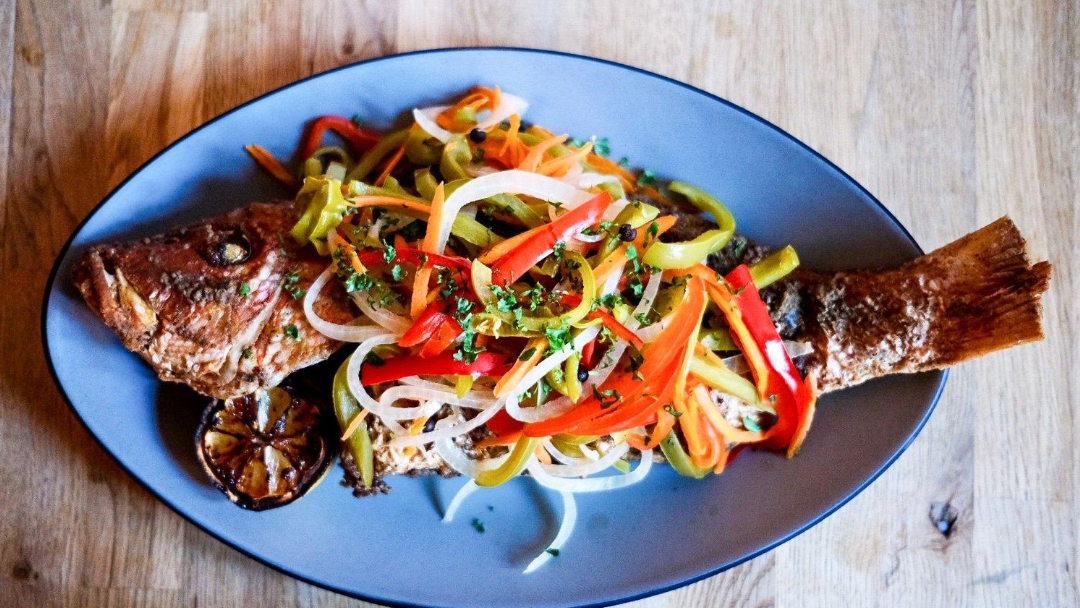
Escovitch fish has always understood texture
The best Jamaican street and casual food often works because it gives you contrast.
Crisp fish.
Acidic pickle.
Heat from Scotch bonnet.
Soft vegetables.
That is the logic behind escovitch fish.
The dish is traditionally associated with fried fish topped with a vinegar-based preparation of vegetables and peppers. It is a powerful combination because every component has a job.
The vinegar cuts through the richness.
The pepper brings heat.
The vegetables bring freshness and texture.
The fish provides the centre.
A chef looking for a lesson in balance could spend a lot of time studying a plate like that.
Festival is proof that side dishes can steal the show
Festival is technically an accompaniment.
Nobody seems particularly interested in treating it like one.
The slightly sweet fried dough is served alongside jerk, fried fish and other dishes, and it has developed its own following.
That matters because modern restaurant menus increasingly understand the value of the side that people remember more than the main course.
Jamaican cooking has been doing that for years.
A great festival changes the meal.
So does good bammy.
So does a properly prepared breadfruit.
The Jamaican plate does not always respect the hierarchy that Western restaurant menus traditionally impose.
The “side” can become the reason people come back.
The roadside cook understands theatre
There is another thing restaurants can learn from street vendors.
People like watching food being made.
The fire.
The knife work.
The smoke.
The flipping.
The seasoning.
The moment the food is wrapped or plated.
Street food puts the process in public.
The customer does not have to wonder what is happening behind the kitchen door.
This has obvious relevance to modern restaurants, where open kitchens, chef counters, live-fire cooking and tableside preparation have become increasingly popular.
But again, the roadside version came first.
A jerk vendor turning meat over coals does not need a concept deck to understand that fire is part of the experience.
The best street food is hyper-local
One of the mistakes a restaurant can make is treating Jamaican street food as a single national flavour.
It is not.
The food changes with geography, ingredients, communities and circumstance.
A fish vendor in a coastal community has different raw materials from someone selling food in Kingston.
A rural roadside cook may have access to produce that would be expensive or difficult to source elsewhere.
The food tells you where you are.
That is exactly what makes it valuable to restaurants trying to create a sense of place.
A menu that says “Jamaican” without understanding Jamaica can feel generic.
A menu that understands where its ingredients, techniques and references come from has a much better chance of feeling authentic.
What chefs are really copying is confidence
The most interesting thing restaurants can learn from Jamaican street food is not a specific dish.
It is attitude.
Street food does not apologise for flavour.
It does not dilute the pepper because someone might find it too assertive.
It does not hide the smoke.
It does not ask whether a dish is sophisticated enough.
It simply has to be good.
That confidence is increasingly valuable in contemporary cooking.
The global restaurant industry has spent years talking about authenticity, local sourcing and food heritage.
Jamaican street vendors have been doing versions of those things because they had no reason to do otherwise.
But copying the dish is not the same as understanding it
There is a line between inspiration and extraction.
A restaurant can take a Jamaican dish, give it a new presentation and put it on a menu.
That does not automatically mean it understands the culture behind the dish.
This matters as Jamaican food becomes increasingly visible internationally.
Jerk seasoning can become a generic “Caribbean” flavour.
Plantain can become decoration.
Scotch bonnet can become a novelty heat source.
And traditional dishes can be stripped of context until the thing being celebrated is no longer recognisably Jamaican.
The better approach is to learn from the people who have kept these foods alive.
Buy from local producers.
Work with Jamaican cooks.
Credit the traditions.
Understand the ingredients.
And recognise that the roadside version is not a rough draft waiting for a restaurant to finish it.
It is the original work.
The restaurant version can still be worth eating
None of this means chefs should leave street food alone.
Quite the opposite.
The best reinterpretations can introduce Jamaican flavours to people who might never have eaten them otherwise.
A chef can take a familiar technique and apply it to a different ingredient.
A restaurant can build a tasting menu around Jamaican food traditions.
A hotel kitchen can source from local vendors and producers.
A contemporary Jamaican restaurant can use modern technique without pretending that tradition has no value.
The key is knowing what can change without losing the thing that made the dish matter.
Jamaica’s street food has an advantage money cannot buy
It has memory.
People know where they ate their first patty.
They remember the jerk stand their family used to visit.
They know whose roast yam is better.
They have strong opinions about soup.
They have watched somebody cook the food.
That emotional connection is difficult to manufacture in a restaurant.
A chef can reproduce the seasoning.
It is much harder to reproduce the memory.
That is why Jamaican street food remains powerful even as the island’s restaurant culture becomes more ambitious.
The roadside kitchen is still ahead
There is a temptation to think of food culture as a ladder.
Street food at the bottom.
Restaurants at the top.
Jamaica makes that hierarchy look increasingly silly.
The roadside cook has already solved problems that expensive kitchens continue to study.
How do you make food people crave?
How do you create theatre?
How do you make local ingredients memorable?
How do you serve food quickly?
How do you build a reputation through word of mouth?
How do you make somebody come back tomorrow?
The answer, very often, is the same.
Make the food good.
Make it distinctive.
And give people a reason to remember where they ate it.
Jamaica’s best restaurants may borrow from the street.
They should.
But they should also remember which direction the influence is travelling.
The roadside kitchen was never waiting for fine dining to catch up.
Frequently Asked Questions
What is Jamaican street food?
Jamaican street food is a broad category of foods prepared and sold in public or informal settings, including jerk meats, patties, roast yam, corn, fried fish, festival, bammy and other snacks and meals. There is no single definitive list because Jamaican street food varies by location and vendor.
What is the most popular Jamaican street food?
Jerk chicken is among Jamaica’s best-known street foods internationally, but popularity varies by location and personal preference. Patties, roast yam and saltfish, fried fish and other roadside foods are also widely associated with Jamaican food culture.
Why is Jamaican street food so popular?
Jamaican street food combines strong flavour, portability, relatively accessible ingredients and the experience of watching food being prepared. Its connection to local communities and memories also gives many dishes cultural significance beyond their ingredients.
Where can you find Jamaican street food?
Street food is found throughout Jamaica, from Kingston and Montego Bay to smaller towns and rural communities. Specific foods and vendors vary considerably by location.
What makes Jamaican jerk different?
Jerk traditionally involves seasoning meat with a characteristic blend of ingredients and cooking it over wood or other fuel that produces smoke. Scotch bonnet peppers, pimento and other seasonings are commonly associated with jerk, although recipes and techniques vary between cooks and regions.
Is Jamaican street food authentic?
Street food is an important part of Jamaican food culture, but “authentic” is not a simple test. Recipes and techniques vary between families, communities and vendors. A dish does not become more authentic simply because it is prepared outdoors, nor does a restaurant version automatically become inauthentic because it uses modern techniques.
Blue Mountain coffee commands extraordinary prices around the world. But for the farmers growing it, the economics can look very different.
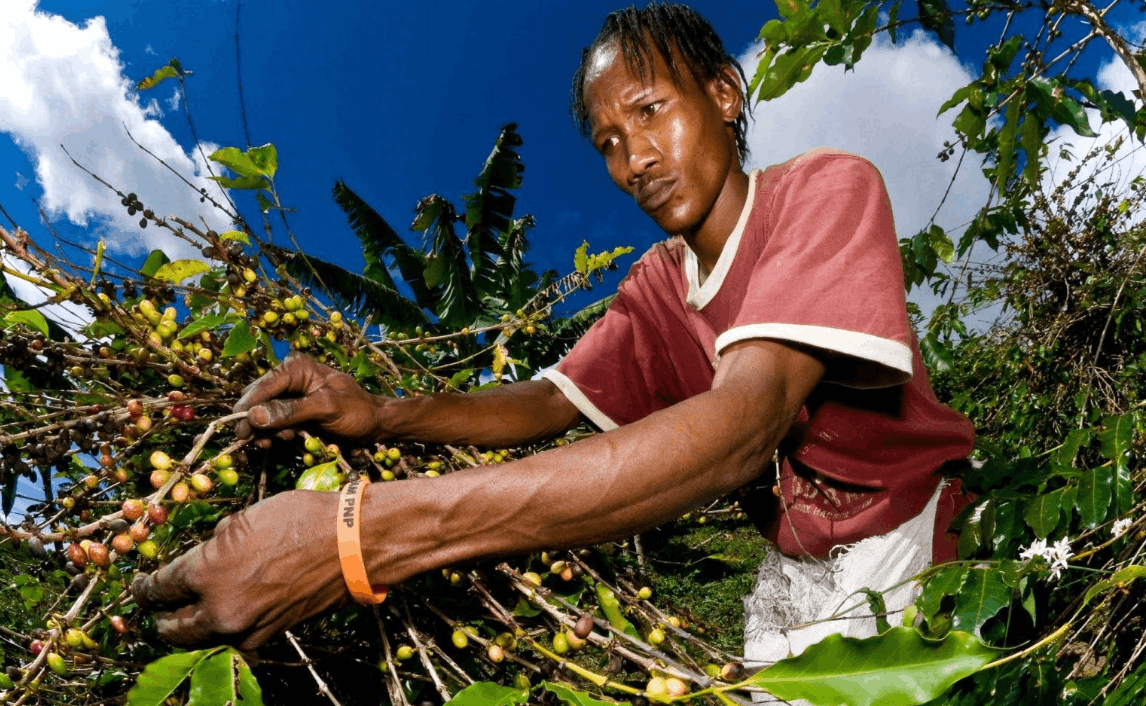
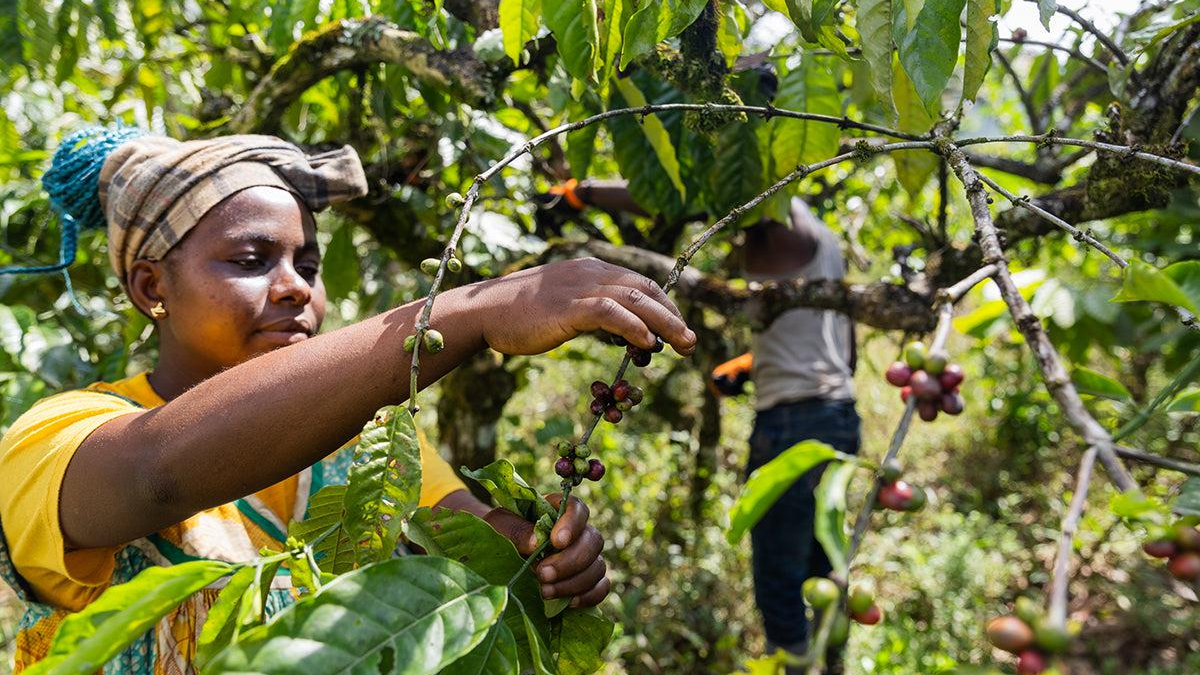
On the shelves of specialty coffee shops, Blue Mountain coffee carries a price that makes people stop and look twice.
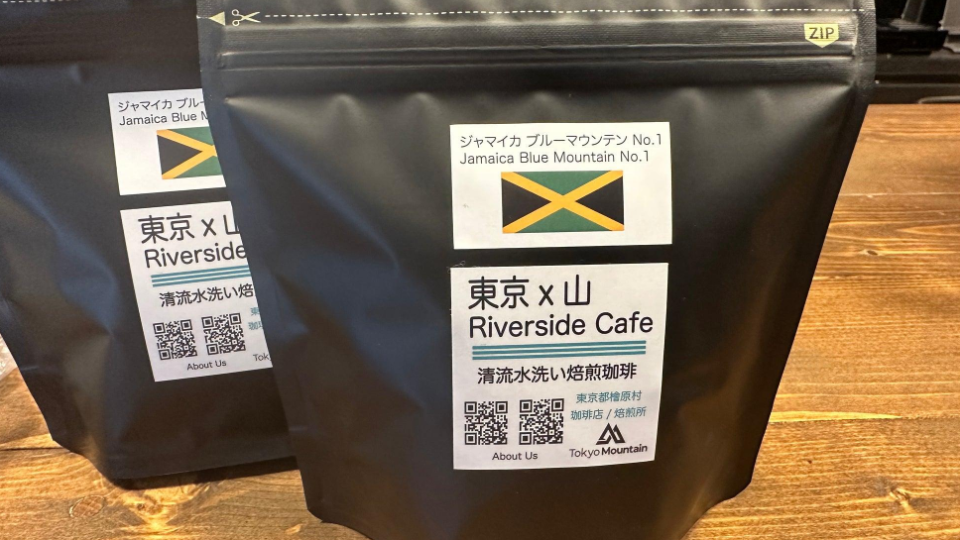
The name alone has become shorthand for rarity, quality and Jamaican provenance. Japan has built a particularly strong market for it, and licensed buyers and exporters around the world continue to trade on the value of the Jamaica Blue Mountain name. (Jacra)
But go back up into the mountains, to the farms where the coffee begins, and the economics become considerably less glamorous.
Jamaica’s coffee farmers have spent years warning that the price they receive does not always make the crop easy to sustain. In 2017, farmers told the government they were receiving about J$6,000 per box and said the price did not cover their input costs. (Ministry of Agriculture and Fisheries)
The numbers have changed since then. The underlying question has not.
If Blue Mountain coffee is valuable enough to command a premium around the world, how much of that value actually reaches the person growing it?
That is the uncomfortable question behind Jamaica’s most famous coffee.
The name is worth money
First, it is important to understand what is actually being sold.
“Jamaica Blue Mountain” is not simply a poetic description for Jamaican coffee grown somewhere in the hills.
The Jamaica Agricultural Commodities Regulatory Authority, JACRA, regulates the coffee sector, while its subsidiary Coffee Marks Limited owns the Jamaica Blue Mountain® certification trademark and licenses its use. (Jacra)
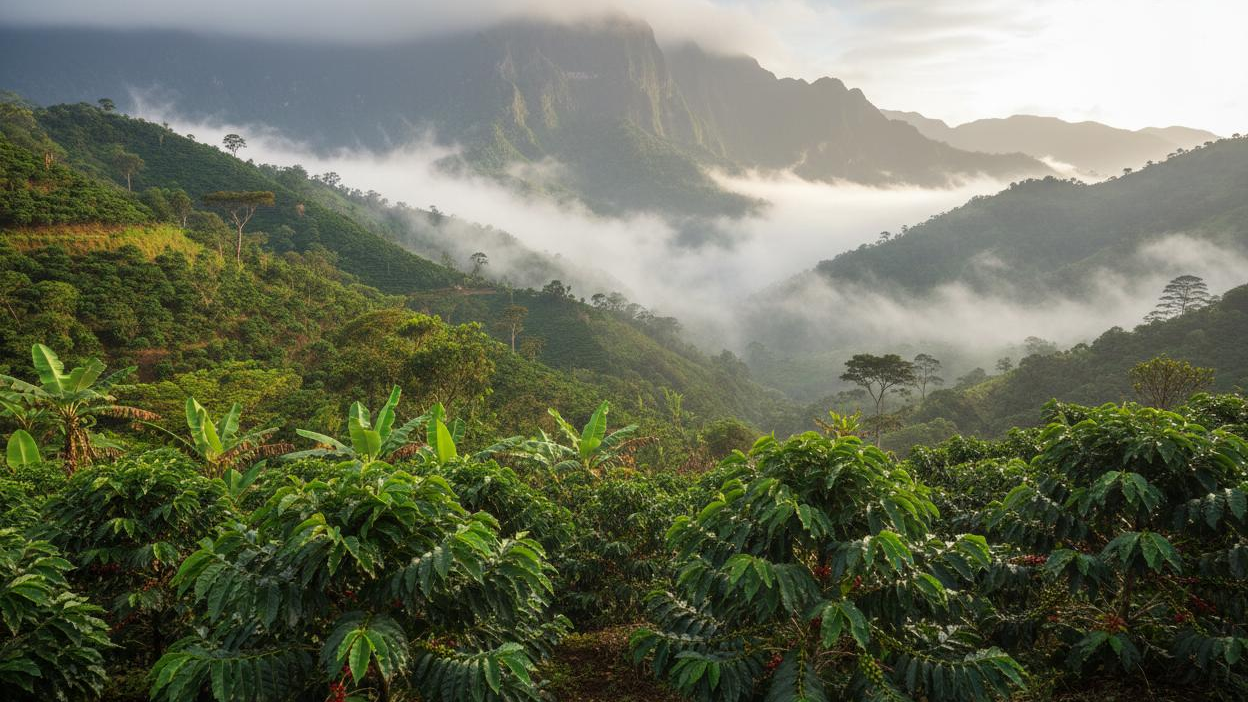
Coffee grown in the Blue Mountain area spans parts of St. Thomas, St. Andrew and Portland. Jamaica also produces premium High Mountain coffee outside the Blue Mountain area, which is a separate designation. (Jacra)
That geographical and regulatory distinction is part of the product’s value.
So is scarcity.
Jamaica is not a giant coffee-producing country. JACRA describes Arabica Typica as the dominant variety in the Jamaican industry and notes that it is prized for cup quality but is not a particularly heavy producer. (Jacra)
The result is a coffee with a powerful combination of attributes: recognised origin, limited production, established reputation and a global market willing to pay for all four.
But premium does not mean simple
Here is where the story gets complicated.
The price a consumer pays for a finished bag of premium coffee is not the same thing as the price paid to the farmer for coffee cherries.
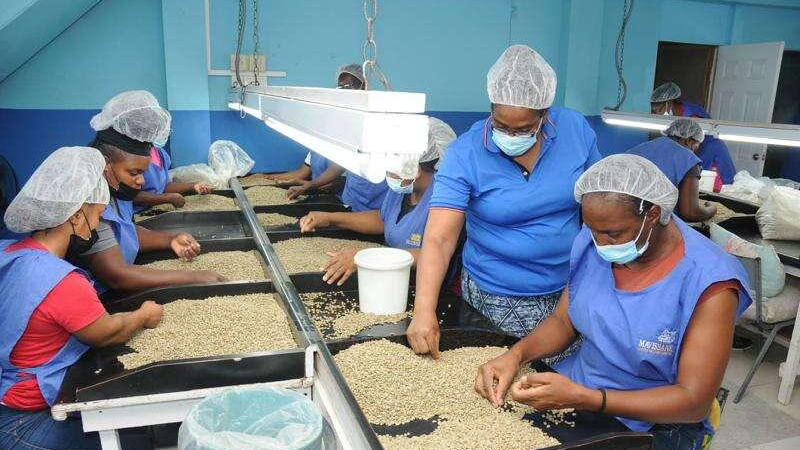
Between the farm and the final cup are harvesting, processing, grading, certification, transportation, financing, roasting, packaging, marketing, distribution, retail and, in export markets, importers and other intermediaries.
Every stage adds cost.
Some stages also add value.
That distinction matters.
It would be misleading to look at the retail price of a bag of Blue Mountain coffee and assume the difference between that price and a farmer’s payment is simply someone else’s profit.
But it would be equally misleading to assume that the farmer automatically benefits whenever the consumer price rises.
The supply chain is where the real economic story lives.
Jamaica has been having this conversation for years
The tension is not new.
In 2017, Blue Mountain coffee farmers protested over what they considered inadequate prices. The Ministry of Agriculture recorded their complaint that J$6,000 per box was insufficient to cover their input costs. Buyers and exporters, meanwhile, were explaining that prices for the crop year were being determined in consultation with Japanese importers, who purchased a large share of Jamaica’s coffee. (Ministry of Agriculture and Fisheries)
That is a revealing detail.
The farmer grows the crop.
But the price does not exist in isolation on the farm.
It is shaped by buyers, exporters, overseas demand, production conditions and the broader structure of the market.
The same tension surfaced again in 2023, when Agriculture Minister Floyd Green said the government wanted to ensure coffee farmers received a fair price for their beans and linked farmer returns directly to the long-term sustainability of the sector. (Ministry of Agriculture and Fisheries)
This is not an argument that farmers receive no premium.
It is an argument that the existence of a premium product does not automatically guarantee a sustainable farm business.
Growing coffee in the Blue Mountains is not cheap
The romance of the Blue Mountains can obscure what farming there actually involves.
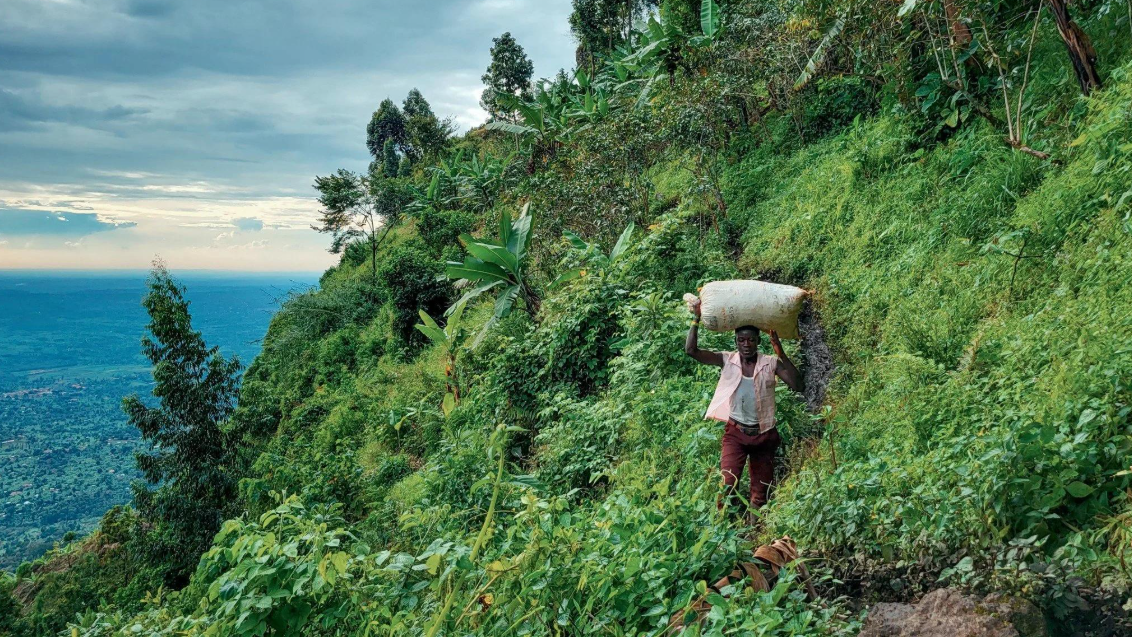
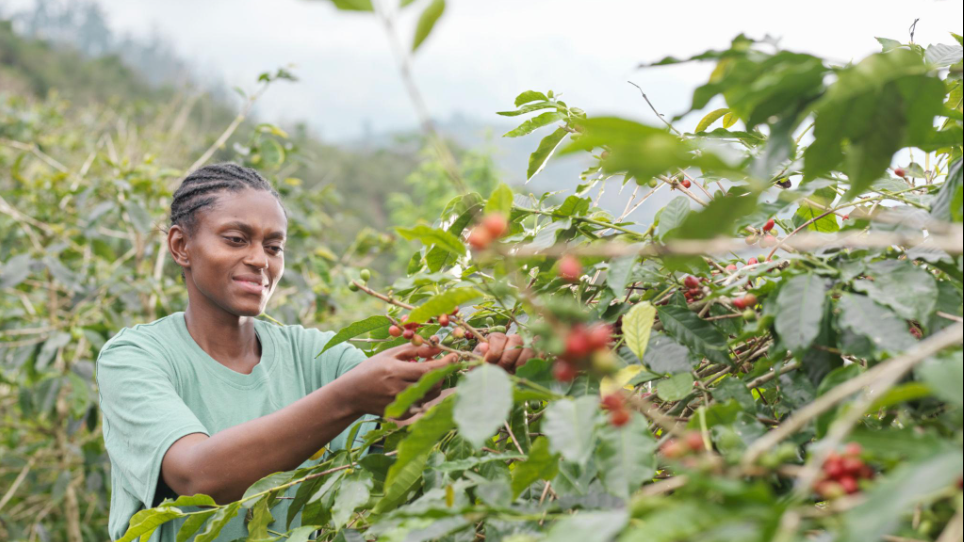
The terrain that contributes to the coffee’s distinctive growing environment also makes farming difficult.
The government has identified ageing farms and farmers, harsher climate conditions, rising agricultural input costs and inadequate farm roads among the challenges facing the sector. (Ministry of Agriculture and Fisheries)
Then there are pests, plant disease, weather damage and praedial larceny.
JACRA has described all of these as pressures on coffee farmers and has had to provide farmers with seedlings, fertiliser and crop-protection inputs to help restore production. (Jacra)
After Hurricane Melissa, the government committed substantial additional resources to rehabilitation of the coffee sector. In April 2026, the Ministry of Agriculture said J$132 million had been spent on rehabilitation, with much of the support directed to the Blue Mountain region. (Ministry of Agriculture and Fisheries)
That tells you something important.
A crop can be globally prestigious and still require significant public support to remain viable at farm level.
The farmers are carrying the risk
Coffee is not a factory product.
If a processor has a bad month, production can be adjusted.
A farmer cannot simply decide not to have a harvest.
Trees take years to establish.
Weather does what it wants.
Pests do not care about export contracts.
Roads can become impassable.
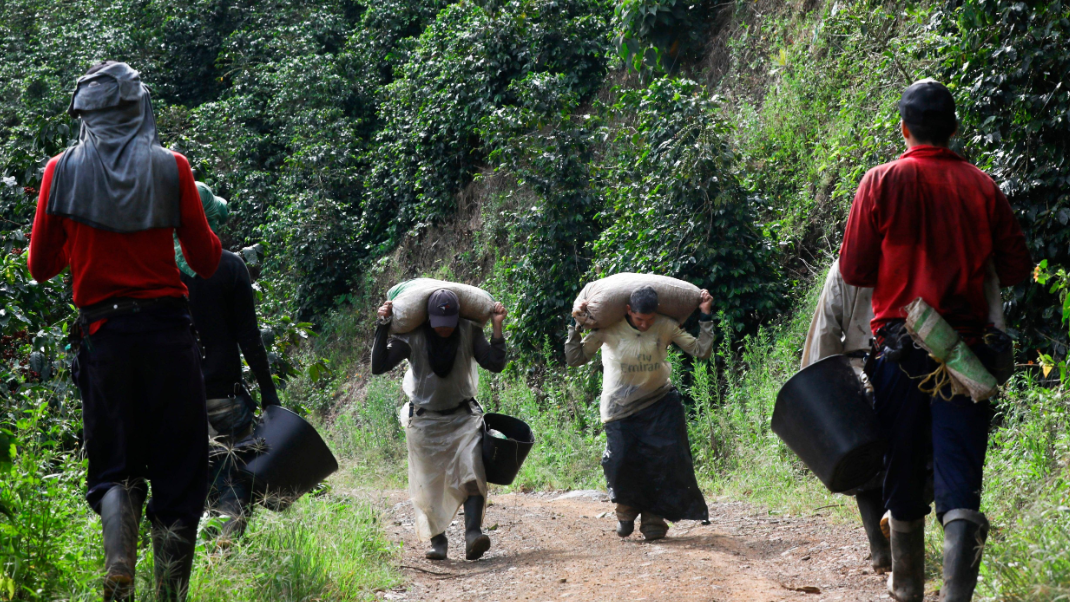
Fertiliser and other inputs cost money before the farmer knows exactly what the eventual crop will bring.
And the farmer’s income depends on what happens after all of that work.
That makes the economics particularly unforgiving for small growers.
JACRA’s recent interventions specifically target thousands of farmers across the Blue Mountain region with planting material and agricultural inputs, reflecting the scale of the production challenge. (Jacra)
So who actually benefits from the Blue Mountain premium?
There is no honest one-line answer.
Farmers benefit from producing a crop that has a recognised premium market.
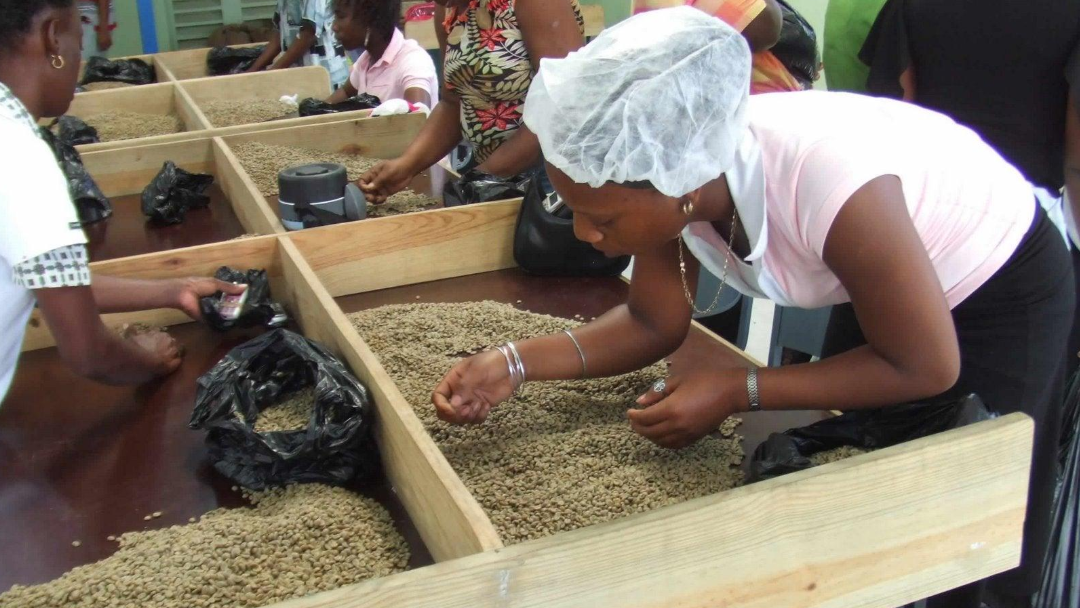
Processors and dealers add value by handling, grading and preparing the coffee.
Exporters connect Jamaican coffee to overseas buyers.
Importers and distributors move it into foreign markets.
Roasters transform green beans into the product consumers recognise.
Retailers sell the final product.
The Jamaican state also has an interest in protecting the certification and reputation that support the entire chain.
The question is not whether these roles deserve to exist.
They do.
The question is whether the distribution of value and risk across that chain is sustainable.
That is harder to answer because the public record does not provide a simple, current percentage showing exactly how much of every consumer dollar reaches a Blue Mountain farmer.
Any article claiming otherwise without a specific supply-chain study is pretending to know more than it does.
The export market creates opportunity and vulnerability
Japan is central to the story.
The Jamaican government has repeatedly identified Japan as an important market for Blue Mountain coffee. In 2017, officials said Japanese firms purchased the bulk of the local commodity, while JACRA continues to list Japanese companies among licensed users and importers of the Jamaica Blue Mountain trademark. (Ministry of Agriculture and Fisheries)
That demand helped build the international reputation of Jamaican coffee.
But dependence on a major market also creates exposure.
If demand changes, if consumer preferences move, if economic conditions weaken or if buyers become more price-sensitive, Jamaican producers feel the effects.
The answer is not necessarily to walk away from the Japanese market.
It is to build more routes to market and more ways for Jamaican producers to capture value.
The opportunity may be in doing more than growing beans
This is where the conversation becomes more interesting.
A coffee farmer does not necessarily have to make all of their money from selling raw or processed coffee.
JACRA has been encouraging farmers to explore coffee by-products, including coffee scrubs, soap, candles and lotions. (Jacra)
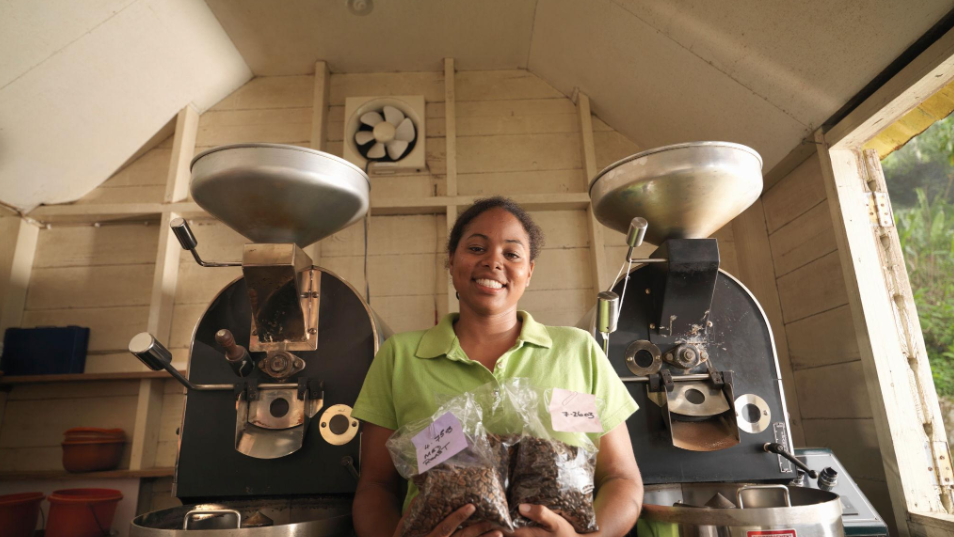
There is also room for more local processing, direct-to-consumer sales, tourism experiences and other forms of value addition.
That does not mean every farmer should suddenly become a roaster, retailer and tourism operator.
It means the coffee economy does not have to end when the beans leave the farm.
The more stages of the value chain that Jamaican businesses can participate in, the greater the potential for economic value to remain in Jamaica.
That is an opportunity worth taking seriously.
Quality is part of the problem too
There is an uncomfortable counterargument that cannot be ignored.
Premium pricing depends on premium quality.
If quality becomes inconsistent, the reputation that supports the premium becomes harder to defend.
JACRA has explicitly warned about this problem. The authority has noted that inconsistent quality has opened space for lower-quality coffee brands in markets such as Japan, where they can sell for a fraction of the price of Jamaican Blue Mountain coffee. (Jacra)
That creates a difficult balancing act.
Farmers need better returns to justify investment in their farms.
But the industry also needs farmers to invest in the practices that maintain quality.
If the economics do not support the investment, quality can suffer.
If quality suffers, the premium becomes harder to sustain.
That is not a farmer failure.
It is a value-chain problem.
The Blue Mountain name cannot farm itself
This may be the central point.
Jamaica has built one of the world’s most recognisable coffee brands around a very specific place.
But a geographical reputation is only as durable as the farms producing the thing that carries the name.
If farmers cannot make a sustainable living from the crop, younger generations have less reason to take over.
If farms age without adequate replanting, productivity suffers.
If infrastructure deteriorates, costs rise.
If climate pressures intensify, the risk increases.
And if the people doing the hardest part of the work cannot capture enough value, eventually the premium becomes a marketing story detached from the economic reality that created it.
That is a dangerous place for any agricultural brand to end up.
The future is not just about selling more coffee
Jamaica’s stated ambition is to increase production.
In 2023, the Ministry reported national coffee production of 288,196 boxes and set an objective of reaching 450,000 boxes over the following three to five years. (Ministry of Agriculture and Fisheries)
More production can help.
But volume alone is not the answer.
If Jamaica produces more coffee without improving farmer economics, the country could simply be scaling the wrong part of the problem.
The better ambition is more sophisticated:
Produce better coffee.
Pay farmers sustainably.
Protect the Blue Mountain designation.
Build more Jamaican-owned value around the crop.
Diversify markets without destroying the premium.
And make sure the people who have carried this crop through generations are not the only people in the value chain who cannot afford the thing they helped make valuable.
The cup tells only half the story
The next time someone puts a very expensive cup of Blue Mountain coffee in front of you, the price tells you something.
It tells you that the world has decided this coffee is special.
It tells you that Jamaica has successfully built a premium agricultural brand around geography, quality and scarcity.
But it does not tell you how the money travelled to get there.
For that, you have to follow the coffee backwards.
Past the roaster.
Past the exporter.
Past the processor.
Past the dealer.
Back into the mountains.
Back to the farmer.
Because the real test of Jamaica’s Blue Mountain legacy is not whether the world will continue paying a premium for it.
It is whether the people growing it can afford to keep doing so.
Frequently Asked Questions
Why is Blue Mountain coffee so expensive?
Jamaica Blue Mountain coffee benefits from its recognised geographical origin, limited production, established reputation and quality. The Jamaica Blue Mountain name is also protected through a certification trademark administered within Jamaica’s regulatory framework. (Jacra)
Do Jamaican coffee farmers receive the full premium paid for Blue Mountain coffee?
No. The retail price of coffee is distributed across multiple stages of the supply chain, including processing, exporting, importing, roasting, distribution and retail. There is no single current public figure that establishes what percentage of every retail sale reaches the farmer.
Why have Blue Mountain coffee farmers complained about prices?
Farmers have repeatedly raised concerns about whether the prices they receive adequately cover production costs. In 2017, farmers reported receiving J$6,000 per box and said that amount could not cover their input costs. (Ministry of Agriculture and Fisheries)
Where is Jamaica Blue Mountain coffee grown?
The Blue Mountain coffee area includes parts of St. Thomas, St. Andrew and Portland. Jamaica also produces High Mountain coffee in other areas, which is a separate category. (Jacra)
Who regulates Blue Mountain coffee in Jamaica?
The Jamaica Agricultural Commodities Regulatory Authority, or JACRA, is responsible for regulating and standardising Jamaica’s agricultural commodities sector, including coffee. Its subsidiary Coffee Marks Limited owns the Jamaica Blue Mountain certification trademark. (Jacra)
Is Blue Mountain coffee mainly exported to Japan?
Japan has historically been a major market for Jamaican Blue Mountain coffee, and the Jamaican government has identified Japanese firms as major purchasers of the local commodity. Current JACRA records also show Japanese companies among licensed Jamaica Blue Mountain trademark users and importers. (Ministry of Agriculture and Fisheries)
Is Jamaica producing enough Blue Mountain coffee?
Production has faced significant challenges from ageing farms, climate conditions, agricultural costs, pests and infrastructure. The government has been investing in replanting and rehabilitation while pursuing higher production targets. (Ministry of Agriculture and Fisheries)
Before fashion editors started calling it “bold,” “maximalist” or “street luxury,” Kingston already knew what it looked like.
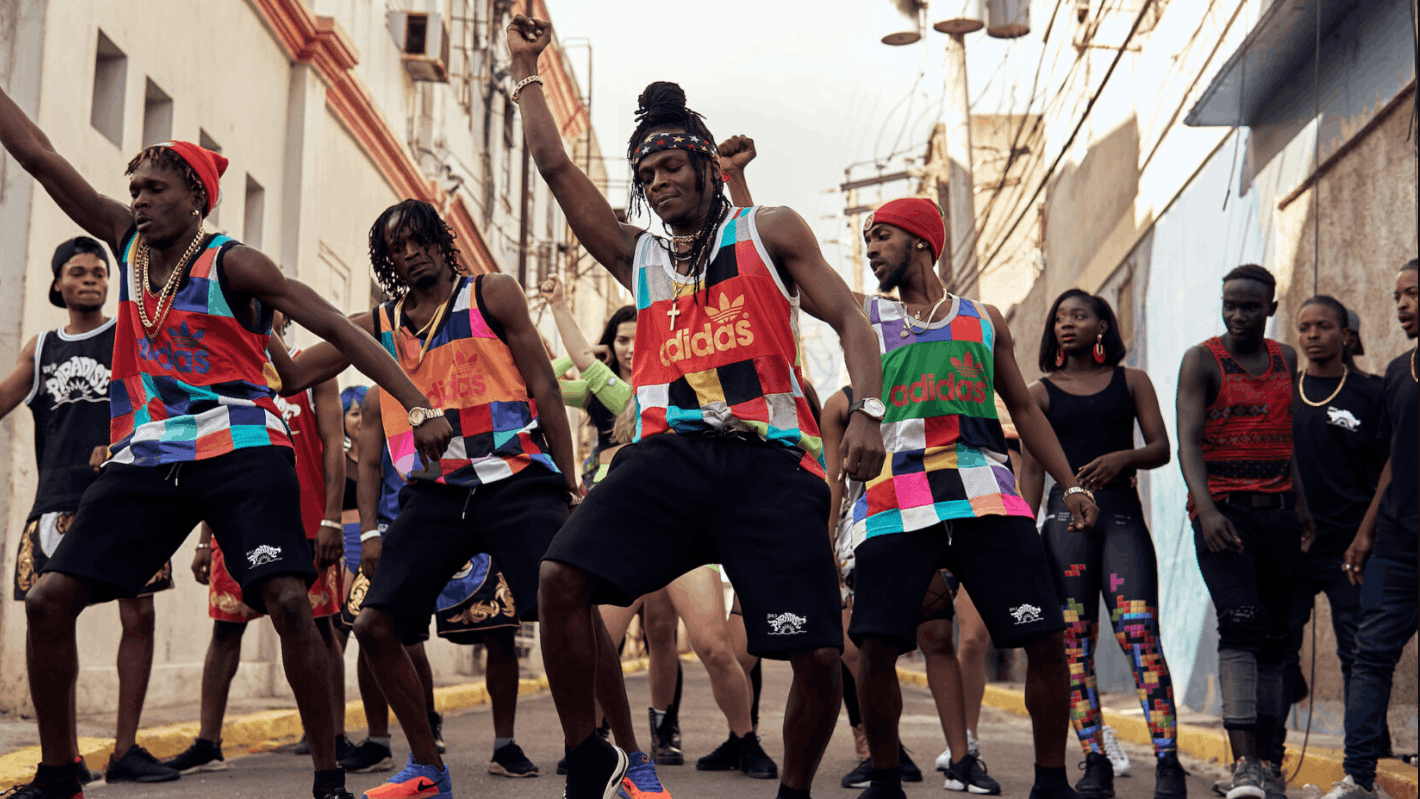
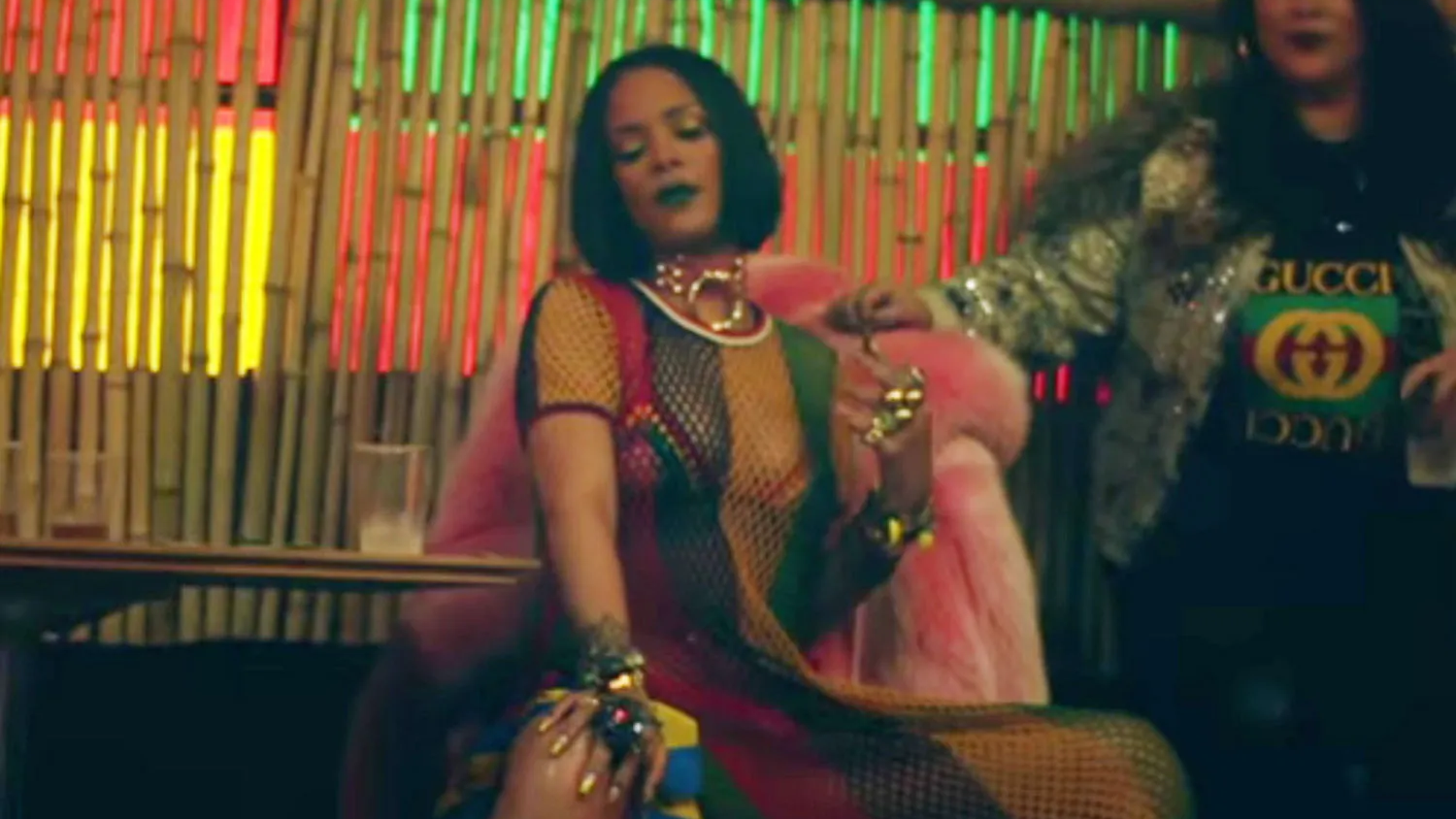
A mesh marina pulled tight against the body. Gold chains stacked across the chest. Oversized colour. Custom tailoring. Rhinestones. Leather. Denim. Hair that could not be ignored. A woman arriving at the dance dressed not simply to look good, but to make an entrance.
Dancehall understood something fashion eventually learned to sell back to the world: clothes are not just worn. They are performed.
That is why the influence of Jamaican dancehall fashion reaches further than a handful of Jamaican designers or musicians. Its visual language has travelled through hip-hop, music videos, streetwear, club culture and international fashion. Researchers have described dancehall as one of Jamaica’s most influential cultural exports, with its impact extending into international fashion as well as music, film and dance. (Nova Southeastern University)
The more interesting question is not whether Jamaican style influenced fashion.
It did.
The question is how a culture built in Kingston’s dance spaces became part of the vocabulary of global fashion, while the people who created much of that vocabulary were often left out of the official story.
Dancehall was a runway before it was a fashion reference
A dance was never just somewhere to hear music.
You had to arrive looking the part.
That made dancehall a participatory fashion environment long before social media turned everyday dressing into content. The audience was part of the spectacle. Clothing communicated confidence, sexuality, status, aspiration and individuality.
And because people were dressing for movement, heat, nightlife and public attention, the rules were different from those of conventional formalwear.
The look could be exaggerated.
The colours could be loud.
The jewellery could be excessive.
The silhouette could be revealing.
The outfit could be completely custom.
What mattered was whether you could carry it.
Academic work on Jamaican dancehall culture has described fashion as a site where global influences were absorbed, remixed and then returned to the wider world in altered form. (ResearchGate)
That is an important distinction.
Dancehall did not develop in isolation from international fashion. Jamaicans were consuming global images and products too.
But they were not simply copying them.
They were making something else.
The Jamaican street style that luxury eventually recognised
Some of the most recognisable elements of dancehall style emerged from that process of adaptation.
The mesh marina, for example, became far more than an undershirt. In the 1990s it could be brightly coloured, worn close to the body and paired with heavy gold jewellery, oversized jackets and other deliberately attention-grabbing pieces.
Jamaican fashion coverage has documented the distinctive combination of mesh marinas, gold chains and colourful clothing associated with dancehall’s classic male style. It has also traced similarities between those Jamaican looks and elements appearing in collections by luxury houses including Versace and Burberry Prorsum. (Jamaica Observer)
That does not mean Versace or Burberry simply copied dancehall.
Fashion rarely moves in such a clean line.
It means the visual conversation was real.
A style that had become ordinary, desirable and competitive in Kingston’s dance culture was also becoming legible to international fashion.
And once luxury fashion adopts a visual language, the world tends to give it a different name.
Shabba Ranks understood the power of the image
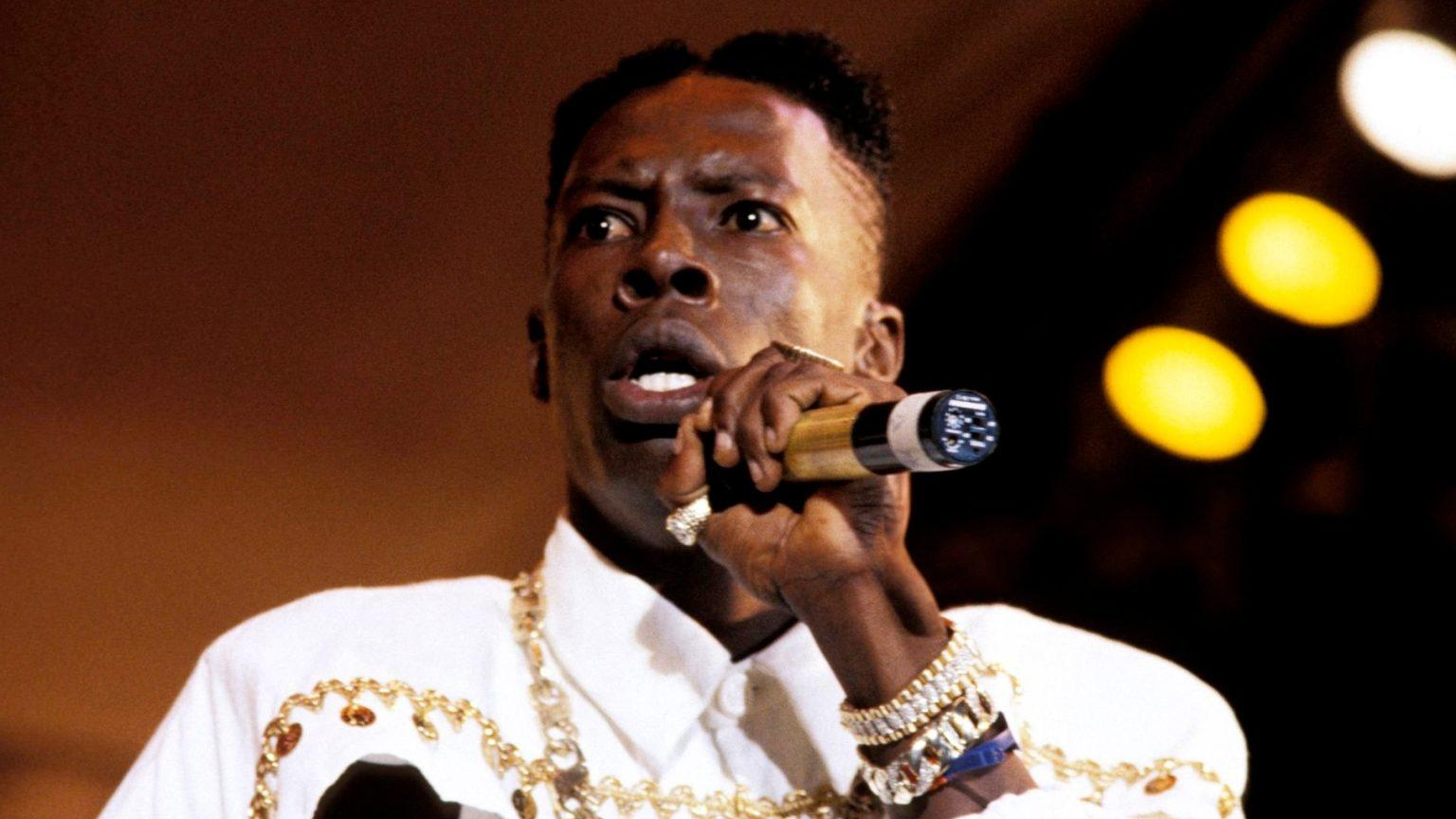
If dancehall fashion needed a global ambassador, Shabba Ranks was one of the most important.
His music travelled internationally. So did his clothes.
In the early 1990s, dancehall’s fashion became increasingly visible alongside its music, and Jamaican designer Earl “Biggy” Turner became closely associated with the flamboyant custom looks worn by Shabba and other major artists. Jamaican reporting has described Biggy as a key dancehall designer whose work helped establish the genre’s larger-than-life image. (donotcallmeafashionista.blogspot.com)
This matters because the clothes were not incidental to Shabba’s international identity.
They were part of it.
A dancehall artist did not simply arrive on a foreign stage as a Jamaican musician. He arrived as a visual proposition.
That helped create a model that became increasingly familiar in global popular culture: the artist as fashion character.
Today, that sounds obvious.
It was not always.
The ghetto tailor was part of the fashion system
There is another part of this story that gets lost when dancehall fashion is described only through famous artists.
The designers mattered.
The seamstresses mattered.
The local tailors mattered.
Dancehall’s visual culture depended heavily on people who could take an idea and turn it into a garment quickly, locally and often uniquely.
Earl “Biggy” Turner is one of the clearest examples. His work grew from Kingston’s urban fashion environment rather than a European fashion school, and his designs became associated with some of dancehall’s biggest stars. (Jamaica Observer)
That system produced something luxury fashion has always understood the value of: exclusivity.
But dancehall produced it differently.
You did not necessarily need a global fashion house to have something nobody else had.
You needed a good tailor.
And an idea.
Dancehall women changed the conversation too
Any history of dancehall fashion that focuses only on men misses half the story.
Women in dancehall developed an equally powerful visual vocabulary.
Body-conscious clothing.
High heels.
Colour.
Hair.
Nails.
Makeup.
Jewellery.
Custom pieces.
The dancehall queen became one of the culture’s most recognisable visual figures, and the broader fashion culture around women in dancehall helped establish an aesthetic in which the body itself became part of the styling.
That influence was not simply about revealing clothing.
It was about control of attention.
A woman could decide exactly how much visual space she wanted to occupy.
That idea has travelled extensively through music videos, pop performance and contemporary fashion.
And again, the important point is not that Jamaica invented every element individually.
It did not.
The power was in the combination.
Dancehall put them together in a particular way.
Fashion was “extra” before “extra” became the point
One of dancehall’s greatest contributions to global style may have been its comfort with excess.
More jewellery.
More colour.
More texture.
More hair.
More shine.
More personality.
The classic dancehall look could be deliberately over the top because being noticed was not a problem to solve.
It was the objective.
This is especially visible in the 1990s, when flamboyant colour, customised clothing and heavy jewellery became central to the visual identity of dancehall. Contemporary Jamaican reporting from the period describes dancehall fashion as something people used to make a public statement and distinguish themselves from one another. (Jamaica Gleaner)
Global fashion has repeatedly returned to this idea.
Maximalism.
Logomania.
Body-conscious silhouettes.
Statement jewellery.
Hyper-styled beauty.
Nightlife dressing.
These trends have many sources.
But Kingston had been experimenting with the underlying attitude for decades.
The luxury house changes the meaning of the look
This is where the story gets uncomfortable.
A fashion idea can have one meaning when it appears in a Kingston dance and another when it appears on a Milan runway.
The garment has not necessarily changed.
Its social value has.
Academic research into Jamaican dancehall fashion has described precisely this cycle: global styles enter Jamaican culture, are remixed and given new meaning, and elements of dancehall style can then be absorbed into international high fashion, where the same aesthetic acquires new prestige. (ResearchGate)
That is not unique to Jamaica.
It is a recurring pattern in fashion.
But dancehall offers an unusually clear example because its style was so visually distinctive.
The mesh marina does not become more inventive because a luxury designer notices it.
The gold chain does not become more expressive because it appears in an editorial.
The dancehall community had already done the creative work.
The fashion industry simply gave some of those ideas a new platform.
When Versace and Burberry started looking familiar
There are moments when the influence becomes particularly difficult to ignore.
In 2014, the Jamaica Observer examined the relationship between classic dancehall menswear and contemporary luxury collections, identifying similarities between Jamaican elements such as the mesh marina, gold jewellery and saturated colour and collections from Versace and Burberry Prorsum. (Jamaica Observer)
That article is useful because it captures something that is often missing from retrospective fashion histories.
The Jamaican audience recognised the visual relationship immediately.
For them, these were not abstract runway references.
They were familiar clothes.
Familiar proportions.
Familiar attitudes.
Familiar colour.
The difference was context.
A Kingston dance can make an outfit famous inside a community.
A Milan runway can make the same visual language visible to the world.
Dancehall’s influence did not stop in Jamaica
The influence travelled through the Jamaican diaspora and through music.
Dancehall’s relationship with hip-hop was particularly important.
Jamaican artists moved internationally.
American artists absorbed Jamaican sounds and imagery.
British club culture developed its own relationship with Caribbean music.
Fashion moved alongside all of it.
A 2021 survey of Jamaican fashion trends highlighted the international reach of dancehall-associated details, including the mesh marina and the visual influence of Shabba Ranks. It also noted how elements of Jamaican styling appeared in the work and imagery of global artists. (DancehallMag)
The process was not linear.
Jamaica influenced New York.
New York influenced Kingston.
London influenced Kingston.
Kingston remixed London.
The diaspora brought it somewhere else.
A designer saw it.
An artist wore it.
A photographer documented it.
A brand commercialised it.
Then the trend came back home looking slightly different.
That circular exchange is part of what makes Jamaican fashion history so interesting.
You can see the legacy in today’s Jamaican designers
The influence is not only historical.
It is still producing designers.
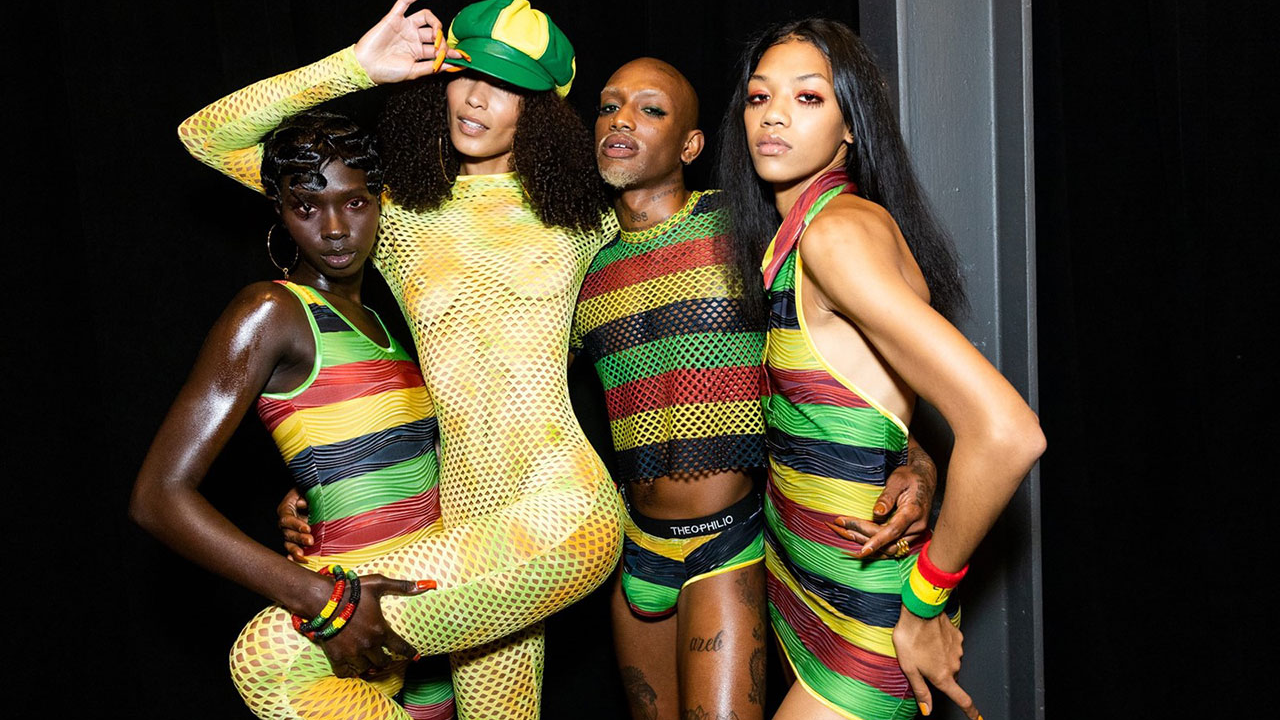
Edvin Thompson’s Theophilio is one example. The Kingston-born designer has built Jamaican heritage, colour, silhouettes and cultural references directly into a New York fashion practice. Teen Vogue described the label’s aesthetic as “dancehall chic,” while SSENSE has placed Thompson alongside a wider generation of Jamaican and Jamaican-descended designers reshaping the international fashion conversation. (Teen Vogue)
Rachel Scott’s Diotima offers another route.
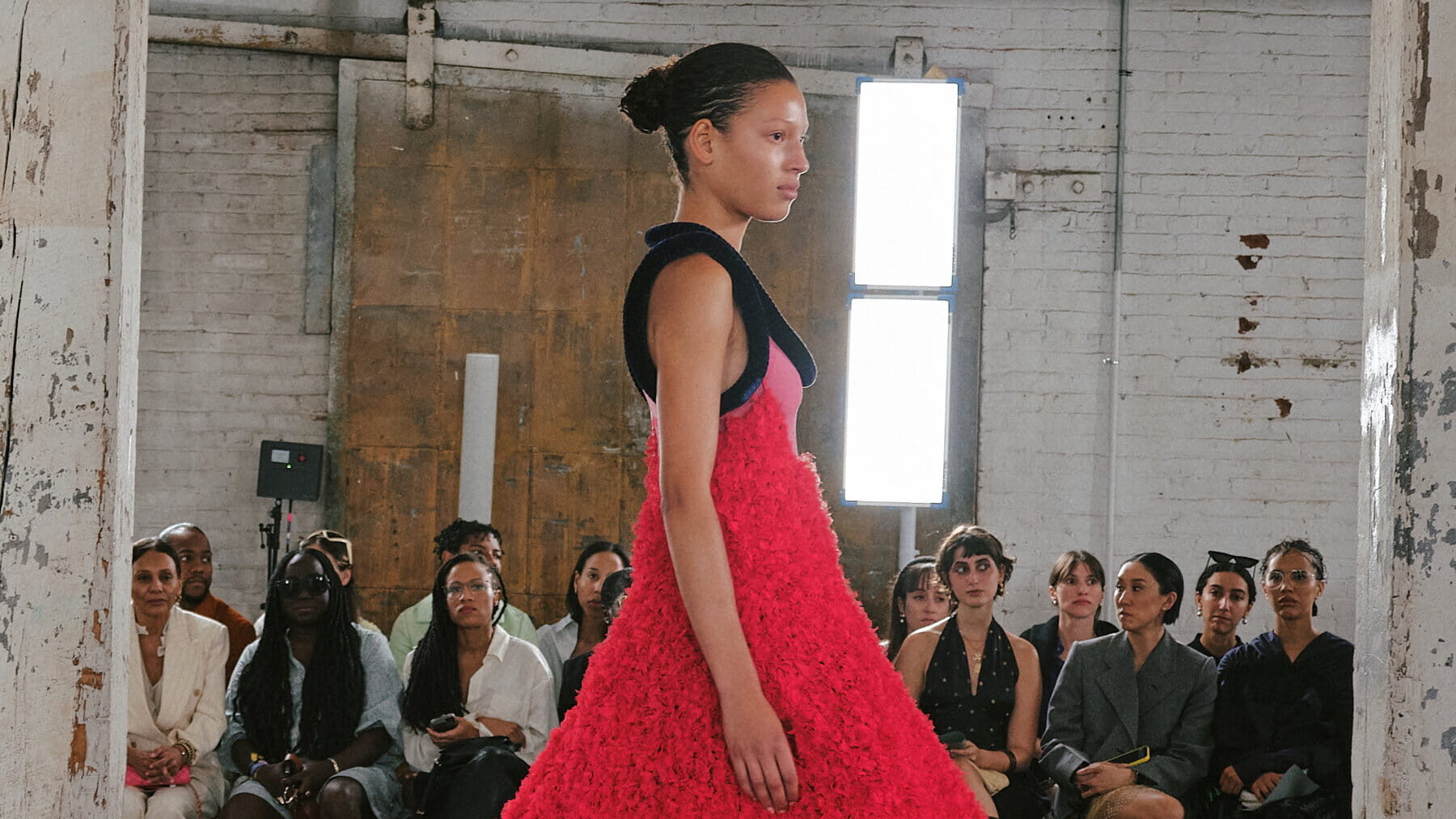
Her work draws on Jamaican heritage and her upbringing in Kingston, including visual memories of mesh marinas, Clarks and dancehall culture. Vogue has documented how those references inform her work and how Jamaican craftsmanship, particularly crochet, has become part of the label’s identity. (Vogue)
This is an important evolution.
The story is no longer only about Jamaica inspiring somebody else’s collection.
Jamaican designers are increasingly entering the room themselves.
The fashion industry is finally having the Jamaica conversation
That shift is visible in fashion media too.
SSENSE has written about the expanding international presence of Jamaican designers including Martine Rose, Grace Wales Bonner, Theophilio, Diotima, Stanley Raffington and Jawara Alleyne. (SSENSE)
Vogue has likewise highlighted the current Jamaican fashion ecosystem and its relationship to global designers and brands. (Vogue)
The interesting thing is that this new generation is not simply reproducing a nostalgic version of dancehall.
They are doing something more sophisticated.
They are treating Jamaica as source material, lived experience and design methodology.
The difference matters.
The old pattern was:
Jamaica creates. The world borrows.
The emerging pattern is:
Jamaican designers create. The world has to engage.
That is a much more interesting future.
The credit problem is part of the story
There is a reason this article needs to be more than a celebration of Jamaican influence.
Fashion has a long history of stripping ideas from their original social context and giving them new prestige somewhere else.
Dancehall is particularly vulnerable to this because its visual language has often been dismissed when worn by the people who created it.
The same combination of mesh, body-conscious silhouettes, dramatic accessories, colour and nightlife styling can be read as excessive or “ghetto” in one context and editorially sophisticated in another.
That does not mean every international designer who uses a similar element is appropriating dancehall.
Influences overlap.
Fashion is built on borrowing.
But attribution still matters.
If a visual language has a history, knowing that history changes how we understand the look.
And if Jamaican designers and communities helped develop it, they should not disappear from the story when the aesthetic becomes valuable elsewhere.
Dancehall did not invent fashion’s appetite for Jamaica
There is another important distinction.
Jamaican influence on global fashion predates dancehall.
The island’s music, Rastafari, ska, reggae, Caribbean identity and broader Black Atlantic culture have all shaped international style.
John Galliano’s well-known Dior Rasta collection is part of that larger history. Contemporary fashion coverage has also traced a much longer relationship between global fashion and Jamaican cultural references. (SSENSE)
So dancehall should not be presented as the single source of every Jamaican influence in fashion.
Its contribution is different.
It took the Jamaican instinct for style, performance and cultural self-definition and made it intensely urban, visual and immediate.
It turned the dance into a runway.
And then the runway started looking back.
So, did dancehall change global fashion?
Yes, but not in the simplistic sense that one Jamaican genre invented modern fashion.
Fashion does not work that way.
Dancehall changed the global fashion conversation by demonstrating the power of a particular combination:
street style + performance + sexuality + customisation + excess + confidence + cultural identity.
It showed that fashion could be generated outside the traditional centres of fashion authority.
It showed that a community could establish its own visual rules.
It showed that an outfit could be a performance before anyone called it one.
And it showed that street culture could generate ideas sophisticated enough to travel into luxury fashion.
Perhaps the most important part is what happened when those ideas travelled.
The world did not suddenly teach Kingston how to dress.
Kingston had already figured that out.
The world simply got better at noticing.
Frequently Asked Questions
What is dancehall fashion?
Dancehall fashion is the distinctive style culture that developed around Jamaica’s dancehall scene. It encompasses clothing, tailoring, footwear, jewellery, hair, beauty and overall presentation. It is closely tied to performance, identity, status and visibility.
What is the influence of dancehall fashion?
Dancehall fashion has influenced international street style, music performance, clubwear and elements of luxury fashion. Its visual language has travelled through Jamaican artists, the diaspora, popular music and fashion media. Academic research has identified international fashion as one area in which dancehall’s broader cultural influence is visible. (Nova Southeastern University)
How did Jamaican dancehall influence luxury fashion?
The relationship is complex rather than a simple story of direct copying. Jamaican dancehall developed distinctive combinations of mesh, colour, jewellery, body-conscious silhouettes and customised clothing, and Jamaican fashion coverage has documented similarities between those styles and elements appearing in collections by luxury houses including Versace and Burberry Prorsum. (Jamaica Observer)
Who is Earl “Biggy” Turner?
Earl “Biggy” Turner is a Jamaican fashion designer closely associated with dancehall. He became particularly prominent for creating flamboyant custom designs for major Jamaican artists, including Shabba Ranks, and helped establish the visual language of dancehall fashion internationally. (Jamaica Observer)
Why is Shabba Ranks important to dancehall fashion?
Shabba Ranks helped carry Jamaican dancehall’s music and visual culture onto international stages in the early 1990s. His flamboyant custom clothing, particularly designs associated with Earl “Biggy” Turner, made fashion part of his international artist identity. (donotcallmeafashionista.blogspot.com)
What is a mesh marina?
A mesh marina is a Jamaican sleeveless mesh garment that became strongly associated with dancehall style, particularly in the 1990s. It was often worn close to the body and paired with jewellery and other statement pieces. (Jamaica Observer)
Which Jamaican designers are influencing global fashion today?
Contemporary Jamaican and Jamaican-descended designers working internationally include Edvin Thompson of Theophilio, Rachel Scott of Diotima, Martine Rose, Grace Wales Bonner, Stanley Raffington and Jawara Alleyne. Their work reflects different relationships with Jamaican identity, culture and design. (SSENSE)
At five in the morning, downtown Kingston belongs to people most of the city will not see.
The vendors are already there.
The produce has arrived.
Plastic bags are being opened. Crates are being shifted. Handcarts move through narrow spaces. Someone is calling out a price. Someone else is asking where the yam came from. A buyer is already looking for the best bunch of bananas before the morning crowd arrives.
Outside, Kingston is still dark.
Inside Coronation Market, the day has already started.
That is the first thing to understand about Coronation Market. It is not simply a place where Kingston goes to buy food.
It is one of the places that helps Kingston get fed.
The Kingston and St Andrew Municipal Corporation lists Coronation Markets and its annexes as one of the municipality’s major wholesale and retail food markets, with 1,763 vending facilities offering ground provisions, fruits, vegetables and groceries. (Kingston & St. Andrew Council)
By the time most office workers are thinking about coffee, the market has already been trading for hours.
And at 5 AM, before the city arrives properly, you can see the system underneath the noise.
Coronation Market Kingston starts before Kingston does
There is a particular misconception about markets.
People imagine the market begins when the customers arrive.
It does not.
The market begins with movement.
Farmers and traders have already sourced produce. Vendors have to get it into the market. Goods have to be sorted, displayed and priced. Buyers who know what they want can arrive early, sometimes before daylight, because early morning is when the market’s working rhythm is most apparent.
A recent account of shopping at Coronation describes arriving around 5:30 AM and finding the market still poorly lit in places, with shoppers using phone lights to examine produce. It is a useful reminder that “5 AM Coronation” is not a polished tourist experience. It is a working market. (Jamaican Cookery)
That distinction matters.
This is not the Jamaica of resort brochures.
It is the Jamaica of people getting the day’s food into the city’s hands.
The first thing you notice is not the colour
It is the sound.
Markets have their own acoustics.
A crate hits the ground.
A vendor calls to somebody across an aisle.
A buyer asks for a price.
A handcart rattles over the floor.
Plastic rustles.
Someone laughs.
Someone complains.
Somebody is already bargaining.
Then, gradually, the voices multiply.
By mid-morning, Coronation can feel almost theatrical.
At five, it is different.
The market is still becoming itself.
There are gaps between the voices. Spaces between customers. Moments when you can hear individual transactions rather than one continuous wall of sound.
That is when the market reveals its rhythm.
Not chaos.
Coordination.
Follow the produce
The best way to understand Coronation is not to start with the architecture.
Start with what is on the ground.
Yam.
Potatoes.
Sweet potatoes.
Coco.
Bananas.
Plantains.
Dasheen.
Chocho.
Cabbage.
Tomatoes.
Callaloo.
Scallion.
Peppers.
Fruit in season.
The exact mix changes with supply, season and price.
That variability is part of the point.
Coronation connects the city to agricultural production beyond the city.
A 2015 Jamaica Information Service report described Coronation vendors as people who sourced produce despite crop shortages caused by drought, while another JIS account described more than 50 Coronation vendors taking their produce to an uptown farmers’ market. (Jamaica Information Service)
The market is therefore not an isolated downtown attraction.
It is a junction.
Farmers.
Higglers.
Wholesalers.
Retailers.
Restaurant buyers.
Households.
All meeting over food.
The people who arrive first know what they are doing
There is a difference between somebody visiting a market and somebody shopping a market.
The regular knows the questions.
Where did this come from?
When did it arrive?
Is this today’s?
How much for the whole bag?
What happened to the price?
Is there more inside?
Can you give me a better price if I take two?
They can look at a pile of produce and see differences that a casual shopper misses.
Freshness.
Size.
Ripeness.
Damage.
Variety.
Potential shelf life.
That knowledge is part of the market’s invisible infrastructure.
It does not appear on a sign.
It is transmitted through repetition.
A person learns from shopping.
A vendor learns from selling.
A farmer learns from what buyers reject.
And the information travels back through the chain.
“Higgler” is not just an old-fashioned word
Jamaica has its own vocabulary for market life.
Higgler is one of the most familiar.
The word carries a complicated history, but in Jamaica it is closely associated with informal trade, buying and selling and the movement of goods.
A higgler is not merely somebody standing behind a table.
The trade depends on relationships.
Who has produce.
Who needs produce.
Who can move it.
Who has customers.
Who knows a farmer.
Who knows what will sell today.
The market is a network before it is a building.
That is why simply describing Coronation as a collection of stalls misses what makes it important.
This is one of Kingston’s oldest commercial rhythms
Coronation did not appear in isolation.
Kingston’s market system has deep historical roots.
Markets such as Jubilee, Coronation, Solas and others helped structure the city’s commercial life, connecting produce arriving from different parts of Jamaica with consumers in Kingston. Historical accounts describe produce moving into the city by truck, tractor, dray and railway, with markets functioning as major points of exchange. (Jamaica Observer)
That history helps explain why downtown remains so important to Jamaica’s food trade.
The city grew around commerce.
The markets grew with it.
Then the city expanded outward.
Supermarkets appeared.
Shopping centres multiplied.
Kingston’s commercial centre changed.
But Coronation remained.
That persistence is part of the story.
At five, the city feels different
There is another reason to go early.
Kingston before sunrise is a different city.
The traffic has not built up.
The office workers are not moving through downtown.
The streets have not filled.
The market, however, is already awake.
That creates a strange inversion.
The city centre appears quiet from outside.
Inside, there is economic activity.
It is one of the great contradictions of urban life.
The people who make the city function are often moving before the people who work in its offices have left home.
And Coronation makes that visible.
The best produce is not necessarily the prettiest
This is another lesson the supermarket shopper can forget.
A supermarket trains you to expect uniformity.
Similar sizes.
Clean surfaces.
Neat rows.
Predictable packaging.
Markets work differently.
A pile of mangoes can be uneven.
A yam can be enormous.
A bunch of bananas can be at a different stage of ripeness from the one beside it.
A pepper can look slightly imperfect and still be exactly what somebody wants.
The shopper is expected to look.
Touch.
Ask.
Compare.
Choose.
That relationship between buyer and food is one of the reasons markets remain culturally important even as supermarkets become more convenient.
You are not simply selecting a packaged object.
You are evaluating produce.
Then the bargaining begins
Nobody should pretend every Coronation transaction is a theatrical performance of charming Jamaican bargaining.
Sometimes the price is simply the price.
Sometimes the buyer bargains.
Sometimes the vendor refuses.
Sometimes they meet somewhere in the middle.
But negotiation is part of the market’s social language.
The transaction can contain more information than the number on a price.
A vendor knows what the produce cost.
The buyer knows what they paid last week.
Both know what season it is.
Both know whether supply is tight.
The conversation is therefore part of price discovery.
It is economics conducted out loud.
That is one reason markets remain fascinating even for people who have no particular interest in shopping.
You can watch an economy negotiate with itself.
Coronation has seen Kingston at its best and worst
It would be dishonest to turn Coronation into a romantic postcard.
The market has had serious problems.
Crime has affected vendors and customers.
Infrastructure and sanitation have been longstanding concerns.
The market district has also experienced periods when fear, rumours and violence affected business.
In 2021, vendors told the Jamaica Observer that robberies and false reports about violence were hurting sales, while police increased their presence in the district. (Jamaica Observer)
Earlier reporting also documented significant problems with the physical condition and management of downtown markets. (Jamaica Gleaner)
Those realities belong in the story.
So does the fact that the market has repeatedly been renovated and improved.
After the 2010 violence in downtown Kingston, Coronation Market vendors were among those affected, and the market underwent subsequent renovation. The Kingston mayor’s office later highlighted improvements completed in 2011 and described continued efforts to improve management and upkeep. (Jamaica Parliament)
A real market is not cleanly divided into “beautiful” and “broken.”
It can be both.
It can be essential and difficult.
It can be vibrant and imperfect.
That is much more interesting than pretending otherwise.
There is a reason the market matters to people who never shop there
Walk into a supermarket and you are looking at the final stage of a food system.
Walk into Coronation early enough and you are closer to the machinery.
You see the people.
You see the volume.
You see the negotiation.
You see produce in quantities that make it obvious food does not simply appear on shelves.
That matters in a country where food security, agricultural production and food prices are serious national questions.
A market makes those questions tangible.
If yam prices change, somebody feels it.
If a crop fails, somebody feels it.
If transport costs rise, somebody feels it.
If a farmer cannot get a fair return, somebody eventually feels it.
The market is where those pressures meet the consumer.
And then Kingston starts arriving
At some point, the market changes.
The early-morning buyers are joined by more customers.
The quiet gaps disappear.
The voices overlap.
The aisles become harder to navigate.
The city outside becomes louder.
Kingston has woken up.
And Coronation has been awake the entire time.
That is perhaps the best reason to see it early.
At ten in the morning, you see the market as a destination.
At five, you see it as infrastructure.
The market is not performing for you
This is important if you are visiting.
Do not arrive expecting a curated cultural attraction.
Coronation is a working market.
People are there to make money.
People are there to buy food.
People are moving goods.
If you photograph somebody, ask first.
If you are in somebody’s way, move.
If you do not know what something is, ask rather than grabbing it.
And if you want to experience the market properly, go with someone who knows it.
The market rewards context.
A local can tell you what is worth buying, what is in season, which areas sell what, when to arrive and how to move through the space without becoming another obstacle.
The difference between being a visitor and being a nuisance is often simply awareness.
Go hungry, but know what you are looking for
If you are going to Coronation at five in the morning, do not arrive with a rigid shopping list and a stopwatch.
Leave room for discovery.
Look at what is actually abundant that day.
Ask vendors what is fresh.
Watch what regular customers are buying.
Pay attention to the produce that keeps moving.
The market can tell you what Jamaica is eating right now.
That may be more interesting than any restaurant trend report.
There is a bigger story hiding in the market
Coronation is often discussed as a downtown Kingston issue.
It is more than that.
It is part of Jamaica’s food infrastructure.
It connects rural production with urban consumption.
It supports thousands of transactions.
It provides livelihoods.
It preserves forms of trading knowledge that predate modern supermarkets.
And it keeps downtown connected to the agricultural Jamaica outside the city.
The market is therefore a physical expression of something Jamaica sometimes forgets.
The island is not just beaches, hotels and restaurants.
There is a country behind the plate.
Coronation is one of the places where you can watch that country arrive.
By sunrise, the secret is gone
The magic of Coronation at 5 AM is not that it is empty.
It is that the market is already full of life before most of Kingston has noticed.
The vendors are there.
The produce is there.
The negotiations have started.
The work is underway.
Then the sky lightens.
The roads fill.
The city arrives.
And Coronation becomes what everybody knows it as: busy, loud, crowded, colourful and impossible to ignore.
But if you arrive before sunrise, you get to see something else.
Not a tourist attraction.
Not a nostalgic version of Kingston.
Not a market performing Jamaican culture for an audience.
You see a working city feeding itself.
And for a few hours before Kingston wakes up, you can hear the machinery underneath it.
Frequently Asked Questions
Where is Coronation Market in Kingston?
Coronation Market is in downtown Kingston, with the Kingston and St Andrew Municipal Corporation listing the market and its annexes at 34½ Spanish Town Road. (Kingston & St. Andrew Council)
What can you buy at Coronation Market?
The market specialises in wholesale and retail food products, including ground provisions, fruits, vegetables and groceries. What is available changes with season, supply and demand. (Kingston & St. Andrew Council)
What time should you visit Coronation Market?
There is no single official “5 AM opening” time that should be treated as universal. Trading activity begins early, and accounts from early-morning shoppers describe arriving around 5:30 AM. The exact experience varies by vendor, day and market section. (Jamaican Cookery)
Is Coronation Market worth visiting as a tourist?
Yes, if you are interested in Jamaican food culture and everyday Kingston rather than a curated attraction. It is a working market, so visitors should be respectful, ask before photographing people and avoid obstructing vendors or shoppers.
Is Coronation Market safe?
Conditions can change, and the market has experienced documented problems with robbery and other crime in the past. Visitors should check current local conditions, go with someone familiar with the area where possible and use normal urban safety precautions. Historical reporting should not be treated as a current crime assessment. (Jamaica Observer)
Why is Coronation Market important to Kingston?
It is a major wholesale and retail food market connecting agricultural producers, traders, vendors and consumers. The municipal corporation lists 1,763 vending facilities across the Coronation Markets and annexes. (Kingston & St. Andrew Council)
What is a higgler in Jamaica?
“Higgler” is a Jamaican term historically associated with people involved in buying and selling goods, particularly through informal and market-based trade. The term is closely associated with Jamaica’s long-established trading culture.
There was a time when you could walk through a Jamaican neighbourhood and find lunch growing over somebody’s fence.
June plum hanging heavy from a tree.
Otaheite apples turning red in the sun.
Guineps appearing in season by the bagful.
A star apple tree doing what star apple trees do, holding its fruit stubbornly to the branches.
You did not necessarily buy these fruits. Somebody’s yard had them. A neighbour had them. An auntie had them. Somebody’s grandfather had planted the tree years before and never thought of it as anything particularly special.
That is what makes the quieter disappearance of some Jamaican fruits worth noticing.
This is not a story about Jamaica running out of fruit. The island still produces mangoes, bananas, pineapples, citrus, ackee, breadfruit and plenty more.
It is about something more specific.
Some of the fruits that once belonged to everyday Jamaican backyard life are becoming harder to encounter casually.
Agricultural records have recognised the problem for decades. A Food and Agriculture Organization assessment of Jamaica identified traditional “non-orchard” fruits including ackee, guava, June plum, mango, naseberry, otaheite apple, star apple, soursop and tamarind, and noted that many tropical non-orchard fruits were becoming scarce as natural habitats were eroded. The report also pointed to low returns, long production cycles, limited land, weak markets and praedial larceny as barriers to fruit-tree cultivation. (FAOHome)
Today, there is another pressure.
The backyard is changing.
And when the backyard changes, the fruit tree goes with it.
What counts as a “rare Jamaican fruit”?
First, a correction.
Most of the fruits in this story are not botanically Jamaican, and some are not particularly rare in the agricultural sense.
June plum, for example, originated in Polynesia and was introduced to Jamaica in the eighteenth century. Otaheite apple is native to Southeast Asia. (ScienceDirect)
“Jamaican fruit” here means something different.
It means a fruit that has become part of Jamaican food culture, memory and everyday life.
Some are now less commonly encountered in yards or markets than they once were. Others remain widely available during their seasons but have become less familiar to younger Jamaicans.
That distinction matters because nostalgia can exaggerate disappearance.
The evidence supports a story about changing availability and cultivation, not a claim that these fruits are on the verge of extinction.
And some are still readily obtainable as trees. Jamaica’s Forestry Department continues to list June plum, otaheite apple, guinep, star apple, mammee, rose apple, mountain guava and other fruit trees among its regular food and fruit trees. (Forestry Department)
The trees are still there.
The question is whether enough people are still planting them.
1. June Plum
If any fruit can make a Jamaican suddenly eight years old again, it is June plum.
Green and crunchy with salt.
Ripe and yellow.
Sliced into pieces.
Blended into juice.
Turned into a drink.
Or eaten straight from the tree before anybody has had a chance to tell you that it is not ready yet.
The June plum tree can become enormous, which is part of the problem.
Jamaica’s Forestry Department says a June plum tree can reach 10 to 15 metres at maturity and takes roughly four to five years to mature. It remains available through the Forestry Department’s plant programme, including dwarf varieties. (Forestry Department)
So it is not disappearing.
But the economics of planting a large fruit tree in a small modern yard are different from those of a Jamaican yard several generations ago.
There is also the question of time.
You plant it now.
You wait years.
You need space.
You have to protect it.
And when the fruit arrives, somebody has to harvest it.
A supermarket shelf makes none of those demands.
2. Otaheite Apple
The Otaheite apple is one of those fruits that looks almost invented.
Deep red skin.
White, watery flesh.
A shape somewhere between an apple and a pear.
And a name that makes you wonder why Jamaica’s version of an apple has nothing to do with the apples in the supermarket.
It has been part of Jamaican food culture for generations and has traditionally been eaten fresh or used in drinks. Jamaica’s official tourism site still includes Otaheite apple among the country’s characteristic foods and describes its crisp white flesh and crimson skin. (Visit Jamaica)
The Forestry Department lists the local Otaheite apple as a regular fruit tree. It says the tree takes about four to five years to reach maturity and can grow between five and 20 metres. (Forestry Department)
Again, the issue is not extinction.
It is familiarity.
If you grew up with an Otaheite apple tree nearby, you know exactly what it is.
If you did not, you might walk past one without knowing what was hanging from it.
That is how cultural disappearance often begins.
Not with the tree dying.
With nobody recognising it.
3. Guinep
Guinep season used to create its own kind of temporary economy.
Somebody had guineps.
Somebody else had mangoes.
Someone had June plums.
Children traded.
Adults traded.
Vendors sold them in bags.
The fruit is almost comically simple: crack the green skin, pull out the slippery flesh and work around the seed.
But that simplicity is precisely what makes guinep memorable.
There is no packaging.
No preparation.
No recipe.
Just fruit.
The Forestry Department continues to list guinep, Melicoccus bijugatus, among Jamaica’s regular food and fruit trees. (Forestry Department)
Yet guinep is also a good example of the difference between being available and being central to everyday life.
A fruit can still exist in Jamaica while becoming less visible in the places where people live.
4. Star Apple
Star apple has one of the best names in Jamaican fruit culture.
Cut it across and the flesh and seeds can form a star-like pattern.
The fruit itself is soft, sweet and almost custard-like when properly ripe.
Jamaica’s tourism authority notes another Jamaican observation: the fruit is sometimes called the “mean” fruit because it can remain attached to the tree even after ripening. It also records the traditional Jamaican dessert of combining star apple pulp with sweetened milk, known as matrimony. (Visit Jamaica)
That dessert alone tells you something.
This was not simply a fruit.
It was part of a household food culture.
The Forestry Department still lists star apple among its regular fruit trees. (Forestry Department)
But star apple trees need room, and old backyard trees cannot simply be replaced overnight.
Once a mature tree is removed for construction, there is no equivalent replacement waiting on the supermarket shelf.
5. Mammee Apple
Mammee apple is one of those Jamaican fruits that can feel almost forgotten until somebody mentions it.
Then somebody else remembers.
It is large.
It has thick skin.
The flesh can range from yellow to orange and has a distinctive flavour.
It is also not the easiest fruit to grow casually. Like many large perennial fruit trees, it needs time and space.
The Forestry Department continues to list mammee apple, Mammea americana, among its regular food and fruit trees. (Forestry Department)
Its presence on the official list is reassuring.
Its absence from many modern yards is less so.
That is the larger pattern with these fruits.
The question is not whether the government knows the tree exists.
It does.
The question is whether ordinary households are still making room for it.
6. Rose Apple
Rose apple is another fruit that belongs to an older Jamaican landscape.
The tree can be substantial, the fruit is aromatic and the name itself has the slightly mysterious quality of many old Caribbean food names.
The Forestry Department lists rose apple among Jamaica’s regular fruit trees. (Forestry Department)
It is also a reminder that “rare” does not necessarily mean commercially valuable.
A tree can be useful to a household without ever becoming a major commercial crop.
That was part of the genius of the old backyard food system.
The yard did not need to make money from every tree.
A tree could provide fruit for the family, shade for the house and something to give to a neighbour.
That economic logic is harder to reproduce when land itself becomes more valuable.
7. Stinking Toe
Then there is stinking toe.
Even the name sounds like Jamaica decided that fruit should have a personality.
The fruit comes from the locust tree, Hymenaea courbaril, and Jamaica’s tourism authority includes it among the island’s distinctive fruits. The Forestry Department also lists it among its regular food and fruit trees. (Visit Jamaica)
It is not a fruit you buy every week.
It is not competing with mangoes for supermarket shelf space.
And that is precisely why it belongs in this conversation.
Some Jamaican fruits survived not because they were commercially dominant, but because somebody knew where the tree was.
A child knew.
A grandmother knew.
A neighbour knew.
When that network of knowledge disappears, the fruit becomes functionally rare even if the species itself remains.
The backyard was once part of Jamaica’s food system
This is the bigger story.
A Jamaican backyard was not necessarily ornamental.
It could be productive.
Fruit trees did not need to form an orchard to matter.
One mango tree could supply a family.
One June plum tree could supply a neighbourhood.
One Otaheite apple tree could produce enough fruit for eating, sharing and making drinks.
That informal production system is precisely why older agricultural literature treated many Jamaican fruit trees as “non-orchard” crops. They were not necessarily grown in large commercial plantations, but they were part of the country’s agricultural landscape. (FAOHome)
The problem is that informal systems are easy to overlook.
There is no giant June plum industry to measure.
No national campaign announces that the number of backyard guinep trees has fallen.
Nobody reports the loss of one old Otaheite apple tree in a suburban yard.
But multiply those losses across generations and the landscape changes.
Space is becoming part of the problem
A mature fruit tree is a commitment.
It takes years.
It occupies space.
Roots spread.
Branches cross boundaries.
Fruit falls.
Birds arrive.
Neighbours complain.
Children climb.
Somebody has to prune it.
For an older Jamaican house with a large yard, that could be perfectly normal.
For a modern home on a much smaller lot, it may feel like a nuisance.
The tree loses.
The Forestry Department’s current planting programme shows that these trees remain viable choices, but it also illustrates how deliberate planting has become. June plum and Otaheite apple are now items that people can seek out from a plant sale rather than simply trees that happen to be growing behind the house. (Forestry Department)
That is a subtle but important cultural shift.
Markets favour some fruits over others
There is another reason certain fruits become harder to encounter.
Markets reward predictability.
Commercial agriculture generally prefers crops with reliable demand, organised distribution, appropriate production economics and established buyers.
Older Jamaican agricultural analysis identified several reasons why farmers were reluctant to grow traditional non-orchard fruit crops as dedicated commercial crops, including long production periods, low returns, limited land, inadequate markets and praedial larceny. (FAOHome)
That creates a strange situation.
A fruit can be beloved.
It can have cultural significance.
People can still enjoy eating it.
And yet it may make little sense for a farmer to dedicate valuable land to producing it.
That is how a fruit becomes a seasonal memory rather than a reliable commodity.
Some of these fruits are not disappearing at all
This needs to be said plainly.
The headline is deliberately provocative.
The evidence does not establish that June plum, Otaheite apple, guinep, star apple, mammee apple, rose apple and stinking toe are all in measurable population decline across Jamaica.
In fact, Jamaica’s Forestry Department continues to propagate and sell many of them. (Forestry Department)
There are also Jamaicans deliberately maintaining backyard food forests.
In 2026, a Jamaican family’s backyard food forest was profiled for producing breadfruit, June plums, avocado, lemons and other crops despite being planted on rocky land. (The Cool Down)
So the better story is not “these fruits are about to disappear.”
It is:
Why are fruits that once felt ordinary becoming less ordinary?
That is a much harder question.
And then Hurricane Melissa changed the conversation
Jamaica’s fruit-tree story has acquired another urgency since Hurricane Melissa struck the island in October 2025.
In February 2026, the Ministry of Agriculture said the hurricane had destroyed many ackee and breadfruit trees, particularly in western Jamaica, and announced efforts to expand fruit-tree planting. (Ministry of Agriculture and Fisheries)
By June, the government had announced an ambitious programme targeting 3,000 hectares of fruit trees by 2035 as part of a broader effort to strengthen food security and rebuild agricultural resilience. (Jamaica Information Service)
The immediate emphasis has been on crops such as ackee, breadfruit, mango, coconut and avocado.
That makes sense economically.
But it also raises a broader question.
When Jamaica replants its fruit trees, which Jamaica are we replanting?
The export crops?
The commercially important crops?
The familiar national symbols?
Or some of the less celebrated trees that once made individual yards small food forests?
There is room for all of them.
The value of a fruit is not always measured in dollars
A June plum tree does not need to become Jamaica’s next export crop to be valuable.
Neither does an Otaheite apple.
Their value can be cultural.
It can be nutritional.
It can be ecological.
It can be social.
And it can be deeply personal.
The fruit tree gives something else that a supermarket cannot.
Memory with a season.
You know June has arrived because the fruit is appearing.
You know where to find it.
You know who has the tree.
You know which neighbour will give you some.
You know how your grandmother used to eat it.
That knowledge is part of the fruit.
The real loss is knowing what used to grow there
Walk through an older Jamaican community and ask an elderly resident what used to grow in the yards.
The answers can become a catalogue.
Mango.
Guinep.
June plum.
Otaheite apple.
Star apple.
Rose apple.
Sour orange.
Sweet sop.
Mammee.
Tamarind.
Sometimes the tree is still there.
Sometimes it was cut down for a house.
Sometimes the yard was divided.
Sometimes nobody replanted after the old tree died.
Sometimes the younger generation simply preferred something else.
That is how cultural landscapes disappear.
Quietly.
One yard at a time.
Maybe the answer is to plant them again
The good news is that this story has a very practical ending.
You do not need to build a commercial orchard to preserve Jamaican fruit culture.
You need people to plant trees.
The Forestry Department already makes many traditional fruit trees available, including June plum, Otaheite apple, guinep, star apple, mammee, rose apple and others. (Forestry Department)
The government’s broader fruit-tree planting drive is also creating renewed attention around perennial food crops. (Jamaica Information Service)
The challenge is making sure the planting conversation does not become exclusively about the crops with the biggest export potential.
A country can have a thriving fruit industry and still lose some of the fruits its grandparents knew.
Those are not contradictory things.
One is agriculture.
The other is culture.
Before you forget what they taste like
The next time you see a June plum tree, stop.
If you see an Otaheite apple tree, ask who planted it.
If somebody offers you guineps, take the bag.
If a child does not recognise a star apple, show them how to cut it.
Ask an older relative which fruit used to grow in their yard.
Ask what they called it.
Ask how they ate it.
Ask which ones they miss.
Because the most dangerous thing about a disappearing fruit is not that the tree dies.
It is that nobody notices what has gone missing.
Jamaica still has the trees.
It still has the knowledge.
It still has people who remember.
For now, that means the story does not have to end with loss.
It can end with somebody planting another tree.
Frequently Asked Questions
What are some rare Jamaican fruits?
Fruits that can be less commonly encountered in everyday Jamaican life include June plum, Otaheite apple, guinep, star apple, mammee apple, rose apple and stinking toe. These are not necessarily rare or endangered species. The term “rare” here refers to their declining familiarity or availability in some everyday settings.
Is June plum native to Jamaica?
No. June plum, Spondias dulcis, originated in Polynesia and was introduced to Jamaica in the eighteenth century. It subsequently became well established in Jamaican food culture. (ScienceDirect)
What is an Otaheite apple?
Otaheite apple, Syzygium malaccense, is a tropical fruit with red skin and crisp, watery white flesh. It is native to Southeast Asia but has long been grown and eaten in Jamaica. Jamaica’s Forestry Department continues to list it as a regular fruit tree. (Forestry Department)
Are Jamaican fruits actually disappearing?
There is evidence that traditional non-orchard fruit crops have faced scarcity and declining cultivation pressures, including habitat loss, limited land, low returns, long production periods and inadequate markets. However, there is not sufficient current evidence to say that every fruit discussed here is experiencing a measurable population decline. (FAOHome)
Where can I get Jamaican fruit trees?
Jamaica’s Forestry Department sells a range of fruit trees, including June plum, Otaheite apple, guinep, star apple, mammee and rose apple. Availability varies by plant-sale location and season. (Forestry Department)
What is the difference between a rare Jamaican fruit and an endangered fruit?
A fruit can be uncommon in markets or backyards without its plant species being endangered. This article uses “rare” in the cultural and everyday-availability sense, not as a formal conservation classification.
What is Jamaica doing to plant more fruit trees?
Following the agricultural losses caused by Hurricane Melissa in 2025, the Jamaican government announced expanded fruit-tree planting initiatives. In June 2026, the government announced a target of establishing 3,000 hectares of fruit trees by 2035. (Jamaica Information Service)
Why are traditional fruit trees disappearing from Jamaican backyards?
Several factors can contribute, including smaller residential lots, development, long maturation periods, limited commercial incentives, weak markets, praedial larceny and the replacement of older trees when they die. Historical agricultural analysis has documented several of these pressures. (FAOHome)
On June 18, 2025, Jamaicans did something that would sound ridiculous if you described it without context.
They queued for hours for fried chicken.
At some locations, lines began before opening. Cars backed up onto main roads. Families waited together. Social media filled with photographs and videos of crowds that looked more like concert audiences than customers waiting for lunch.
The reason was KFC Jamaica’s 50th anniversary promotion: buy a three-piece Big Deal and receive two additional pieces through the anniversary offer. The response was so large that Jamaican media treated it as a cultural event in its own right. (Jamaica Gleaner)
But the queues were not really the story.
They were evidence of something Jamaicans have known for years.
KFC is not just another fast-food chain in Jamaica.
It has become part of the country’s social vocabulary.
People joke about it. Families have KFC stories. Artists reference it. Children learn early that a box of KFC can be a reward. Adults who have travelled the world will argue that Jamaican KFC tastes better than KFC elsewhere.
And somewhere along the way, an American fast-food franchise became something that feels distinctly Jamaican.
So why KFC?
KFC arrived in Jamaica earlier than most people realise
The Jamaican KFC story officially begins on June 18, 1975.
That was when the Myers family, operating under licence from Hueblein International, opened the first KFC restaurant at 170 Old Hope Road in Kingston 6. The restaurant was housed in a refurbished residential building and is credited with having Jamaica’s first drive-through. (KFC Jamaica)
But the story starts slightly earlier if you want to understand why the brand was not completely unfamiliar when that first restaurant opened.
Before Restaurants of Jamaica took over the franchise, there were already four Tops restaurants in Kingston selling KFC products. The Myers family eventually acquired those restaurants, refurbished them and brought them under the KFC name. The Cross Roads KFC is one of those former Tops locations. (Jamaica Observer)
That matters.
KFC did not arrive in Jamaica as an entirely foreign concept and immediately demand that Jamaicans change how they ate.
There was already a market.
There was already familiarity with the product.
And there was already an appetite for fried chicken.
The franchise simply built a much bigger machine around it.
Then Jamaica did something unusual with the brand
The international KFC formula stayed intact.
The Jamaican experience did not.
Restaurants of Jamaica says its restaurants use Jamaican-sourced ingredients apart from KFC’s proprietary seasoning. (KFC Jamaica)
More importantly, the franchise developed its own relationship with Jamaican consumers over five decades.
It expanded steadily.
It built restaurants in commercial centres.
It became part of Friday-night routines.
It became a family treat.
It became something you could pick up after school, after work, after church, after a football match or on the way home.
That kind of repetition matters.
A brand becomes culturally embedded not because people occasionally try it, but because it appears in enough ordinary moments that eventually nobody thinks of it as foreign.
The numbers tell part of the story
KFC Jamaica had 32 restaurants across 12 parishes by 2012. (Jamaica Observer)
The operator reported 40 restaurants across 11 parishes in January 2023. (KFC Jamaica)
By the 50th anniversary in 2025, Jamaican reporting put the number at 41 or 42, depending on the point in the anniversary period being reported. (Jamaica Observer)
And the expansion has continued.
In January 2026, the opening of KFC Morant Bay brought the chain to 43 Jamaican restaurants. The Ministry of Industry, Investment and Commerce described the location as the 29th outlet outside Kingston and highlighted the $350 million investment behind it. (Ministry of Industry)
There is another KFC planned for the Constant Spring Road area of St Andrew for the first half of 2027. (Jamaica Observer)
That is not simply a restaurant chain maintaining a footprint.
It is a business continuing to invest in the assumption that Jamaicans will keep showing up.
So far, that assumption has been remarkably good.
The lines are part of the culture
Ask a Jamaican about KFC and the conversation can turn strangely personal.
Where was your first one?
Original or barbecue?
Breast or wing?
Spicy?
When did you first start going?
Did your mother buy it?
Did your father?
Did you get it after school?
Was KFC a special occasion?
Was there a particular branch?
A 2005 Jamaica Observer feature collected exactly these kinds of memories. People described childhood trips to Tops and later KFC, Friday-evening treats, discovering the Old Hope Road location and passing the habit down to their own children. (Jamaica Observer)
That is the part that a conventional market analysis misses.
KFC has accumulated memory.
A teenager buying chicken today may be participating in a ritual their parents established decades earlier.
That is difficult for a competitor to manufacture.
It crosses class in a way that is easy to underestimate
There is a temptation to explain KFC’s popularity through price.
That is only part of it.
The brand is accessible enough to reach a broad customer base, but it also carries enough cultural familiarity to work as a treat, a reward and a small occasion.
That gives it unusual range.
The 2025 anniversary crowds made this visible. Reports showed parents with babies, elderly customers, working people and large groups converging on the same restaurants. (Jamaica Gleaner)
We should be careful about turning photographs from one promotion into a rigorous demographic study. They do not prove that every social class consumes KFC at the same rate.
But they do demonstrate something harder to miss.
KFC has broad social reach.
It can be an ordinary meal.
It can be a reward for a child.
It can be something a family buys when nobody wants to cook.
It can be a nostalgic treat for somebody who grew up eating it.
It can also become a national joke.
That flexibility is part of its strength.
KFC became a reward before it became a ritual
There is a particular Jamaican childhood economy around food.
You behave.
You get something.
You pass an exam.
You get something.
You go somewhere special.
There might be KFC.
That relationship between KFC and reward appears in personal recollections and contemporary commentary. In 2025, dancehall artist Busy Signal described KFC as part of childhood special occasions and family milestones. (Jamaica Observer)
Once a food becomes associated with reward, it acquires emotional value beyond its ingredients.
The chicken is no longer just chicken.
It is Friday.
It is childhood.
It is somebody bringing home the box.
It is the moment your mother said yes.
That is difficult to compete against with a better menu.
Jamaica already loved fried chicken
This is perhaps the biggest reason the KFC story worked.
Jamaica did not need to be persuaded to love fried chicken.
Fried chicken was already comfortably inside Jamaican food culture.
The local tradition includes fried chicken from home kitchens, cookshops, roadside vendors and restaurants.
KFC offered something different.
It standardised the experience.
The seasoning was consistent.
The presentation was recognisable.
The restaurant was clean and predictable.
You could walk into a KFC in Kingston or another Jamaican town and know roughly what you were getting.
That consistency became part of the appeal.
A 2005 Jamaica Observer feature included consumers recalling the cleanliness, speed and freshness they associated with the Old Hope Road restaurant. (Jamaica Observer)
For a growing urban middle class and for families looking for a dependable treat, that mattered.
KFC was not replacing Jamaican fried chicken.
It was creating another category around it.
Then there is the taste argument
Every Jamaican who has eaten KFC abroad knows the conversation.
“It doesn’t taste the same.”
Sometimes it is followed by:
“Jamaica has the best KFC.”
There is no reliable basis for declaring Jamaican KFC objectively better than every other KFC market in the world.
But the belief itself is culturally significant.
The Jamaican KFC experience has developed its own identity, including menu items and flavour associations that customers treat as specifically local.
Barbecue chicken, for example, is repeatedly mentioned in Jamaican discussions of what makes the local experience distinctive. (Jamaica Observer)
The local operator also emphasises Jamaican-sourced ingredients apart from the proprietary seasoning. (KFC Jamaica)
So the interesting question is not whether Jamaica literally has the world’s best KFC.
It is why so many Jamaicans believe it.
And the answer may have less to do with blind loyalty than with localisation.
The brand has been in Jamaica for 50 years.
It has been cooked, served and experienced by generations of Jamaican workers.
It has been incorporated into Jamaican routines.
At some point, the question stops being whether KFC is Jamaican.
It simply becomes part of Jamaica.
KFC has also learned how to become local
This is where the history of Restaurants of Jamaica matters.
The local franchise was not simply an American corporation operating restaurants on the island.
The Myers family built the Jamaican operation over decades.
The company says it now employs about 2,500 people and has invested in community programmes, schools, sports and other national initiatives. (Jamaica Observer)
The Jamaican government has also publicly described KFC and Restaurants of Jamaica as contributors to employment, investment and community development. At the 2025 opening of the Black River restaurant, Prime Minister Andrew Holness described the brand as woven into Jamaican identity and pointed to its involvement in sports and community initiatives. (Office of the Prime Minister of Jamaica)
That does not make KFC a Jamaican-owned brand.
It does explain why the relationship can feel different from simply buying an imported product.
The company has local employees.
Local operators.
Local suppliers.
Local restaurants.
Local advertising.
Local memories.
Local jokes.
Local arguments.
And five decades of history.
The brand became part of Jamaican popular culture
You know a brand has crossed the line from commercial product to cultural object when people start making art about it.
In 2019, Jamaican recording artist Shalam released “Weh Di Bwoy Put Inna Chicken?”, a satirical song questioning the country’s loyalty to KFC.
Six years later, when the 50th-anniversary promotion sent customers flooding into KFC locations, the song came back with it.
Social-media users used clips of the track over videos of the queues.
That is almost perfect Jamaican cultural behaviour.
If something is absurdly popular, somebody will make a song about it.
If the song is funny enough, the country will use it to explain itself.
Even the obsession is something Jamaicans argue about
The best thing about the KFC phenomenon is that Jamaicans are not unanimous about it.
Some people love it.
Some insist the chicken was better years ago.
Some prefer local fried chicken.
Some think the barbecue is the best thing on the menu.
Some think the entire phenomenon is ridiculous.
Some will tell you that KFC is practically the national dish.
One 2025 Gleaner letter even repeated the joke that KFC, rather than ackee and saltfish, had become the country’s “national dish.” That is obviously not an official designation. It is a measure of how deeply the brand has entered the national conversation. (Jamaica Gleaner)
And that distinction is important.
KFC is not Jamaica’s national dish.
It may, however, be one of Jamaica’s most successful foreign cultural imports.
The “Americanisation” explanation is too easy
There is a serious cultural argument here.
KFC is an American brand.
Fast food has been part of the wider American cultural influence on Jamaica, and research into nutrition and media in Jamaica has identified KFC as a particularly prominent fast-food advertiser. Scholars have also discussed the broader process of “remote acculturation”, through which American media, products and cultural influences affect Jamaican life without requiring physical migration. (PubMed Central (PMC))
But stopping there misses the more interesting part.
Jamaicans did not simply consume KFC because America told them to.
They made it their own.
They fitted it into family routines.
They created local memories around it.
They argued about the taste.
They made jokes about it.
They put it into songs.
They kept eating it for five decades.
Culture is not just what arrives.
It is what people do with what arrives.
The real secret may be consistency
KFC’s 11 herbs and spices get most of the attention.
But the deeper competitive advantage may be much less mysterious.
It has been there.
For fifty years.
The first generation remembers it.
Their children remember it.
Their grandchildren know it.
A Jamaican can leave the island, live abroad for years and still have an opinion about Jamaican KFC.
That is brand equity in its most powerful form.
Restaurants of Jamaica’s own history says the company deliberately focused from the beginning on quality and affordability, and the Jamaica Observer has reported that those priorities helped build generational loyalty. (Jamaica Observer)
Taste gets you back the first time.
Memory can get you back for decades.
Why the queues keep happening
So, what actually explains the obsession?
Probably not one thing.
It is the combination.
Familiarity. KFC has been part of Jamaican life since 1975.
Accessibility. The chain has expanded far beyond Kingston and continues to open locations across the island.
Consistency. Customers know what they are going to get.
Localisation. The Jamaican operation has its own ingredients, menu associations, marketing and cultural history.
Reward. KFC became associated with treats, milestones and family occasions.
Memory. People inherit the habit.
Identity. The brand has accumulated Jamaican references that did not exist when it first arrived.
Scarcity and excitement. Promotions can turn an ordinary purchase into an event, as the 2025 anniversary crowds demonstrated.
And then there is the simplest explanation of all.
Jamaicans like fried chicken.
Very much.
Maybe the question is backwards
We keep asking what KFC did to Jamaica.
After 50 years, perhaps the more interesting question is what Jamaica did to KFC.
It took a global fast-food formula and made it part of local life.
It gave the brand family memories.
It gave it Jamaican arguments.
It gave it dancehall jokes.
It gave it a local franchise story.
It gave it generations of employees and customers.
It gave it a place in national conversation that cannot be explained by advertising alone.
That is why the lines are so fascinating.
When hundreds of people wait outside a KFC for hours, they are not necessarily demonstrating that fried chicken is irresistible.
They are demonstrating what happens when a commercial product becomes part of a culture’s memory.
The chicken is only the beginning.
The real product is familiarity.
And Jamaica has had 50 years to get very familiar with it.
Frequently Asked Questions
When did KFC first open in Jamaica?
The first official KFC restaurant operated by Restaurants of Jamaica opened on June 18, 1975, at 170 Old Hope Road in Kingston 6. The Myers family opened the restaurant under licence from Hueblein International. (KFC Jamaica)
Who owns KFC Jamaica?
KFC Jamaica is operated locally by Restaurants of Jamaica (ROJ), which holds the KFC franchise licence from Yum!, the international franchisor. The Jamaican operation was established by the Myers family in 1975. (KFC Jamaica)
Why is KFC so popular in Jamaica?
There is no single documented explanation. Its five-decade presence, broad islandwide footprint, consistent product, localised operation, affordability, family traditions and strong association with rewards and special occasions have all contributed to its cultural position.
Does Jamaican KFC taste different?
The experience is locally distinctive, but there is no objective basis for saying Jamaican KFC tastes better than every other KFC market. Restaurants of Jamaica says its restaurants use Jamaican-sourced ingredients apart from KFC’s proprietary seasoning, while local menu and flavour preferences have developed their own identity. (KFC Jamaica)
How many KFC restaurants are there in Jamaica?
The number changes as new restaurants open. The Jamaican government reported 43 KFC restaurants following the opening of the Morant Bay location in January 2026. (Ministry of Industry)
Is KFC a Jamaican company?
KFC is an international American brand. Its Jamaican franchise is operated locally by Restaurants of Jamaica, which was established by the Myers family in 1975. The distinction matters, but so does the fact that the local operation has become deeply embedded in Jamaican economic and cultural life. (KFC Jamaica)
What was the 2025 KFC Jamaica anniversary promotion?
For KFC Jamaica’s 50th anniversary, the company offered customers two additional pieces of chicken with the purchase of a qualifying three-piece Big Deal. The promotion generated exceptionally long queues and significant social-media attention across Jamaica. (Jamaica Gleaner)
Is KFC Jamaica’s national dish?
No. Jamaica has no official designation making KFC its national dish. The phrase is a cultural joke that illustrates the brand’s extraordinary popularity. Ackee and saltfish remains Jamaica’s officially recognised national dish.
The Jamaica you see at noon is not always the Jamaica you get at 9 p.m. In some of the island’s most familiar places, the light changes, the music gets louder and an ordinary beach, heritage site or waterfront becomes something else entirely.
There is a version of Jamaica that belongs to daylight.
You visit Devon House for the mansion and ice cream. You walk Seven Mile Beach with the sun overhead. You surf Boston Bay, photograph Port Antonio’s old buildings or watch the boats around Montego Bay.
Then the sun goes down.
Suddenly, the same places have different rules.
A heritage courtyard becomes a dinner destination. A beach becomes a music venue. A quiet coastal town slows down even further, while a Montego Bay waterfront starts pulling in a crowd.
That is what makes some of the best Jamaica nightlife spots interesting. They are not necessarily places that look like nightlife destinations at first glance.
They transform.
Here are seven worth seeing from both sides of the clock.
1. Devon House, Kingston
By day: Heritage, gardens, shopping and ice cream.
After dark: Dinner, drinks and events beneath the old Kingston estate.
Devon House is one of those places that can feel almost too familiar to Kingston residents. It is where people go for ice cream, lunch, a walk through the grounds or a quick look around the historic mansion.
The property dates to the 19th century and was once the home of George Stiebel, Jamaica’s first Black millionaire. Today, the National Heritage Site has restaurants, shops, gardens and event spaces alongside the restored mansion. (Devon House Jamaica)
The interesting part comes later.
The property stays open into the evening, with the grounds operating until 10 p.m. according to the site’s current information. Its restaurants and bars give the place an entirely different rhythm after the daytime crowds thin out. (Devon House Jamaica)
There is something about eating or having a drink around an old Jamaican house after sunset that changes the scale of the place.
During the day, you are visiting a heritage property.
At night, you are inhabiting it.
Go for: Dinner, drinks, an event or simply seeing one of Kingston’s most recognisable landmarks under lights.
Worth knowing: Not every restaurant or shop operates until the property’s closing time. Check the individual business before heading out.
2. Victoria Pier and Kingston’s waterfront
By day: Harbour views, seafood and a changing downtown skyline.
After dark: Waterfront dining, cocktails and the lights of Kingston Harbour.
Kingston’s waterfront has always been part of the city’s identity, but it is easy to experience it as a daytime landscape rather than a destination in its own right.
That changes around Victoria Pier.
The area around the ROK Hotel and Gloria’s Seafood City has become part of Kingston’s contemporary waterfront experience. Jamaica’s official tourism guide recommends the open-air ROKstone Bar for harbour views before crossing to Gloria’s at Victoria Pier for seafood. (Visit Jamaica)
The difference after dark is visual as much as social.
The harbour stops looking like infrastructure and starts looking like scenery.
The city lights come on.
The water disappears into darkness.
And the same buildings that seem purely functional in daylight begin to frame an evening out.
This is not Kingston’s loudest nightlife experience, and that is precisely the point.
It is the city after the working day has finished.
Go for: Sunset, dinner, drinks and a slower introduction to Kingston at night.
Worth knowing: Waterfront dining and nightlife schedules can change, particularly around events. Check the venue directly before going.
3. Pier 1, Montego Bay
By day: Open-air waterfront restaurant with views across the bay.
After dark: DJs, karaoke, dancing and one of Montego Bay’s better-known nightlife crowds.
Pier 1 is almost built for this article.
In daylight, it makes perfect sense as a waterfront restaurant. You can sit outside, look across Montego Bay and eat seafood or Jamaican dishes.
After dark, the volume changes.
The Jamaica Tourist Board describes Pier 1 as a destination for vibrant nightly entertainment, including sound clashes, karaoke and dancing. (Visit Jamaica)
Its transformation is not subtle.
The same waterfront that feels breezy and relaxed during lunch becomes a backdrop for music and a much more energetic crowd.
Visit Jamaica’s current Montego Bay guide recommends Pier 1 for a Jamaican night out, with live music, DJs and karaoke rotating through the week. (Visit Jamaica)
That makes it one of the clearest examples of the island’s day-to-night switch.
Go for: Dinner that turns into a night out without changing locations.
Worth knowing: Weekly entertainment changes, so check the current schedule rather than assuming a particular DJ, band or theme night will be running.
4. Seven Mile Beach, Negril
By day: Long walks, swimming, sun, water sports and beach bars.
After dark: Reggae, beach parties, dinner, drinks and music running along the shoreline.
Seven Mile Beach has one of Jamaica’s most recognisable daytime personalities.
White sand.
Clear water.
Beach chairs.
People walking barefoot from one end of the strip to another.
Then the sun drops.
The beach does not close down. It changes character.
Jamaica’s official tourism site describes the shoreline as moving from sunny relaxation into cool evenings with reggae music and easy-going nightlife. (Visit Jamaica)
The beach is also lined with restaurants and bars that operate into the evening. At Miss Lily’s, for example, the atmosphere shifts from a breezy beachside setting during the day to DJs playing reggae and dancehall at night. (Visit Jamaica)
That is the appeal of Negril after dark.
You do not necessarily have to choose between the beach and the nightlife.
The beach becomes the nightlife.
Go for: Sunset into dinner, live music and a walk along the strip.
Worth knowing: Stick to well-used, appropriately lit areas and arrange your transportation in advance if you are moving between venues.
5. Rick’s Café, Negril
By day: Cliff diving, ocean views and one of Jamaica’s famous sunset vantage points.
After dark: Music, dancing and a party atmosphere above the West End cliffs.
Rick’s Café is technically an easy choice for a story about transformation because the transition is almost theatrical.
People arrive in the afternoon.
The cliff divers are jumping.
The drinks are flowing.
The ocean is bright blue below.
Then everyone starts looking west.
The sunset is the main event.
After that, the place does not empty out. The atmosphere changes again.
Visit Jamaica describes Rick’s as a nightlife destination where parties continue with local and international DJs, while its current Negril guide highlights the site’s music and entertainment after sunset. (Visit Jamaica)
Rick’s is therefore less about “going out at night” than allowing the evening to happen around you.
Come for the daylight.
Stay for the sunset.
Then decide whether you want to keep going.
Go for: Sunset followed by music and drinks.
Worth knowing: The cliff-jumping areas are inherently hazardous. Watching is enough. If you choose to jump, follow the venue’s safety guidance and do not treat other people’s dives as evidence that the activity is risk-free.
6. Boston Bay, Portland
By day: Surfing, beach time and jerk.
After dark: Food, music and a slower roadside social scene.
Boston Bay is better known for what comes off the grill than what happens after sunset.
That is part of its charm.
The area is widely associated with the development of commercial jerk cooking in Jamaica, and the Boston Jerk Center sits near historic jerk pits. It is also one of the island’s recognised surfing locations. (Visit Jamaica)
During the day, you can watch surfers work the waves at Boston Beach and then eat jerk chicken, pork or other dishes nearby.
As evening comes in, the experience becomes less about the beach and more about the food, people and music.
The Boston Jerk Center has long been associated with DJ Sheppy, who keeps music going while visitors eat. (Visit Jamaica)
This is not Montego Bay.
There is no need for it to be.
Boston’s after-dark appeal comes from the same thing that makes the area interesting during the day: it feels rooted in the community rather than constructed around nightlife.
Go for: Surfing or beach time before dinner, followed by jerk and music.
Worth knowing: This is a quieter area than Jamaica’s major resort nightlife centres. Check current operating hours and evening activity before making it the main event of your night.
7. Port Antonio
By day: Historic buildings, markets, the marina and a sleepy coastal-town rhythm.
After dark: Small bars, live music, dinner and an intentionally slower kind of nightlife.
Port Antonio may be the most interesting transformation on this list because it does not suddenly become loud.
It becomes intimate.
The town’s daytime personality is shaped by its old buildings, market, harbour and surrounding mountains. The Jamaica Tourist Board’s walking tour starts at Musgrave Market and moves through the town’s historic core toward the marina. (Visit Jamaica)
At night, the same town becomes quieter.
That does not mean nothing happens.
The tourism board describes Port Antonio’s nightlife as relaxed, with after-dinner drinks and live music in local bars. (Visit Jamaica)
There are also more polished options. Bushbar at Geejam combines dining and music, while Mike’s Supper Club at the Trident offers dinner alongside cabaret and live jazz. (Visit Jamaica)
This is nightlife for people who do not necessarily want a nightclub.
The evening is the point.
The pace slows.
Conversation lasts longer.
And the mountains become silhouettes around the town.
Go for: Dinner, live music and a slower night that feels very different from Kingston or Montego Bay.
Worth knowing: Port Antonio is deliberately low-key. Do not arrive expecting a dense strip of late-night venues.
Why Jamaica’s best night-time places are not always nightlife spots
There is a reason this kind of night out can be more memorable than simply searching for the biggest club.
Jamaica’s nightlife is not confined to clubs.
It happens on beaches.
At restaurants.
Around old houses.
Beside harbours.
At jerk pits.
In small towns.
And on hillsides overlooking Kingston.
The island’s official tourism guidance reflects that range, from Kingston’s live music venues to Montego Bay’s waterfront bars and Negril’s beach parties. (Visit Jamaica)
That is also why the best way to experience some of these places is not to arrive after dark.
Arrive before the transformation.
See Devon House while there is still daylight on the gardens.
Walk the Kingston waterfront before the harbour lights take over.
Go to Pier 1 for dinner.
Spend the afternoon on Seven Mile Beach.
Reach Rick’s Café before sunset.
Surf Boston Bay before heading for jerk.
Walk Port Antonio while the old buildings are still in full view.
Then stay.
Watch what happens.
Because Jamaica after dark is not necessarily another destination.
Sometimes it is the same place finally showing you its second personality.
Frequently Asked Questions
What are the best Jamaica nightlife spots?
Kingston, Montego Bay and Negril have some of Jamaica’s most established nightlife scenes, but nightlife also exists in places such as Port Antonio and Boston Bay. The best choice depends on whether you want clubs, live music, beach bars, food or a quieter evening. (Visit Jamaica)
Is Jamaica nightlife only about clubs?
No. Jamaica’s nightlife includes live music, beach bars, restaurants, sound systems, cultural events and smaller community gatherings. (Visit Jamaica)
Where can I experience beach nightlife in Jamaica?
Negril’s Seven Mile Beach is one of the strongest options, with beach restaurants, bars, reggae and other entertainment continuing into the evening. (Visit Jamaica)
Where can I see live music at night in Jamaica?
Kingston has a particularly strong live music scene, while Montego Bay, Negril and Port Antonio also offer regular live performances. Current schedules vary by venue and season. (Visit Jamaica)
Is Kingston good for nightlife?
Yes. Kingston offers a broad range of evening experiences, including live music, sound-system culture, restaurants, bars and lounges. Current tourism guidance highlights venues ranging from Kingston Dub Club to waterfront and New Kingston establishments. (Visit Jamaica)
What time does nightlife start in Jamaica?
There is no single start time. Dinner and sunset venues can become active in the early evening, while clubs and some music events typically become busier later. Event schedules vary considerably.
Is it safe to go out at night in Jamaica?
Night-time conditions vary by location. Use established venues, avoid unfamiliar isolated areas, arrange reliable transportation and follow local advice. Visitors should also check current venue and area conditions rather than relying on a general assumption about safety.