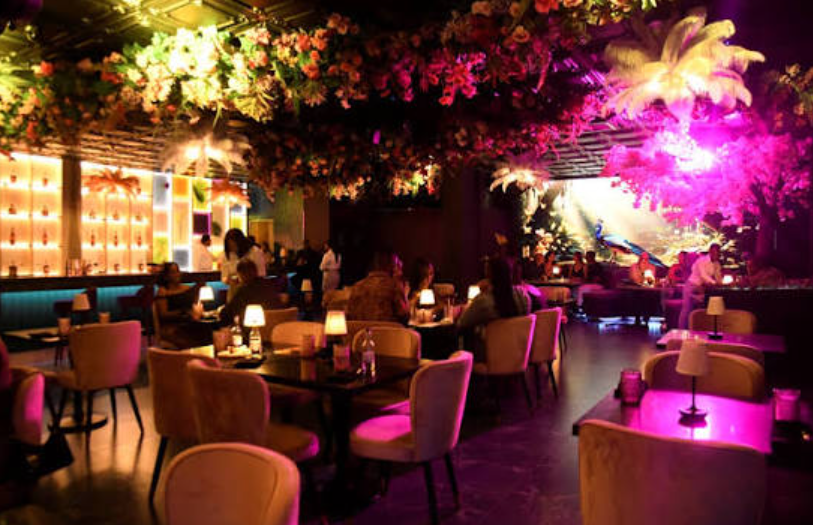
At 69 Knutsford Boulevard, dinner does not necessarily end when the plates leave the table.
Komo Mai was built with another part of the night in mind. The New Kingston venue moves from dining room to lounge, with music, cocktails and an atmosphere designed to carry people later into the evening.
Across the city, some of the newer places built around food and drink are becoming harder to describe with one word.
Restaurant. Bar. Cafe. Workspace. Event venue.
The boundaries are loosening, and not all in the same direction. One venue pushes dinner later. Another turns a Saturday morning into an occasion. A third is trying to give downtown a reason to stay open after the offices empty.
Kingston has always known how to go out. What is changing is the number of hours, and the number of ways, that going out can happen.
Dinner Is Becoming More Than Dinner
Komo Mai makes the shift particularly visible.
The venue runs to roughly 5,000 square feet, combining a dining area with lounge space, and has been described in reporting as both a dining and nightlife destination rather than one or the other.
Chef Shea Stewart’s menu moves between Caribbean ingredients and techniques gathered elsewhere. Tamarind and honey lamb chops sit beside coconut miso salmon. Pimento steak satay shares the table with cocktails built around familiar spirits and local fruit.
The room is equally uninterested in restraint. Guests enter past a large LED installation filled with tropical imagery. Inside, lounge seating and theatrical lighting create a setting intended to feel immersive.
Nothing about Komo Mai is trying to disappear quietly into the background.
That is precisely why it matters. The restaurant is not evidence that Kingston dining is becoming more minimalist or less Jamaican. It is evidence that a venue can now be expected to do several things across one evening.
Dinner is one of them. The rest of the night is another.
The Morning Is Being Programmed Too
A few streets away, the same blurring is happening at the opposite end of the day.
When Cafe Blue prepared to open its ninth outlet on Grenada Crescent in New Kingston, the company was not simply adding another counter for Blue Mountain coffee. Managing Director Jason Sharp told the Financial Gleaner the location would include a DJ booth alongside indoor and outdoor dining, and spoke about attracting professionals and creatives.
The idea had already been tested. Morning DJ sets at Cafe Blue’s Constant Spring location had drawn crowds large enough to spill into the food court.
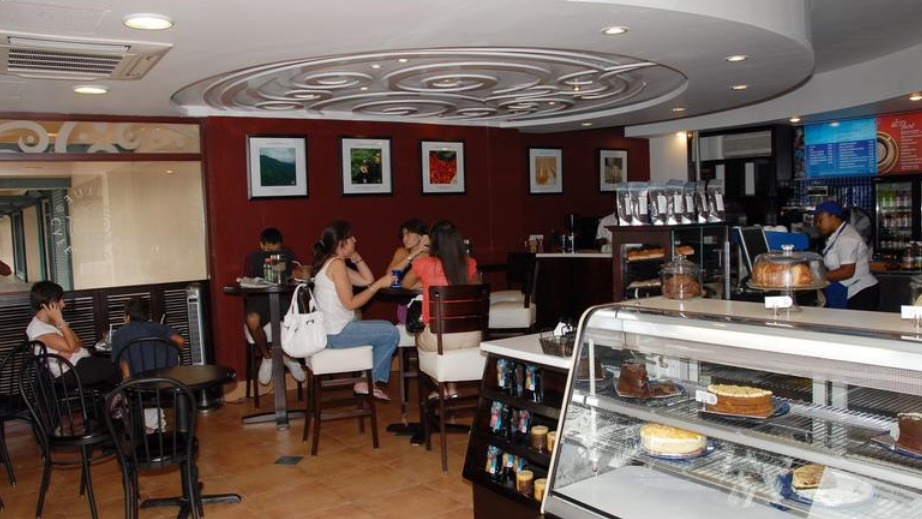
Since opening in early February 2026, the New Kingston branch has become a working part of the business district. Operations manager Jodi-Ann Stewart described it as a space built for the business community, serving all-day breakfast alongside the coffee the chain is known for.
It has also become a venue. In May, the location hosted the third staging of the Cafe Blue Coffee Party, running from seven in the morning until midday.
That detail is worth pausing on. The cafe closes at seven in the evening. This is not nightlife. It is something less expected: a morning designed as an occasion rather than a transaction, in a district built around people arriving for work.
Cafe Blue’s Jamaican identity is not incidental to any of it. The company is connected to Coffee Traders Limited, and the coffee is grown, processed, roasted and brewed by the same operation.
A cafe in New Kingston can be Jamaican, corporate, social and occasionally musical without deciding which comes first.
The Menu Moves Easily Too
On Constant Spring Road, Mezza Luna starts somewhere else entirely.
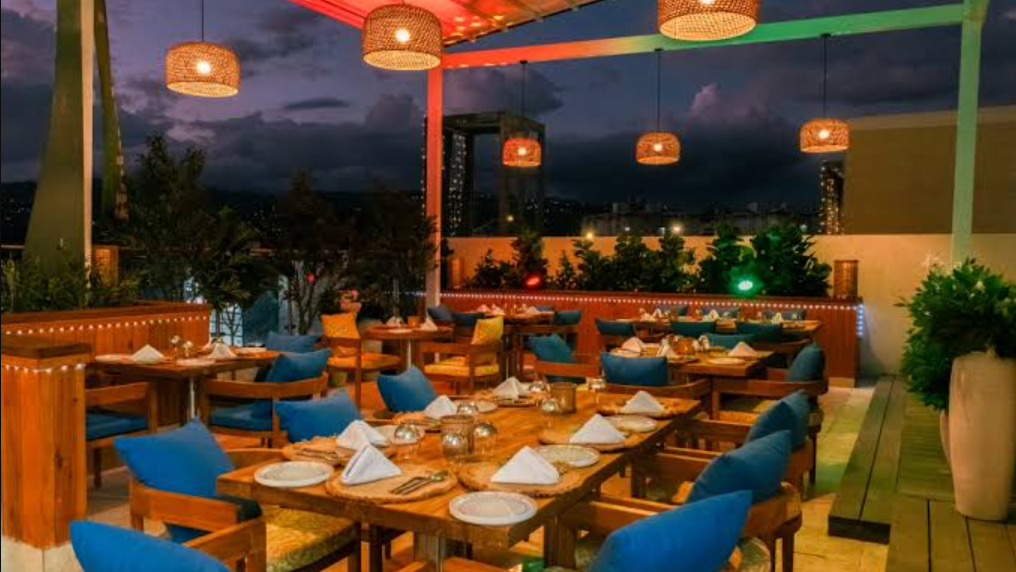
The rooftop restaurant identifies itself through the Mediterranean. That does not require Jamaica to disappear from the table.
Scotch bonnet can enter hummus without becoming a declaration about fusion. A Mediterranean spice-pairing dinner can happen above the traffic of Constant Spring Road and remain completely at home in Kingston.
There is confidence in that ease.
Jamaican food culture has never existed in isolation. The island’s kitchen carries histories arriving through colonisation, enslavement, indenture and migration, absorbed across generations until questions about where one influence ends and another begins become difficult to answer cleanly.
Contemporary restaurants are working inside that inheritance. They do not need every local ingredient to perform authenticity. They can simply use it.
Across current Kingston menus, that freedom produces combinations that would once have required explanation. Callaloo becomes chimichurri. Oxtail enters arancini. Ackee becomes mousse. Curried goat becomes a croquette.
The point is not that these treatments improve the original dishes. They do not need improving.
The point is that Jamaican ingredients have enough cultural confidence to travel.
Downtown Is Asking People to Stay
The same question becomes larger on Water Lane.
For years, one of downtown Kingston’s most familiar rhythms has been movement out. The working day ends. Offices empty. Traffic carries people uptown and outward.
Joseph Johnson thinks hospitality can interrupt that pattern. Johnson owns the restaurant Peckish, and 105 Water Lane marks his move into property under a new brand, Concepts by J.
The development is modest in scale, a two-floor commercial space of roughly 2,680 square feet with a rooftop terrace, in the Water Lane Art District among the murals. It has been positioned to attract art studios, cafes and creative concepts, with terrace space for events.
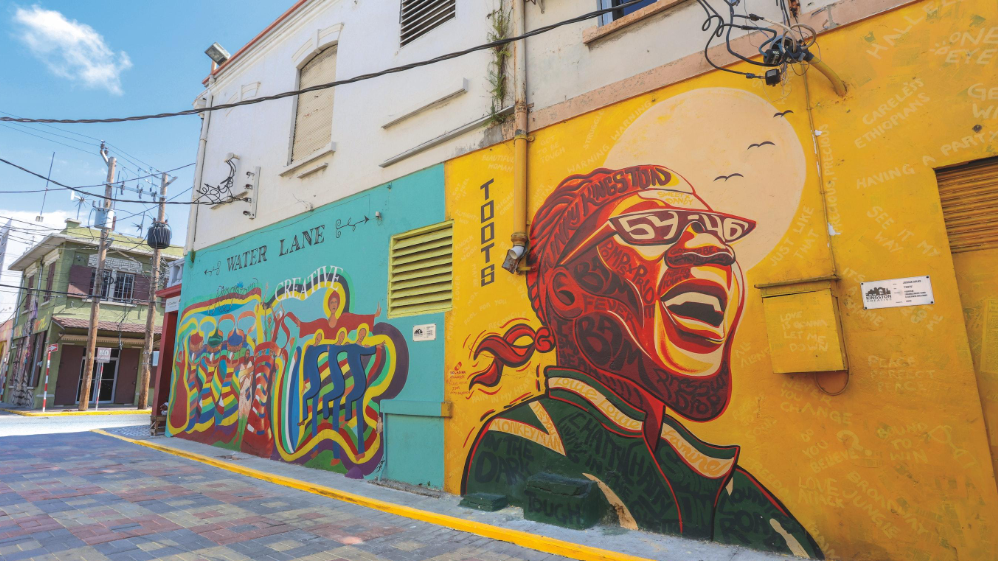
The reasoning is straightforward. Downtown generates significant activity during the working day and empties once offices close. Johnson’s argument is that it should not only function from nine to five.
By mid-2026 the rooftop was operating, drawing an after-work crowd for food, cocktails and DJs. Kingston Mayor Andrew Swaby publicly welcomed the complex, framing it within the municipal corporation’s broader efforts around public space, infrastructure and urban management.
One rooftop does not remake downtown Kingston, and it would be premature to describe the area as revitalised.
What it does demonstrate is narrower and still worth noting. Hospitality is being used deliberately, by at least one current development, as a mechanism for extending how long a part of the city stays socially active.
Restaurants and bars occupy space differently from offices. They require people to remain rather than pass through. At their most useful, they give a street another reason to stay awake.
A City With Fewer Categories
Komo Mai, Cafe Blue, Mezza Luna and 105 Water Lane are not a movement in any organised sense.
They do not share a cuisine. They do not share an aesthetic. They do not serve the same audience at the same hour.
That is what makes them useful together.
Each represents a small expansion of what a hospitality space in Kingston can be asked to do.
A restaurant carries the night beyond dinner. A cafe turns a Saturday morning into an event and the working week into a meeting place. A Mediterranean kitchen absorbs Jamaican ingredients without stopping to explain the exchange. A rooftop becomes part of an argument about keeping downtown alive after the offices close.
None of this replaces the jerk centre, the cookshop, the bar, the bakery, the hotel dining room or the neighbourhood restaurant.
Kingston does not need one new model. It is accumulating more of them.
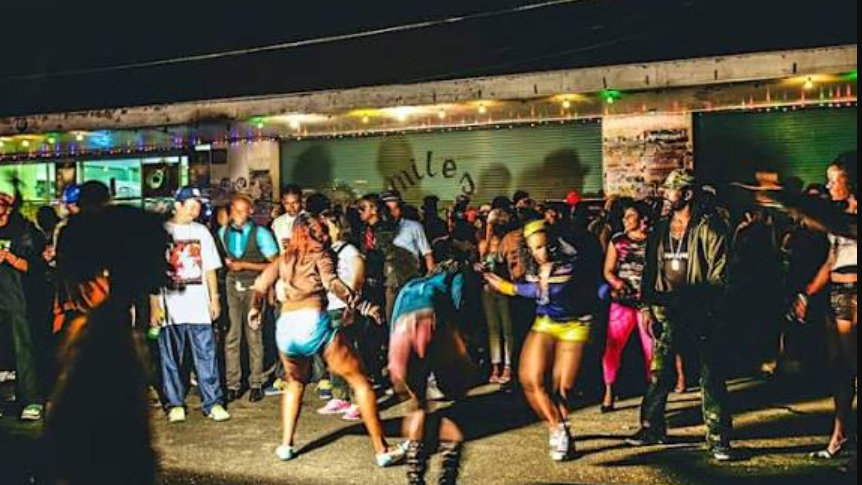
The boundaries between eating, drinking, working, meeting and listening to music are becoming less important than the places that allow several of them to happen at once.
Kingston has always known how to go out.
The newer development is how many different hours of the day that can now begin.
Frequently Asked Questions
What is Komo Mai?
A restaurant and lounge at 69 Knutsford Boulevard in New Kingston, running to roughly 5,000 square feet, combining dining and lounge space with a menu by chef Shea Stewart built around Caribbean ingredients and international technique.
Where is Cafe Blue’s New Kingston location?
On Grenada Crescent in the New Kingston business district, opened in early February 2026 as the chain’s ninth outlet. It operates from seven in the morning, and has hosted event programming including the Cafe Blue Coffee Party.
What is 105 Water Lane?
A two-floor commercial development of roughly 2,680 square feet with a rooftop terrace in downtown Kingston’s Water Lane Art District, led by restaurateur Joseph Johnson under his Concepts by J brand, intended to extend downtown activity beyond office hours.
Is downtown Kingston being revitalised?
Individual developments are attempting to extend after-hours activity, and Kingston’s mayor has welcomed that effort, but one development does not establish successful revitalisation of the wider district.
Are Kingston restaurants moving away from Jamaican food?
No. Contemporary Kingston kitchens are working across culinary traditions while using Jamaican ingredients freely, from callaloo chimichurri to ackee mousse, without treating local ingredients as separate from an international restaurant identity.